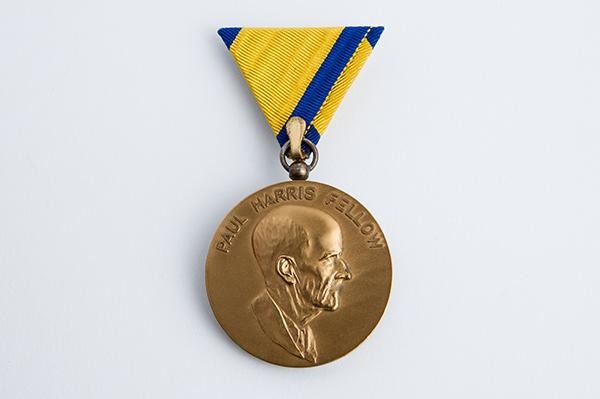
Cultivating Leaders
(1931-1957)
As Rotary clubs continue to spread around the world, we establish ourselves as leaders in international cooperation. Within the organization, we change our governance structure to give members a greater voice in leading Rotary.
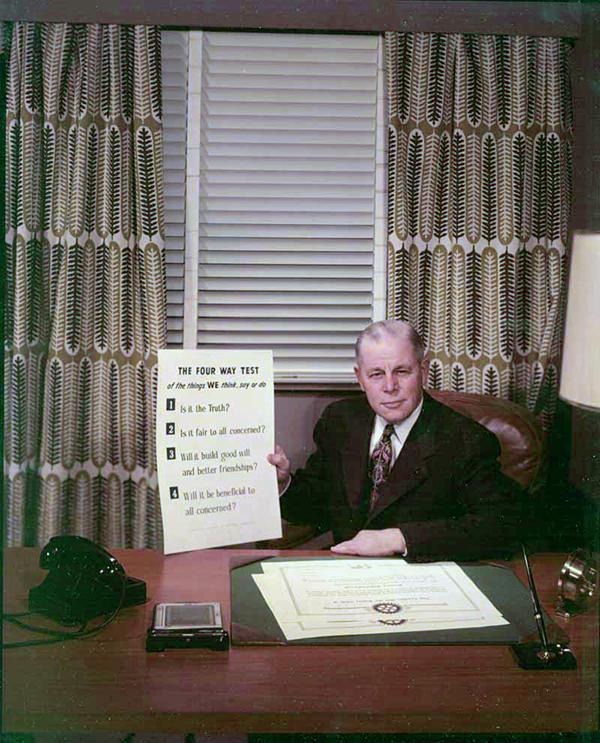
Listen to Herbert J. Taylor speak about the Four Way Test. 1965. "I felt it'd be a fine thing if we only had some simple little measuring stick of ethics…"
1943: The Four Way Test
Rotary adopts The Four-Way Test, one of the world's most widely printed and quoted statements of business ethics. Herbert J. Taylor, a member of the Rotary Club of Chicago, drafted the test in 1932 to help an aluminum company on the verge of bankruptcy during the Great Depression.
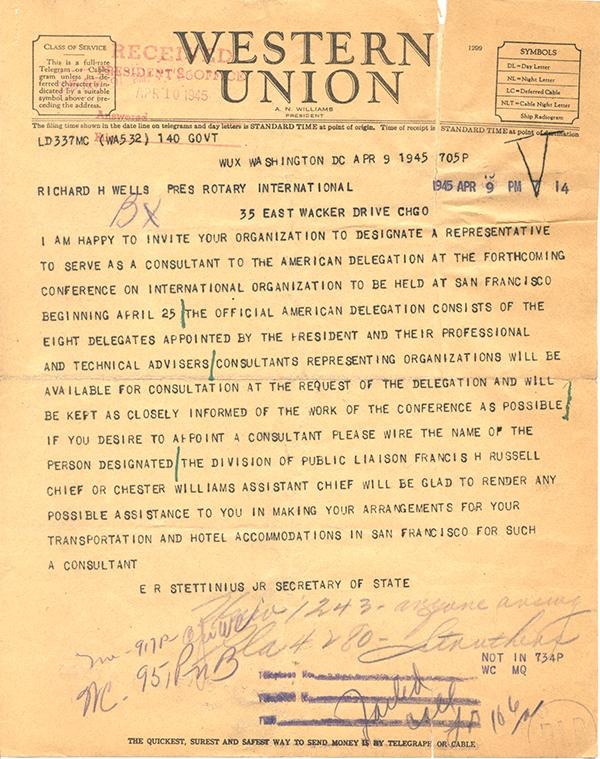
A telegram inviting Rotary International to assist the United States delegation in 1945. Rotary's early involvement with the UN sets the stage for future partnerships with UN agencies.
1945: Rotary and the United Nations
Rotary International serves as a consultant to the U.S. delegation at the United Nations charter conference in San Francisco. Eleven people officially represent Rotary in this capacity. Other members attend as delegates or consultants to their countries.
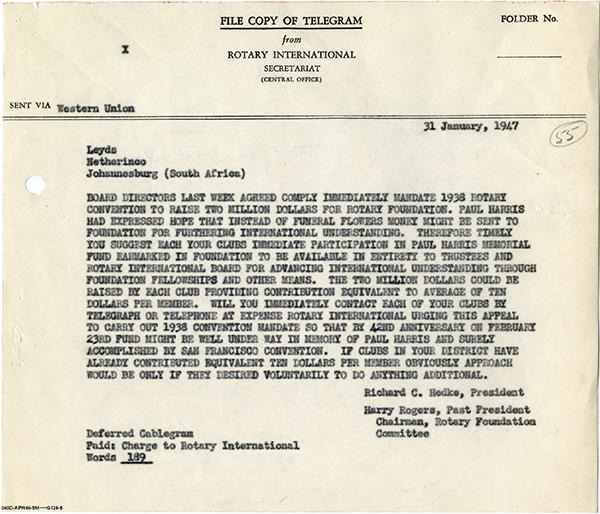
After the death of Paul Harris on 27 January 1947, Rotary sends members a telegram telling them of his desire that, in lieu of flowers, they make contributions to the Foundation.
1947: Paul Harris dies
After a prolonged illness, Rotary's founder dies in January. Members contribute more than $1 million in his memory in the following 18 months. The money is used to support the Foundation's scholarship program.
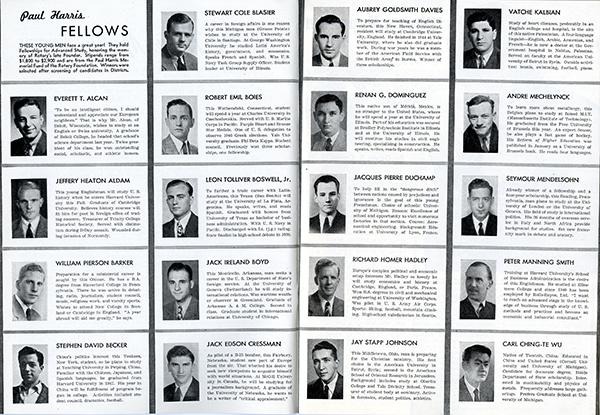
Image: The Foundation selected 19 students for the first class of scholars. Audio: Listen to early scholarship recipients from Norway, Australia, and the United States talk about the significance of their scholarships in a 1950 radio interview.
1947: The first Foundation program
This Foundation program supports scholarships for graduate study abroad and is designed to foster international understanding. Rotary would continue to support education, and the program would be known by many names, including Ambassadorial Scholars and Rotary Scholars.