The next generation of chess masters
In India, Rotary members help to draw young players to the game and its gifts
by Geetanjali Krishna
2 Feb 2026Photography by Siddharth Behl
It’s 9 o’clock on a Sunday morning and the temperature is soaring toward the 90s as hundreds of children make their way toward Marina Beach in the southern Indian metropolis of Chennai. Yet there’s not a towel or sand pail in sight — only water bottles and chessboards tucked under arms as the kids veer toward a college along the shore. Here, over the next several hours, knights will be sacrificed, pawns queened, and kings toppled at this fiercely competitive tournament — one of hundreds held almost daily in what is arguably the most chess-obsessed country in the world.
On this morning in September, some of the younger players are so small they have to stand at the tables to reach across the chessboards. Around the venue, inspirational posters feature local and international grandmasters. A wide-eyed 6-year-old approaches a large photograph of Gukesh Dommaraju, the teenage prodigy from Chennai who at 18 became the youngest world chess champion ever in 2024. “Maybe one day I can be like him,” the child says, an aspiration unquestionably held by children — and parents — all over the country.
From its roaring metropolises to its bucolic villages, India has an enthusiasm for chess on par with that for professional basketball in the United States or for Premier League football in England. And like these franchises, competitive chess is coming to be seen as a golden ticket to international stardom and prestige for young players with the talent and drive to make it to the top. Children carrying rolled-up chessboards through city streets are a common sight. Elite academies nurture budding prodigies, and high-stakes tournaments offer the prospect of cash prizes, corporate sponsorships, and social media fame. Among those nourishing this chess renaissance, it turns out, are legions of Rotary members.
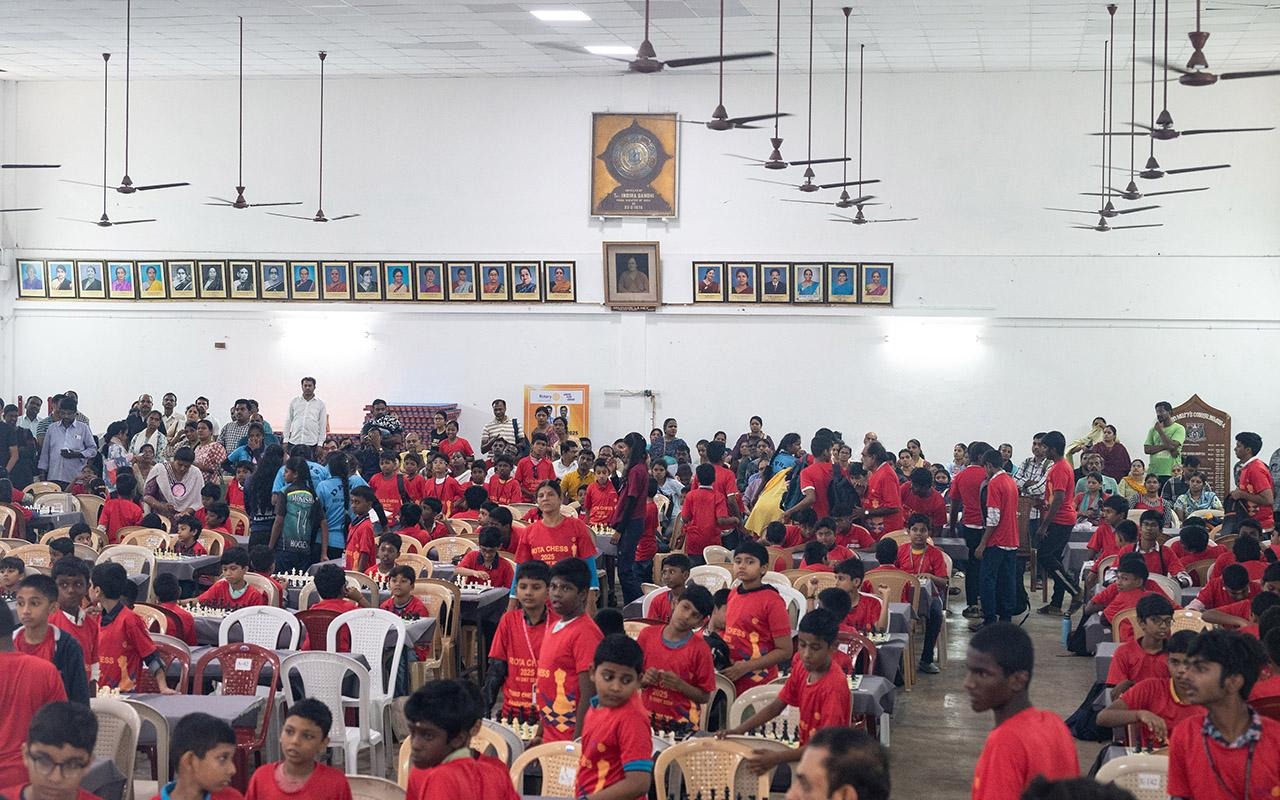
Rota Chess 2025 in Chennai drew hundreds of kids.
At the Victorious Chess Academy in the western city of Pune, in a little shrine decorated with flowers and incense, instructors have made a traditional rangoli — a drawing with colored powder — of the Hindu god Ganesha. But there is a twist: Ganesha, a popular patron of letters and learning, is reading a book of chess rules. For the students here, says founder Kapil Lohana, “chess is a religion.”
Seeking to tap into that passion, Rotary members, clubs, and districts around India are sponsoring tournaments and collaborating with chess academies to expand access to the game, recognizing it presents a pathway to educational advancement, connection, and potential prosperity for the communities they serve.
Lohana regularly organizes tournaments sponsored by Rotary clubs. His academy coaches students in more than 30 countries; one student, Harshit Raja, became India’s 69th grandmaster in 2021. Playing chess competitively helped Lohana find a route out of poverty. He grew up on a cotton farm in central Maharashtra state’s drought-prone Yavatmal district, known tragically for its high rates of farmer suicides.
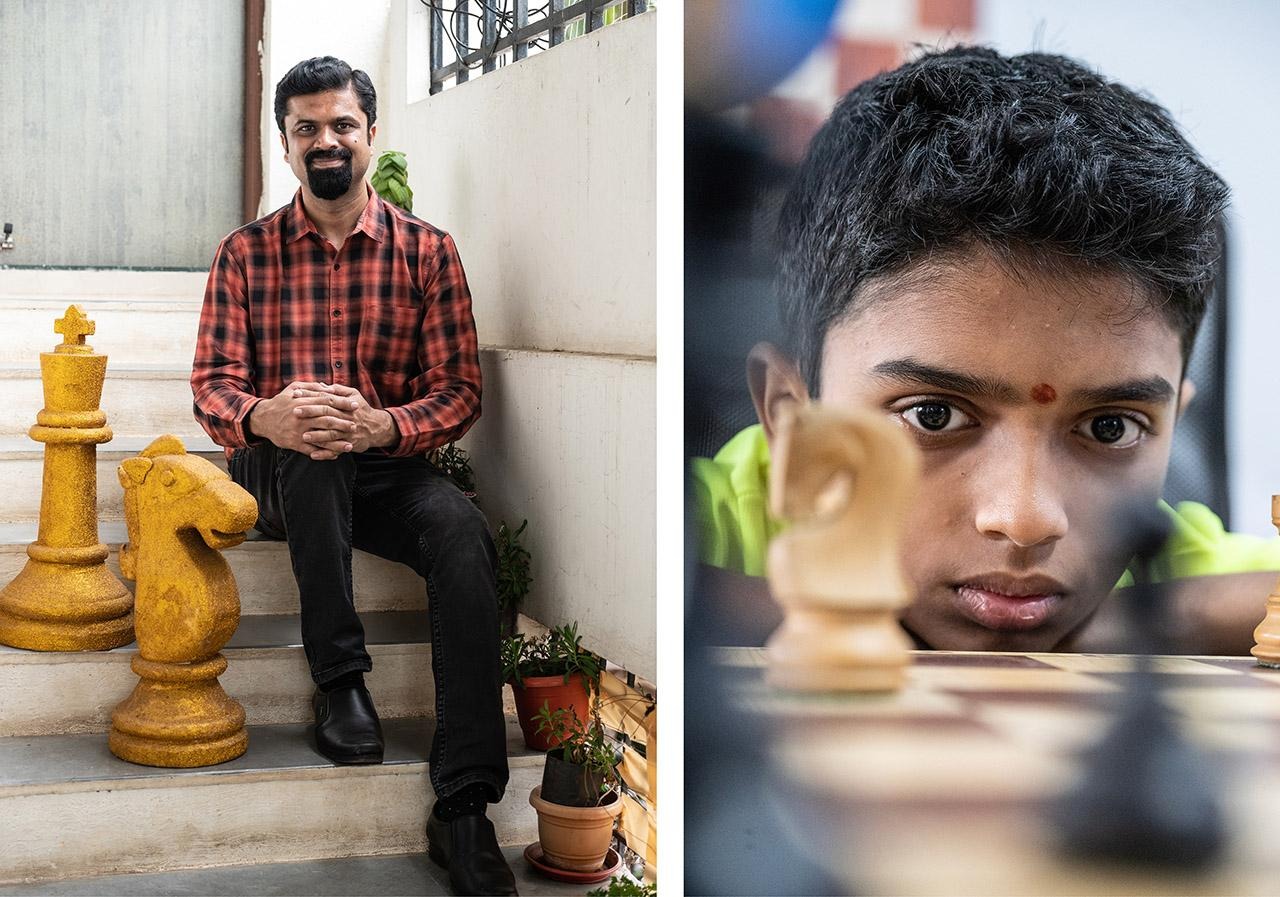
Left: Playing chess helped Kapil Lohana, director of Victorious Chess Academy, find a route out of poverty. Right: Om Ramgude, 12, already has his eye on the grandmaster title.
“In 2003, I told my father that I didn’t want to be a farmer and came to Pune to participate in my first chess tournament,” he recalls. His father disapproved, but Lohana won a small cash purse and spent the next few years competing and living off his winnings. “My own experiences helped me realize that in order to develop international-level players we need to provide the right atmosphere, quality coaching, opportunities to compete and, most of all, financial support to needy players.” With this aim, he founded Victorious Chess Academy and started a special grandmaster training program for advanced players, offering discounts for rising stars who couldn’t afford tuition.
One of those rising stars is 12-year-old Om Ramgude. Rated an 1,836 by the International Chess Federation, Om already has his eye on the grandmaster title. He was barely more than a toddler when he began playing chess online. “I’d downloaded the chess app for myself, but it was Om who quickly began solving puzzles and winning games online to advance to the highest level,” says his mother, Manisha Dayanand Ramgude, a software developer in her 40s. “Can you imagine? He was only 5 at the time!” Marooned at home during the pandemic, little Om immersed himself in online matches, often challenging — and besting — players far older.
Meanwhile, more and more people, especially parents, are coming to view chess as a way to improve academic performance, decision making, critical thinking, and memory skills. In Pune, Aparna Bodhe has been bringing her 5-year-old twins, Parikshita and Aradhita, to the White Knight Chess Academy for coaching. “Playing chess has definitely calmed them down,” she says, as her girls play and giggle at a chessboard. “Earlier, it was impossible to make them sit, but three months of chess has made them a little more focused and able to sit down and concentrate.”
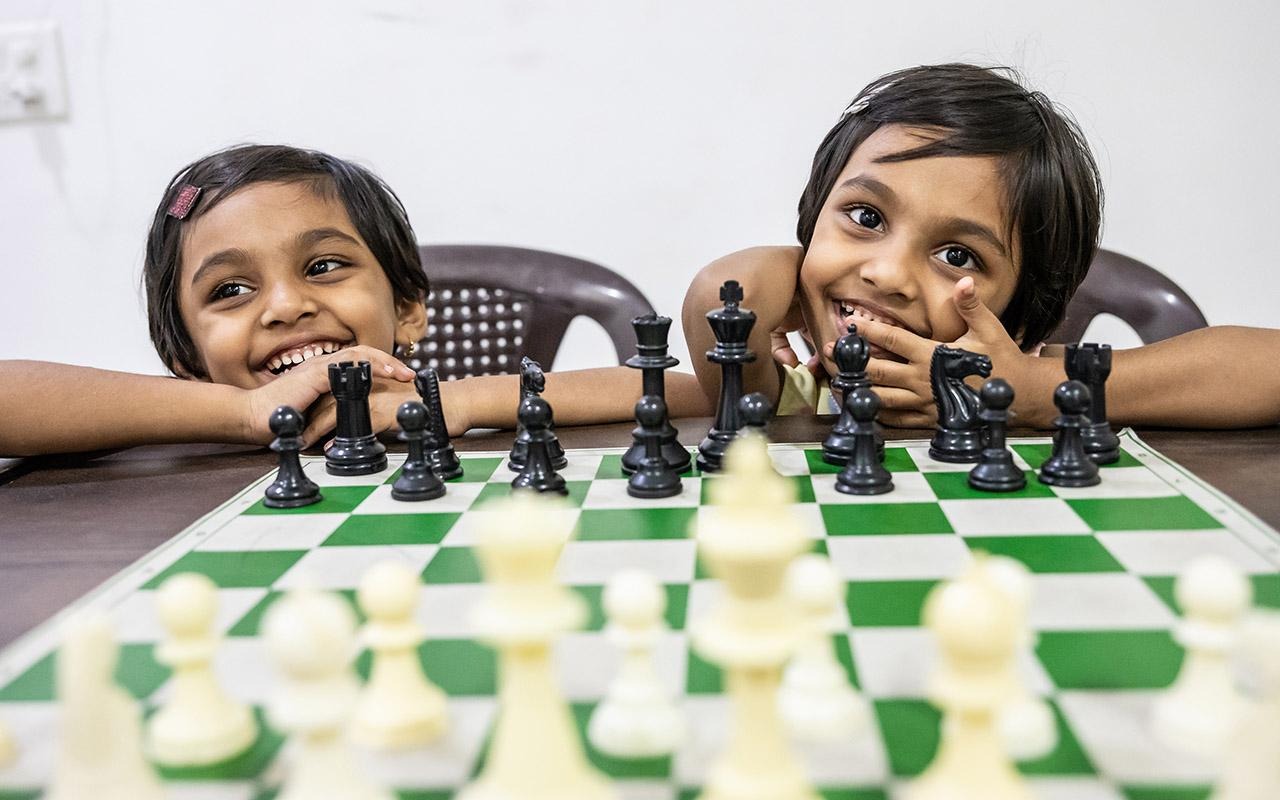
In Pune, 5-year-old twins Aradhita (left) and Parikshita Bodhe giggle at a chessboard.
Many of the young players have improved their grades at school, says Ashirwad Tupe, a member of the Rotary Club of Hadapsar Central who founded the White Knight Chess Academy in Pune in 2019. He says each international win echoes through the halls, with students as young as 4 seemingly able to recall every move of those top matches.
SP Sethuraman, a two-time national champion who practices over six hours a day and became a grandmaster at 17 in 2011, agrees the game uniquely challenges the mind. “There are only 64 squares on the board, but every game I play, there are new challenges,” he says. “Playing chess makes your memory razor-sharp.”
The link between chess and academics is backed by research. One study found that rural Indian school children who received a year of chess training significantly improved their academic performance in subjects like math and science compared with a control group. The researchers observed that the game helped students focus, visualize, think ahead, weigh their options, and juggle multiple considerations simultaneously. A 2019 study that focused on school children in Bangladesh found chess training not only improved grades but taught them to evaluate risk. In chess, successful players think several moves ahead, sacrificing pieces to open paths to victory. “And yet, there’s the danger that if they miscalculate, they could lose not only that piece but the game itself,” Tupe says. “The game teaches players to strategize, adapt, and take hard decisions under pressure.”
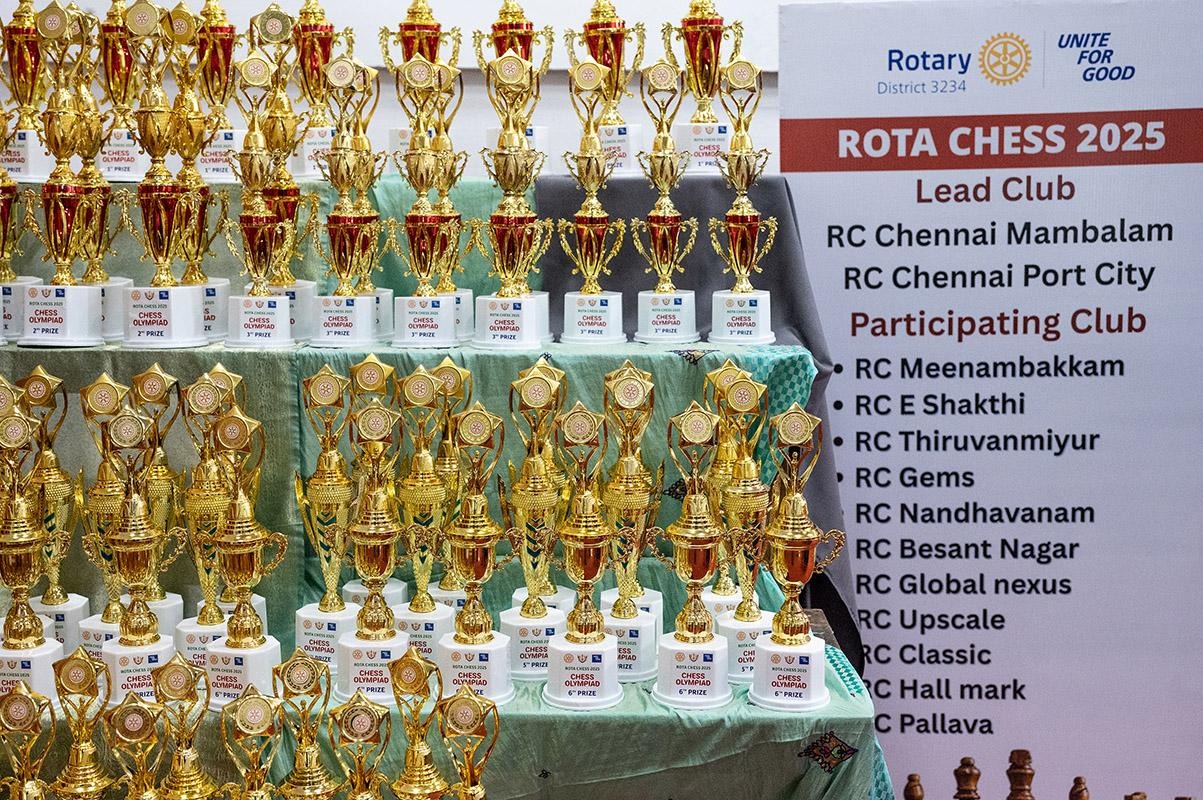
Trophies await winners at Rota Chess 2025.
Indians have been using chess as an instrument of strategy since at least the seventh century, when the ancient Indian game of chaturanga first appears in the historical record. The name chaturanga translates to “four parts,” referring to the military divisions of infantry, cavalry, elephants, and chariots — which later evolved into the pawn, knight, bishop, and rook pieces of the modern game. By the ninth century, the Persians were playing the war strategy game, and it evolved into shatranj. From there it spread across the world as chess. Legend has it that some kings played chess using live human beings — often their vanquished enemies and slaves — as the pieces.
Chess in India has come a long way since, with the nation emerging as a modern-day world chess power. India has about 90 grandmasters (up from five in 2000) and over 30,000 players rated by the International Chess Federation, known as FIDE. Among them is a 3-year-old who late last year became the youngest player in chess history to earn a rating after beating opponents in their 20s and edging out the previous record-holder: another toddler from India who was just a month older at the time. At the end of last year, India’s top 10 male players boasted an average rating of 2,714, not far behind the highest individual rating ever achieved, a 2,882 first held by Norway’s Magnus Carlsen in 2014. Only the U.S. had a higher average men’s rating. India’s top 10 women, meanwhile, averaged 2,404, just behind China.
Behind these statistics are dazzling personal stories: Viswanathan Anand, the five-time world champion who ignited India’s chess renaissance by becoming the country’s first grandmaster in 1988; Gukesh Dommaraju, the teenage prodigy who claimed the world title at just 18; Praggnanandhaa Rameshbabu, who stunned the world at 18 by defeating Carlsen in 2024; and his elder sister, 24-year-old Vaishali Rameshbabu, who made history in Uzbekistan in September by winning the FIDE Women’s Grand Swiss for a second time.
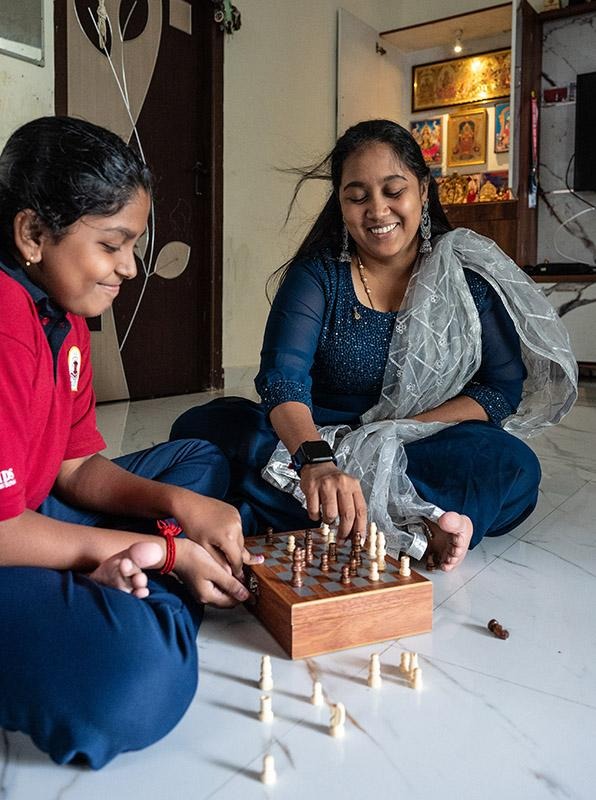
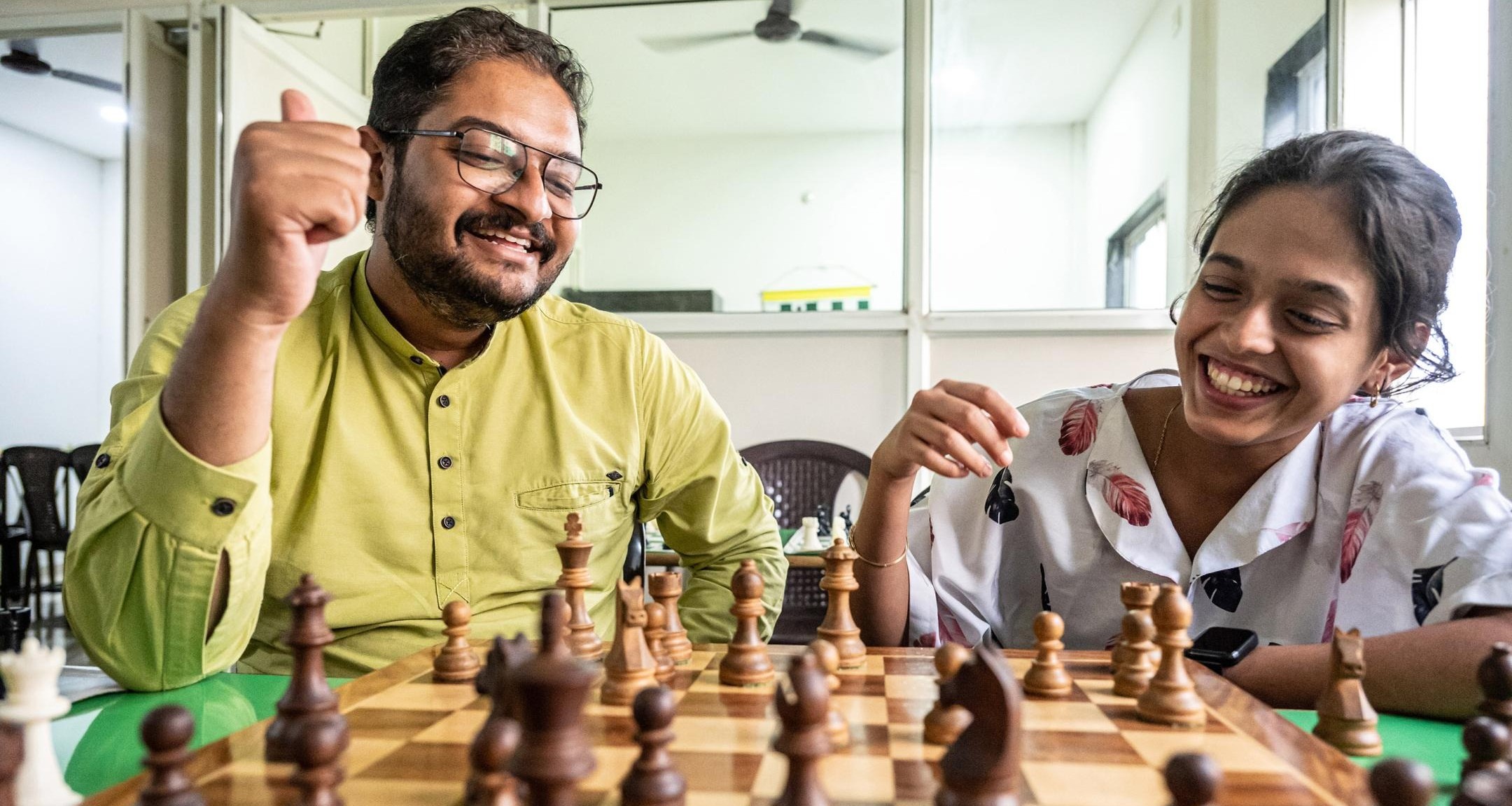
N. Krithika (right), of the Rotary Club of Chennai Harmony, plays chess with Mahashri K.
Today, chess remains a prized tool for building resilience and fortitude. “On the board, one wrong move can change the game, but chess teaches you how to defend, to stay calm, to learn, and to fight back with focus,” says Chennai-based chess coach N. Krithika, a member of the Rotary Club of Chennai Harmony. These are all skills that can resonate far beyond the chessboard and have the power to change the trajectories of not only individual lives but entire communities.
Marottichal is a remote village in the southern state of Kerala known for its verdant hills and breathtaking waterfalls, but its true claim to fame is chess. Over 4,500 of Marottichal’s residents — some 75 percent of its population — are active chess players. In 2016, the village hosted an event in which more than 1,000 people played chess simultaneously.
This is a far cry from the 1970s and early ’80s, when the village was a regional hub for illicit alcohol production. Marottichal’s farmers found that making alcohol required less labor and provided an easy income. The combination of more money, more downtime, and the omnipresence of booze contributed to a rise of vice economies. Alcoholism surged, as did gambling.
In the late 1980s, Charaliyil Unnikrishnan, a former Maoist rebel and a Marottichal native, returned home and was dismayed by what he saw. With help from the wives and mothers of liquor producers, he led a group that raided gambling dens and destroyed illicit alcohol supplies. Then, when he realized that the men needed an alternative pastime, he introduced them to chess.
Incredibly, the game caught the collective fancy of the village. Cases of alcohol addiction began to decline as dropouts went back to school, farmers returned to their harvests, and many local chess players, including Unnikrishnan himself, began playing competitively. Today, he runs a popular chess-themed tea shop in Marottichal, and across the village, from bus stops to rice paddy fields, players can be found hunched over chessboards. The village has its own chess association, hosts local and regional tournaments, and teaches its young residents chess as part of the school curriculum.
Unnikrishnan — or Unni maman (uncle), as he is locally known — says that by teaching players the power of good decision making, chess has become an alternative to destructive behavior. Much like chess taught Aparna Bodhe’s twins to sit still and focus, the game has been shown to improve planning and cognitive reflection tasks in adults as well. In 2025, researchers found chess players showed greater preference for future rewards over short-term gains, reflecting a delayed gratification that is essential to winning a chess match.
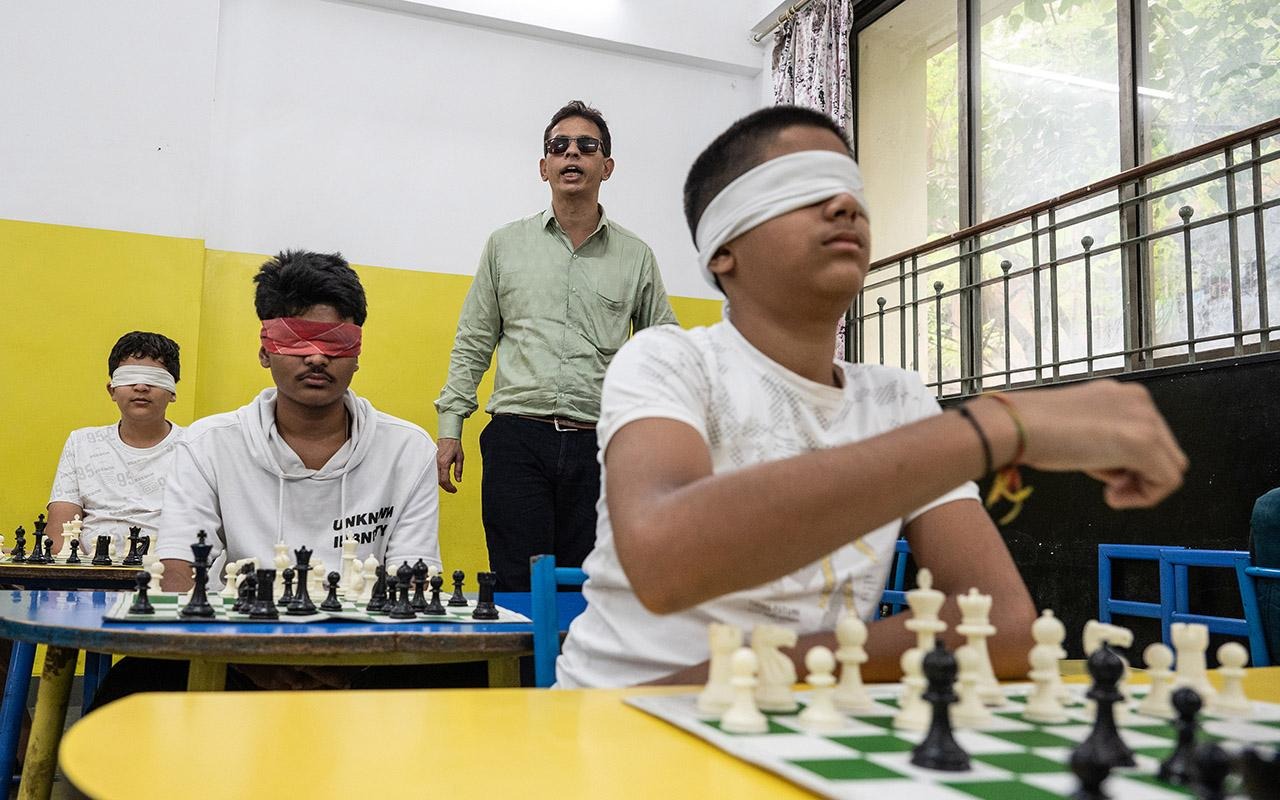
Rajesh Oza (standing), blind since he was 15, teaches players to visualize the game in their minds like he does.
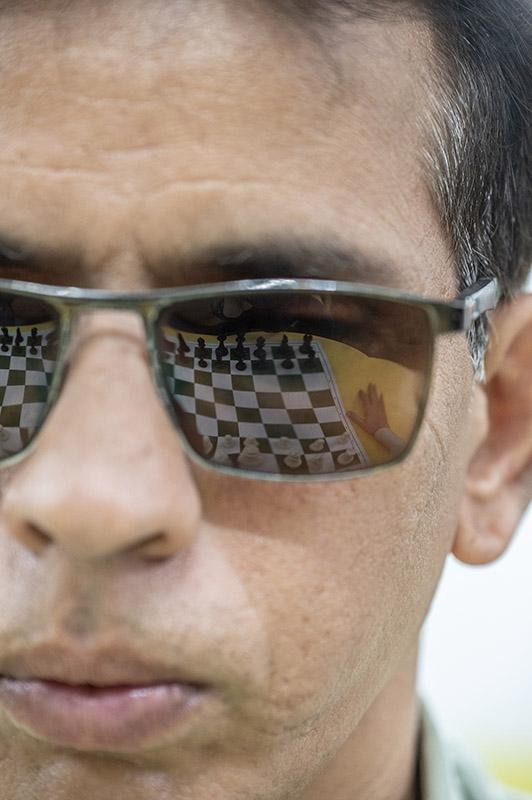
A chessboard is reflected in Oza’s glasses.
Coach Rajesh Oza paces up and down a classroom filled with teenage chess players, teaching them a highly unusual style of play, one that unfolds not on the board in front of them but on a chessboard in their minds. It’s a technique born of necessity: Oza has been blind since he was 15.The passionate teacher credits chess with lifting him out of the depression that enveloped him when he lost his eyesight suddenly in 1993. “When I played chess, I realized I could visualize the board better than most sighted players and this gave me an edge,” he says. “Winning competitions gave me the boost I needed.”
In 2002, he became the national blind chess champion and the first blind chess player in India to earn a FIDE international rating. Today, he teaches his students to visualize the game in their minds like he does, though they can see perfectly well. “This frees their mind of clutter, leaving room only for strategizing on the board,” he says. “I could have never imagined that someone who can’t see would get a life, career, and even the perfect life partner because of chess!” (He met his wife in a chess competition.) “I may be blind, but chess has given me a vision for a bright future.”
Krithika, the Chennai coach and Rotarian, has been instructing students with mental and physical disabilities for years at Phoenix Chess Academy, which she founded. She finds that playing chess competitively helps these students develop confidence and mental clarity. Recently, she organized a well-attended chess tournament in a Chennai school for some of these students.
One of the tournament competitors, 49-year-old P Prema, says she enjoys the level playing field chess affords. “What attracts me to chess is that I don’t need to play it as a para sport,” she explains, drawing a contrast with sports that demand physical ability, though she does those too. Using a wheelchair since she contracted polio in childhood, she is an accomplished para table tennis and badminton player. She is working on improving her chess game so she can get a FIDE rating.
For Krithika, training these players is especially rewarding. “Chess tournaments are a great way for Rotary clubs to help players from disadvantaged backgrounds to build their game, improve their self-confidence, and find new avenues to succeed,” she says.
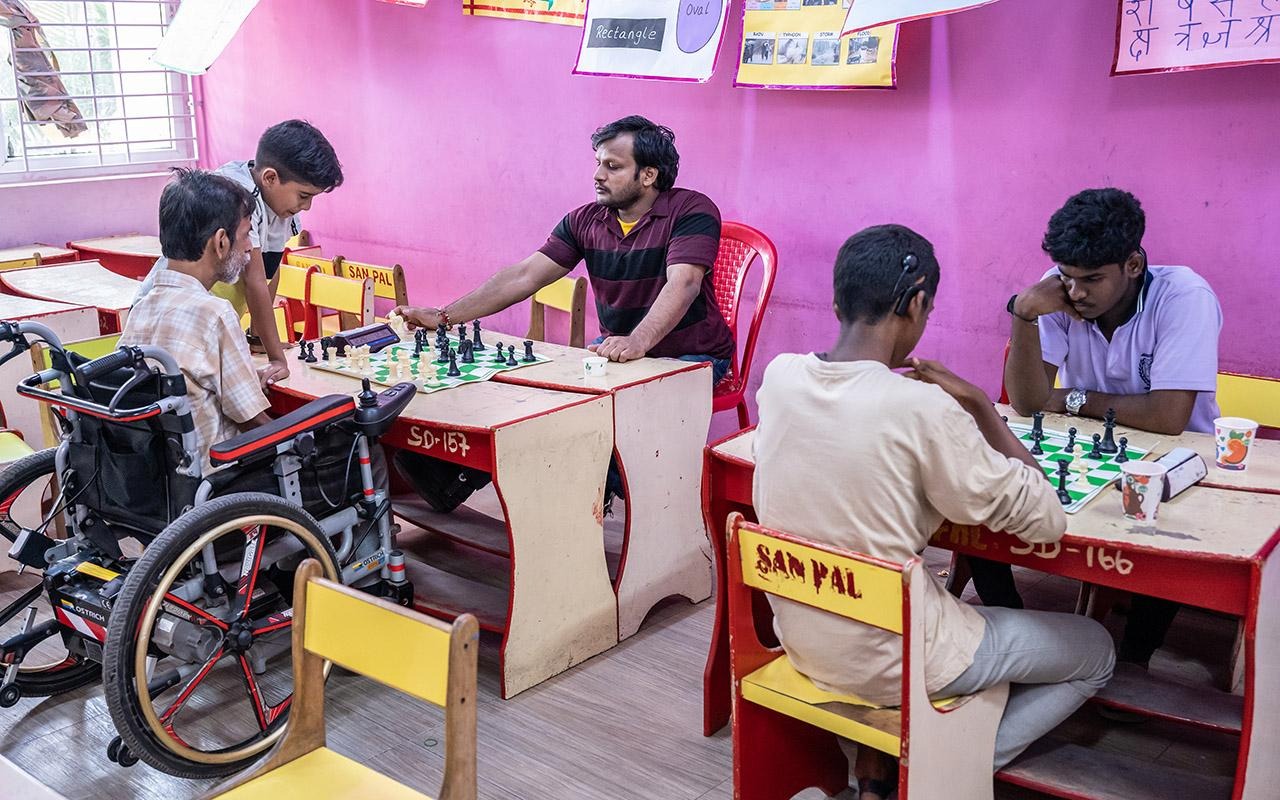
Players compete at a tournament at Krithika’s Phoenix Chess Academy.
Some players leave Krithika’s tournament early — so they can play in another tournament. Chennai is not known as India’s chess mecca for nothing: This particular September weekend alone, the city is hosting almost 100 tournaments. But players aspiring to improve their FIDE ratings say that even this is not enough. Swathi Kumar KP and Sujay Remileon S, participants in an under-21 tournament organized by Rotary members in Chennai, say they need to play in at least 100 tournaments to improve their FIDE ratings. It can be a long, hard slog.
Meanwhile, in Pune, the 5-year-old Bodhe twins, Parikshita and Aradhita, refuse to sleep before one last game of chess. The spirited girls even work references to chess into everyday moments. “The other day, when I asked them to sit with me in front of the family puja [altar], Parikshita asked me to seriously think what my ‘endgame’ was,” their mother says with a laugh.
So what is the endgame for her twins? “I don’t know how far they’ll go in chess,” she says. For now, she’s simply happy the game is helping them to focus and to know that their choices have consequences. As any chess player will tell you, your next move, in a game or in life, can lead to a costly blunder or momentous opportunity.
This story originally appeared in the February 2026 issue of Rotary magazine.