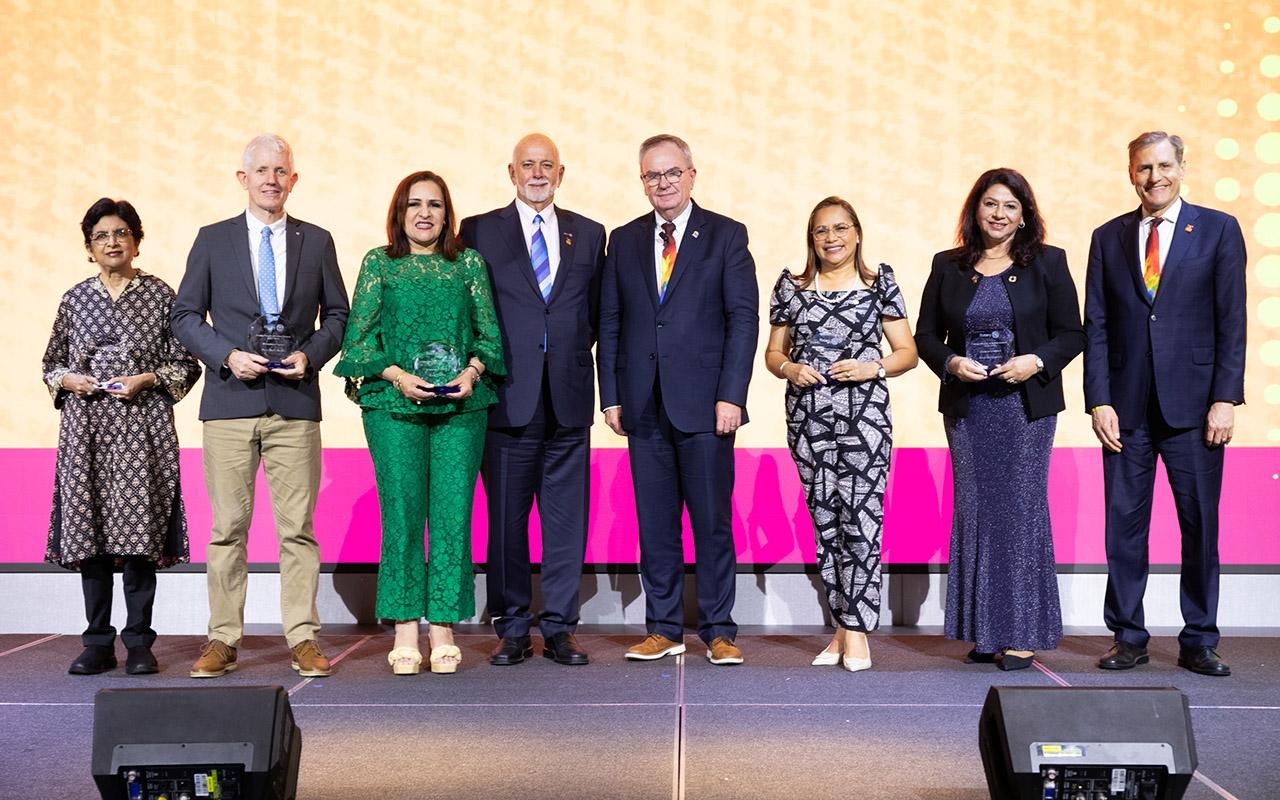
For over a century, Rotary has committed itself to addressing the needs of communities across the globe. In recognition of this commitment, Rotary honors six projects each year that create change – not only in member communities, but around the world. These projects demonstrate how Rotary members are truly people of action.
Loading component...
Why are the People of Action Honors important?
People of Action Honors are presented to Rotary projects that exemplify everything our organization has to offer. Born out of a White House initiative in the United States, the People of Action Honors highlight impactful, sustainable, and scalable projects that are models of service for clubs around the world.
For more than 10 years, the People of Action Honors have brought attention to Rotary projects related to disease prevention, mental health, community development, education, youth empowerment, sustainability, and many more areas of service. The Rotary People of Action honorees represent the standard for the type of change Rotary members create in their communities and across the globe.
2026-27 People of Action honors: Champions of Prevention
Champions of Prevention will highlight Rotary projects demonstrating how early interventions strengthen underserved communities, foster social cohesion, and bring people together through service. Candidates must demonstrate a thoughtful approach to identifying community priorities – including an analysis of underlying causes and documentation of actions taken to meaningfully address challenges.
Rotary, Rotaract and Interact members, Peace Fellows, Global Grant Scholarship recipients, RYLA participants, Rotary Youth Exchange students, or Rotary alumni ages 16 and older are eligible to receive a nomination.
Projects should serve as clear examples of meaningful and effective service that members can replicate. They should focus on promoting community stability, addressing core social concerns through preventive measures, building more inclusive communities and coalitions, and enriching the lives of communities and members.
Nominees must also articulate how engaging in this project helped them become stronger, more knowledgeable advocates, enhanced their leadership skills, and strengthened their connection to the community they worked with.
Examples include (but are not limited to) projects that address issues such as:
- Core causes of conflict – Local crime/recidivism, organized crime/gang violence and activity/human trafficking, bullying, etc.
- Core causes of poverty – Barriers to entrepreneurship, food insecurity/agricultural insecurity, disaster preparedness and resiliency, etc.
- Core causes of disease or health challenges – Vaccine access, limited access to healthcare, sanitation and hygiene in healthcare facilities, etc.
- Core causes of water scarcity – Mismanaged freshwater or marine resources, etc.
- Core causes of environmental harm – Unsustainable land use, climate challenges, etc.
- Core causes of lack of education – Lack of teacher training, lack of early childhood education, children not attending school, sanitation and hygiene in schools, etc.
All viable projects need to:
- Demonstrate the following evaluation criteria and provide evidence of:
- Core challenge — What challenge to the community is the project trying to prevent? How was the problem identified?
- Community assessment/relevance — Who is the project trying to reach before the issue becomes severe? How do you know this intervention is meeting its intended needs, and how did you work with the community to confirm this? Refer to the Conducting Community Assessments guide.
- Collaboration — Are you working with other organizations or relevant partners? Refer to the partners page.
- Measurement — Is the intervention achieving its objectives? What knowledge, skills, behaviors, or conditions have improved because of the project, and how is this being measured?
- Impact — What difference is the project making? Talk about this in Rotary terms of inputs, outputs, and outcomes. Refer to the Impact Handbook.
- Sustainability — How have you ensured that the benefits will last past the end of the project?
- Be currently active or have not concluded before 30 June 2025.
- Have a core focus beyond fundraising or providing material support (i.e., buying laptops, books, pads, etc.), though both can be an element of the larger project.
Champions of Prevention nomination form
The deadline for nominations is 30 October 2026.