Malaysia makes strides to improve mental health
Rotary members’ vision of a country that embraces mental well-being is beginning to blossom with government support
by Rose Shilling
21 Jan 2026Photography by Redhu Malek | Illlustrations by Mike McQuade
Something is missing in the sweeping view of city and sea from the windows of a high-rise hotel in Malaysia where schoolteacher Kasvini Muniandy is enjoying a buffet lunch with Rotary members.
There aren’t enough public parks in the urban areas of Penang Island for kids like her students to play, she notes, including among the apartment towers and dense rows of squat shophouses around the hotel in the charming, historic port city of George Town. Also in short supply is free time to hang out with friends or family. Instead, most kids go straight from school to religious or academic centers until the evening, when they have homework, Muniandy says.
She muses about whether these conditions contribute to the disruptive behavior that she sometimes has to guide her students through while she teaches English at a government school. “These kids in the urban areas, a lot of them are staying in high-rise buildings,” says Muniandy, a guest of Rotarians at a District 3300 conference luncheon that includes red chile rendang curry, a favorite in Malaysia. “They don’t have the opportunity to even go to a playground.”
Concerns like hers are shared by many as people in the Southeast Asian country try to understand the complex factors that may be contributing to a sharp increase in children and adults reporting mental health problems. The troubling trend for children is similar in many countries that monitor detailed mental health data, where parents and officials voice concern over the emotional toll of everything from social media to pressures to succeed in school.

In recent years, Malaysia’s worsening statistics, including increases in adolescents attempting suicide, have jolted Rotary members to act, helping set off a wave of change in Malaysia to prioritize mental well-being. The work is becoming a legacy for Rotary in the country, one that’s still unfolding alongside the government’s commitment to change the culture to better support mental health. At the district conference, Rotarians recounted during breaks how a coalition of clubs started a campaign to upend social stigma so people can feel more comfortable talking about their mental health struggles and getting help.
“We raised the mental health agenda to the national level,” says Bindi Rajasegaran, a member of the Rotary Club of Ipoh Central. When members talk about the effort’s beginnings, they inevitably mention Rajasegaran’s work and how she recruited their help. To honor her dogged devotion, Rotary named her one of its 2023-24 People of Action: Champions of Impact for uniting clubs to bring mental health first aid to schools. Backed by a Rotary Foundation global grant, about 360 counselors and teachers who work with students ages 13-24 learned techniques in 2023 for talking to students with a mental health condition and directing them to counseling, when available, or to other resources, like helplines. Professional counseling is not widely accessible in Malaysia, and a national effort to expand psychological first aid is built around the idea that just as with physical first aid, anyone can learn to listen supportingly to someone’s struggles and guide them to further help.
And even earlier, Malaysian Rotary members created the National Coalition of Mental Wellbeing, which helps the government carry out priorities for mental health funding. Their vision has blossomed alongside a government campaign to raise awareness about mental health care — with initiatives ranging from a mental well-being guidebook for older residents to a focus on mental health in the workplace. Many nonprofits, universities, and health consultants are coalition partners.
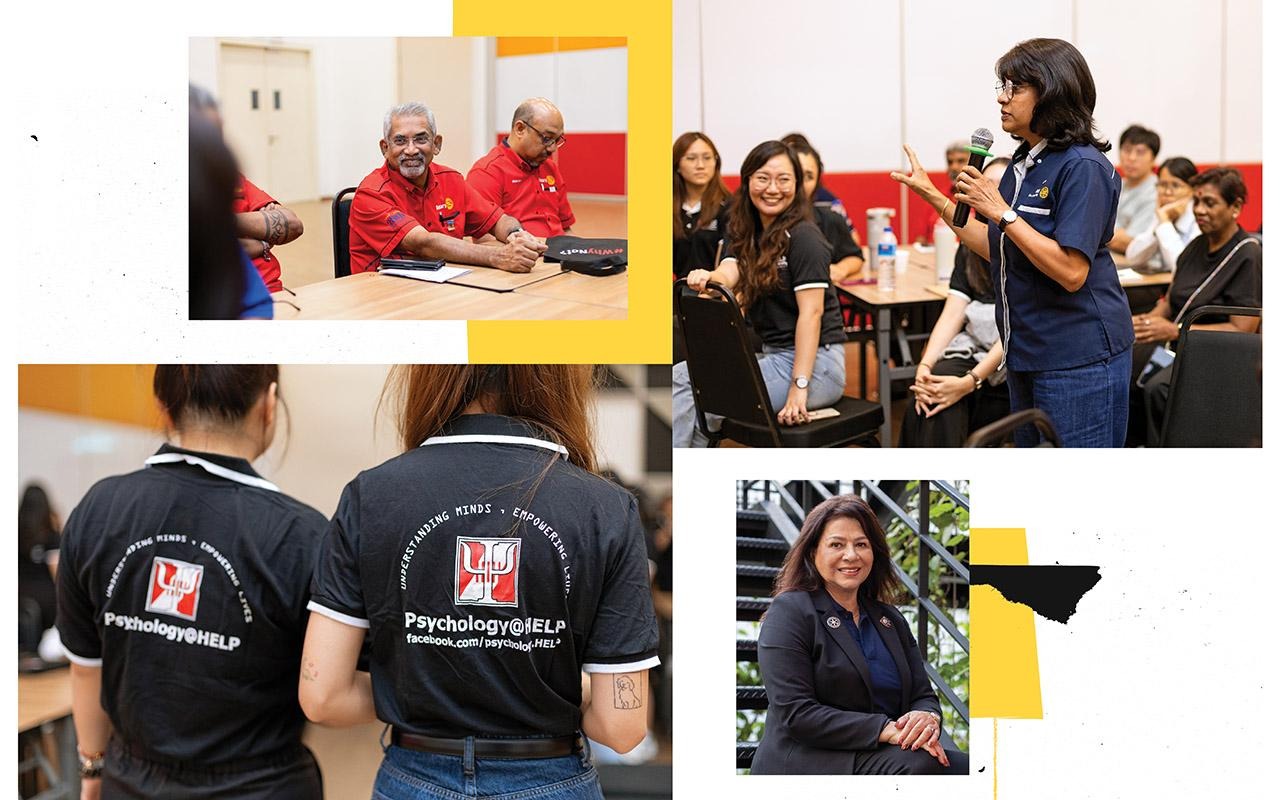
(Top left) Rotarians Palani Nadarajan and Sreeganesh Vasudavan join a Rotary-backed psychological first aid session by experts at Help University. (Top right) Shanthi Thiruchelvam, an organizer, calls the class an eye-opener. (Bottom right) Bindi Rajasegaran inspires Rotarians across Malaysia to push the country toward better mental health. For her dogged devotion, Rotary named her one of its People of Action.
For Rajasegaran, the crusade began after her son-in-law died by suicide, which she says left her withdrawn for years before she finally was able to try to understand. “The more I researched, the more surprised I was at the condition of mental health in our country,” she says. “Number one, it was taboo, unspoken of. The number of suicides and mental health problems amongst the youth was horrifying, and nobody was talking about it.”
She realized that all her research added up to a community assessment, like the ones Rotary members everywhere regularly use to understand people’s needs. That’s why the global grant focused on mental health training for teachers and counselors. “They wanted to learn even more,” Rajasegaran says. “That ignited their interest. All they knew was something just at the surface, not deeper. And the biggest question was, Where do we go?” Now they know the resources and how to get in touch with community groups, nonprofits, and helplines, she says.
About a dozen clubs in Malaysia’s two Rotary districts, 3300 and 3310, supported the learning sessions, along with the grant’s international partner, District 3620, which covers part of Korea, using district and Rotary Foundation funding totaling $49,000. Counselors reported on how the training helped interrupt suicide attempts or otherwise deescalated suicidal thoughts, with data reviewed by the Ministry of Education, listed in the grant as a partner.
By securing Ministry of Health support from the start, Rotarians established a connection that allows them to voice their opinions about policies, says Rajasegaran, a past district governor and a member of The Rotary Foundation Cadre of Technical Advisers. She and Rotarian Siti Subaidah Mustaffa, chair of the coalition, also serve on a separate advisory council that the health minister consults on mental health priorities.
Siti Subaidah, a member of the Rotary Club of Central Damansara, says to counter the shortage of psychology professionals, the coalition is preparing more people to provide first-line support, including police, nurses, and general practice doctors whom people see more regularly. “We really want to be developed as a center of excellence for psychological first aid,” she says.
Methodology: To gauge kids’ mental well-being, Malaysia’s national health survey asked parents or other caregivers to collect answers for their children about their social and emotional health over the month prior, including whether the child had been bullied, often had temper tantrums, or had at least one good friend. Kids with higher tallies of difficulties were considered to have mental health problems.
The need for health insurers to cover mental health services has also come up at coalition meetings. But the effect on premiums will be a big concern as the government tries to rein in recent staggering increases, Rajasegaran notes.
Rotary members already helped push for one of the most significant policy changes in recent years: Attempted suicide is no longer a crime in Malaysia — an important step in reducing stigma and barriers to people seeking help. Rotarians used their connections to reach people in the government and organize an awareness session for members of Parliament, which voted in 2023 for the repeal. “That was a big win for us,” Rajasegaran says. “Now, with all our advocacy, people are beginning to speak about mental health.”
The coalition is expanding its campaign to reach many groups, including providing homeless people with mental health concerns the opportunity to speak with counselors or other coalition volunteers once a month during a food distribution at a Kuala Lumpur shelter. And the pension fund provider for Malaysia’s public employees has asked the coalition to develop an online or in-person option where older residents could seek mental health advice from specialists, Rajasegaran says.
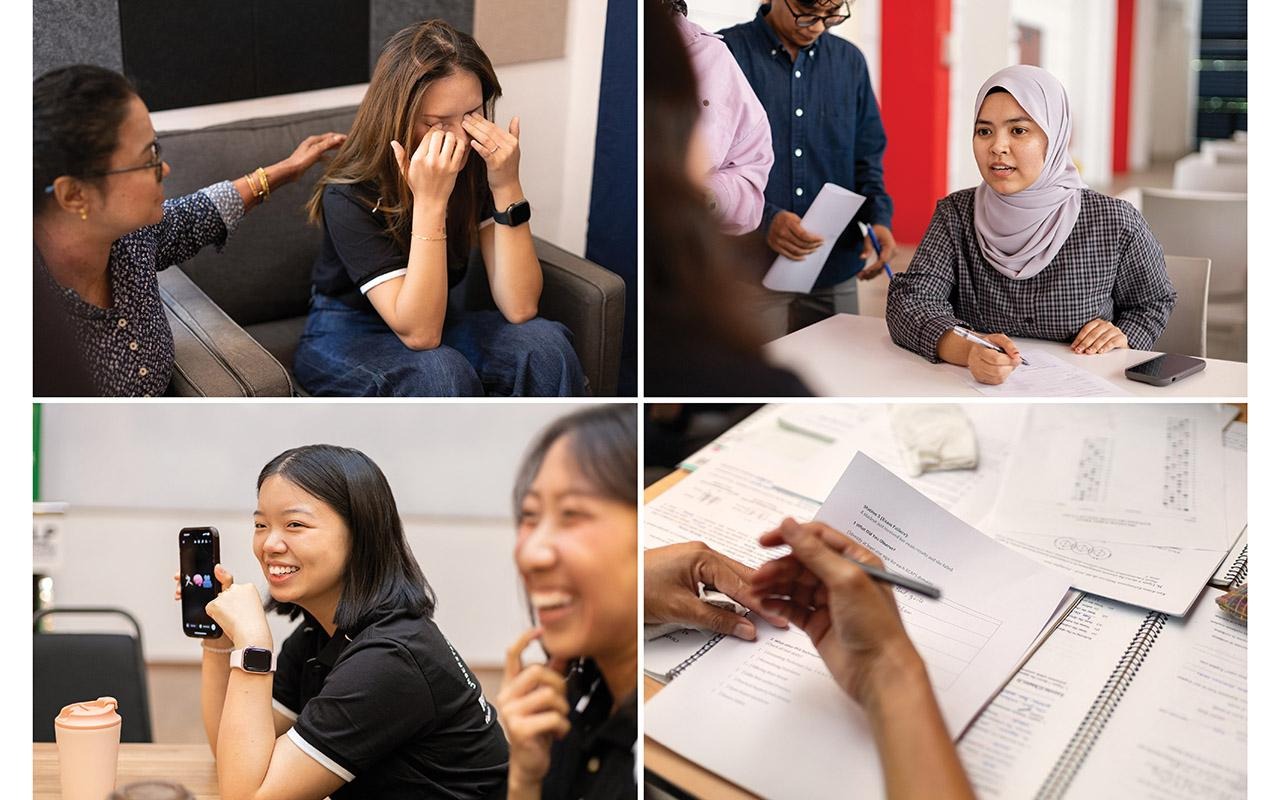
Learning sessions include role-play of talking with people with mental health conditions.
Malaysian members are among those leading the way in Rotary in embracing psychological first aid concepts as this kind of training spreads globally. Rotary clubs in many parts of the world have offered mental health first aid learning sessions, often covering all or part of the cost, for Rotary members and workers from schools or other institutions. Many courses sponsored by Rotary clubs use the Mental Health First Aid curriculum developed 25 years ago by a couple in Australia who became Rotarians.
In parallel with the national efforts, Malaysian Rotary clubs continue to team up to organize psychological first aid instruction for school workers that use learning modules created by the psychology department at Help University in Kuala Lumpur. Shanthi Thiruchelvam, a member of the Rotary Club of Klang Valley, sat in on a session at the school last year sponsored by her club and three others for about 60 counselors and lecturers from universities. She was riveted.
Between moments of levity that induced smiles and bouts of sincere comforting in role-playing exercises, the counselors recorded their observations about the scenarios and passed the mic to share their thoughts. Thiruchelvam learned that she needs to “look, listen, and link,” meaning to look attentively at a person describing a struggle and notice body language, genuinely listen without interjecting opinions, and most importantly, link them to places where they can seek further help. “There is no health without mental health,” she says. “I personally learned so much. What an eye-opener.”
Understanding differing cultural norms — Malaysia’s largest ethnicities are Malay, Chinese, and Indian — is important to reach people from families that for generations have shunned any acknowledgment that grandma was depressed, or an uncle developed a mental health condition after a loved one died, Thiruchelvam says. “This subject was just not a conversation in families,” she says. “We can’t be using those yardsticks anymore.”
In the first aid sessions, master’s students role-played distressing scenarios that could strain a person’s mental health: failing an exam, losing a job, grieving the death of a loved one. Mahendran Daniel, of the Rotary Club of Melawati, says he and the future first-aiders were shaken by the instructors’ realistic role-play. “They were really shivering, quivering, crying, and having anger outbursts,” he says. The counselors said they appreciated the chance to practice how they might react in those situations.
At Help University, a large part of Rotarian Dhanesh Balakrishnan’s job is to ensure students’ well-being as dean of student life and wellness, so working with the school’s experts to provide psychological first aid instruction is a natural fit. In turn, he links university representatives with national coalition and government leaders, including in the Ministry of Youth and Sports, to provide mental health expertise. “My vision is, How do I get as many stakeholders as possible to enhance mental well-being in the country?” he says. “I’m trying to connect the dots.”
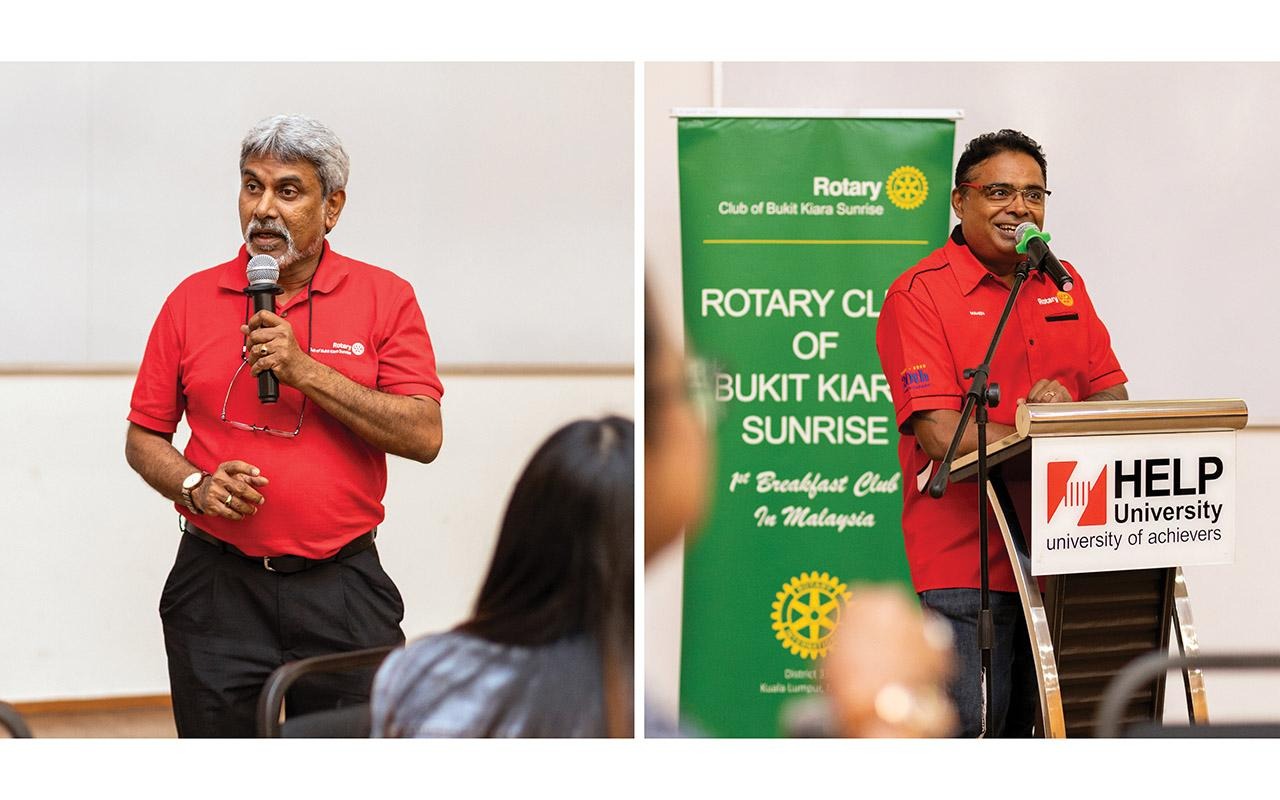
(Left) Dhanesh Balakrishnan connects Rotary clubs with mental health experts from the university where he is dean of wellness. His club learned psychological first aid to help members better mentor teens. (Right) Rotarian Mahendran Daniel says awareness campaigns are preparing Malaysians to accept the idea they might need mental health care.
His club, the Rotary Club of Bukit Kiara Sunrise, held psychological first aid training for members because the group has run a mentoring program for years for kids ages 15 to 19 as they prepare for further schooling after graduation. Rotarians can help the teens access low-cost mental health counseling should they need it, and the first aid training was one example of how the members learn about topics to grow their mentoring skills. “That’s another level of learning for them to mentor their mentees more effectively,” Balakrishnan says.
Future teachers who complete university-level studies at government Teacher Education Institutes receive some child psychology instruction in their pedagogy course, says retired institute instructor Letchumi Ramachandran. “Some of the students do come to us teachers — they feel comfortable talking about relationships, talking about families, home issues,” says Ramachandran, a member of the Rotary Club of Tanjong Bungah in Penang. In a course to learn to instruct adults, the teachers-in-training get some psychology education that helps with productive interactions with parents and any job stress they might feel, she says.
In two years of teaching teens at a private international secondary school in Malaysia, Yevonne Patrick says she noticed two students with evidence of cuts on their arms from self-harming, when they wore shorter-sleeved shirts in gym class instead of their uniforms. She softened some rules for these students, with the principal’s understanding, to make time to listen to what was bothering them and refer them to a school counselor.
With a degree in psychology, Patrick supplemented her skills in how to react in this type of worrying situation by taking a course in psychological first aid a few years earlier. The main lesson she’s held onto is how to interact with students with empathy and without judgment, remembering that what they’re going through can contribute to their sometimes unruly, even rude, behavior. “That develops a bond and it’s easier to talk to them,” she says.
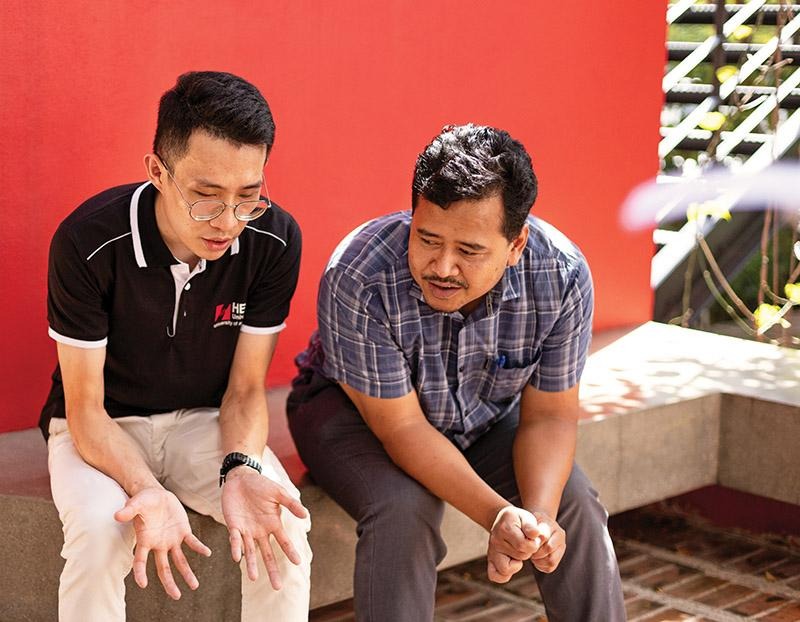
A future psychological first-aider and his instructor
Rotary clubs in Malaysia have held awareness campaigns, promoting slogans like “It’s OK to not be OK,” and online forums during the pandemic for people to share their mental health experiences and feel the support of the group. Daniel, one of the Rotarian organizers, says the larger target behind all the clubs’ educational efforts is to prepare people to consider the idea that they might need professional help. Without that readiness, he says, many people in Malaysia would instantly brush aside a suggestion to see a counselor — or get angry about it — and suffer in silence. “You must go through awareness first before acceptance,” he says.
He touches on similar themes when he helps clubs grow by extolling the fun of Rotary in his role as district membership engagement chair. He worries Malaysians have given up a lot of basic activities. “Confining yourself to the room is not going to help,” he says. “You’ve got to be outdoors. You got to have the green, the air, the water, the trees, the sand, the soil — all of that gives you back the kind of things to build you up.”
The Rotarians are proud of the progress made as they notice more people talking about mental health, but they know the effort to normalize mental health care has a long way to go.
“Addressing mental health issues is not an easy thing,” Rajasegaran says. “It’s ongoing. You have to keep doing it.”
To bolster the national efforts that Rotarians have spurred, district leaders encourage clubs to take their own approaches to promote mental health, making it a priority always, not just when an awareness day (or month) comes up on the calendar. Thiruchelvam, one of the Rotarians who organized the psychological first aid training, issues this challenge: “Mental health is every day, guys. You don’t have to wait to annually do something. Let’s address it here and now.”
This story originally appeared in the January 2026 issue of Rotary magazine.