Rotaractors ready to lead
Newly eligible to seek global grants, Rotaractors are showing they can bring fresh ideas to large international projects
by Arnold R. Grahl | Photography by Nipah Dennis
11 Nov 2026At the dedication of a new water station and borehole at a school in southern Ghana, children in white shirts perform a carefully choreographed dance as onlookers watch under large canopies. In a short skit, a child pours water from a bottle into a cup held by another and they both jump in celebration. Later, a woman balances a bucket on her head as water flows for the first time from an overhead spigot.
Nearly the entire community has turned out for the celebration. It’s one of many that took place throughout the Ashanti region of Ghana in late 2024 and early 2025 during the implementation of a $57,000 global grant from The Rotary Foundation. There’s a lot to celebrate: The project is reaching more than 6,000 people with clean water and improved sanitation. Children at eight schools no longer use pit latrines that contribute to waterborne illnesses. Also of note for Rotary, the initiative was sponsored and led by members of Rotaract, Rotary’s clubs for young adults, in Ghana, Turkey, and Virginia. It was one of the first such projects completed since The Rotary Foundation opened global grants to Rotaract clubs in July 2022. The success was all the more special coming as it did after an initial false start far from West Africa and involving a very different challenge.
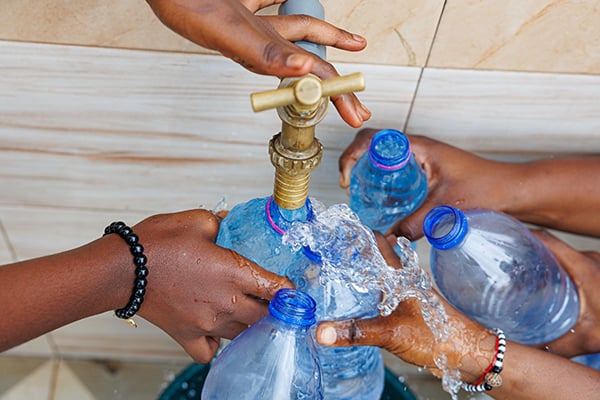
The water station at Pentang Elementary School.
Allisyn Lam, who was then charter president of the university Rotaract club at William & Mary in Virginia, had initially set out to do an international project with the Rotaract Club of Istanbul-Adalar in Turkey. The two clubs had formed a sister club relationship after they were introduced by a Rotarian who had visited Istanbul.
When a powerful series of earthquakes struck southern and central Turkey and parts of Syria in 2023, killing tens of thousands and causing massive damage, the two Rotaract clubs decided to seek an earthquake relief grant to build a water system at a camp for people displaced by the disaster. But after nearly a year of working on details, Rotaractors reluctantly gave up on the project.
Amid an already complex recovery effort on the ground, they had trouble securing the cooperation of other Rotary members who had never worked on a major grant-supported project before in which Rotaractors were in the lead. “At times, this grant felt impossible,” Lam recalls. “We faced numerous challenges as one of the first Rotaract groups attempting a global grant on this scale. The gap between updated Rotary guidelines and understanding of local Rotary groups created delays and barriers to progress.”
While they struggled to gain traction, the Rotaractors did find a Rotarian who believed in them and was ready to lend his support: Walter Hughes, a member of the Rotary Club of Salem, Virginia. Lam met Hughes during a project she worked on with Interact — Rotary’s service program for teenagers — and he served as a mentor to her while she was in college. Hughes has been involved in Rotary projects in Ghana for two decades and encouraged the clubs to shift their focus to that country instead of giving up entirely on an international project.
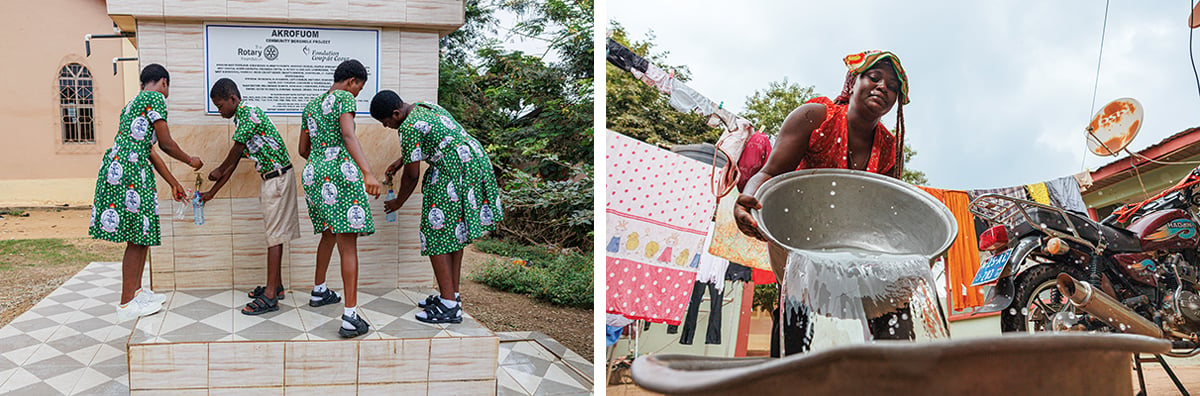
A water system at Pentang Elementary School provided a new water station and microflush toilets.
Hughes introduced the American and Turkish Rotaract clubs to the Rotaract clubs of Obuasi and Kumasi in Ghana’s Ashanti region. Many communities in that region suffer from water scarcity and waterborne diseases such as diarrhea, dysentery, and typhoid fever. Schools lack adequate water and toilets, forcing students to relieve themselves outside in the open.
After conducting extensive research, the Rotaractors focused their project on drilling two new boreholes and providing 90 microflush toilets and 10 urinals for eight schools in the region. The toilets use a minimal amount of water and direct waste to earthworms that convert it into compost. The new project secured a global grant in early 2024, with the Rotary E-Club of District 7040-Premier in Quebec serving as the international sponsor and the Rotaract clubs outside Ghana providing support.
With the project now focused in Ghana, the local Rotaractors received help from other Rotary members, both from their sponsoring Rotary clubs of Kumasi and Obuasi and others throughout the country. “In Ghana, it is easy for Rotaractors to blend with Rotarians in our meetings and in our projects,” says Kwame Annor, president of the Rotary Club of Obuasi. “Whatever the district leadership is planning, they make sure they plan along with the Rotaractors as well.”
The partnership proved powerful. The Rotarians brought knowledge and experience, while the Rotaractors excelled in energy, enthusiasm, and availability. Annor says the Rotaractors made many visits to the worksites to check progress and collect data to measure the ongoing impact of the project. “These young people are so full of energy and innovative ideas, it blows your mind,” says Annor. “They would go into the community and engage with the leaders. They would meet with the chiefs and the county leaders, and then they would set up a meeting to engage the entire community.”
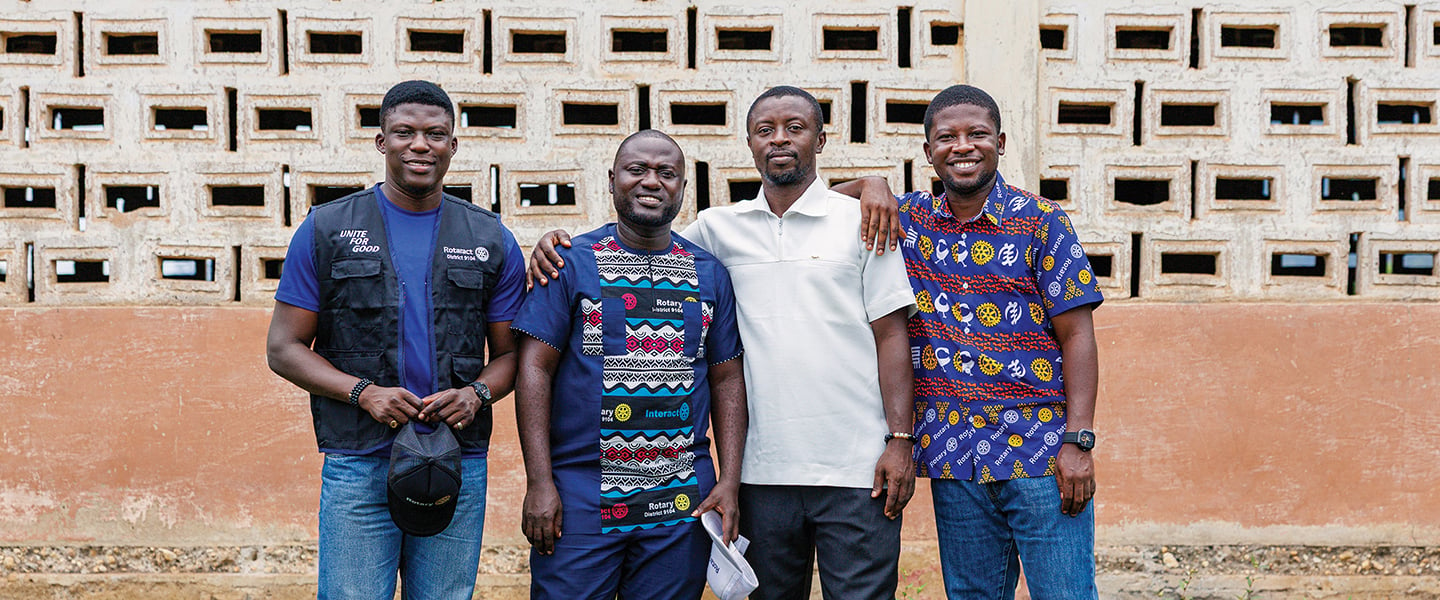
Rotaractors James Asamoah and Emmanuel Boakye-Dankwah from the Kumasi club and Godfred Acheampong from the Obuasi club conducted joint community assessments in multiple locations, focusing on the region’s sanitation needs. They engaged with community leaders and worked with local officials to establish water and sanitation committees, set up bank accounts in each community, and train the committees to collect fees, maintain equipment, and teach proper hygiene.
The Rotaractors’ fresh perspective resulted in new ideas. One was to create a separate changing room within some of the toilet blocks to give girls privacy to address their menstrual needs. The rooms are stocked with sanitary pads and other supplies. “We didn’t want the girls to have to go home or drop their sanitary pads into the toilets,” Acheampong says. “So we said let’s create a room where they can go and change whenever they need to.”
The American and Turkish Rotaractors shared decision-making with the Ghana clubs and played an essential role in fund-raising. Annor, a project planner, trained the Rotaractors on good stewardship practices and provided additional financial management. “I advised them on keeping their transactions as transparent as possible and getting receipts for every transaction,” Annor says. “Because they were representing the district, we knew they needed to put their best foot forward.”
“It has been one of our best initiatives, and we couldn’t have done it without the Rotarians’ help,” adds Acheampong. “They mentored us on organizing needs assessments and how to handle the financial aspects. It really got us excited about how to think, how to implement, how to engage, how to talk, how to identify a community where they need projects like this.”
More than 20 global grant projects by Rotaract clubs have either been completed or are in the works. Here are three of them.
Study hall
The Rotaract Club of Osaka Higashi (East) in Japan sponsored a $32,800 global grant to provide educational materials and teacher training for two primary schools in Ulaanbaatar, Mongolia, benefiting an estimated 3,400 students. The Rotary Club of Khuree, Ulaanbaatar, served as the host sponsor. The schools are located in a district far from the city center where there is no running water or heat. The clubs created space at each school for a heated library where students could study away from home. Teachers can use the libraries to conduct additional exercises, and community members are allowed to use the space for events.
Eye screening
The Rotaract Club of Totoras, Argentina, partnered with the Rotary Club of Minden, Nebraska, on a $33,700 global grant to establish and equip an ophthalmology clinic in a hospital in Totoras to prevent, detect, and treat glaucoma, hypertensive retinopathy, and diabetic retinopathy. The occurrence of these eye diseases had doubled in the community over the previous decade. Detecting and treating the diseases requires specialized instrumentation.
Future lawyer
The Rotaract Club of Tilburg International in the Netherlands sponsored a global grant scholarship for Lucia Wyland to pursue a second year of studying global law at Tilburg University. Rotarians in District 5580 (parts of Minnesota, North Dakota, Wisconsin, and Ontario), the international sponsor, managed the grant funds and arranged for Wyland to speak to various Rotary clubs in the district. Rotaractors welcomed her to their meetings and events and assisted her with accommodations.
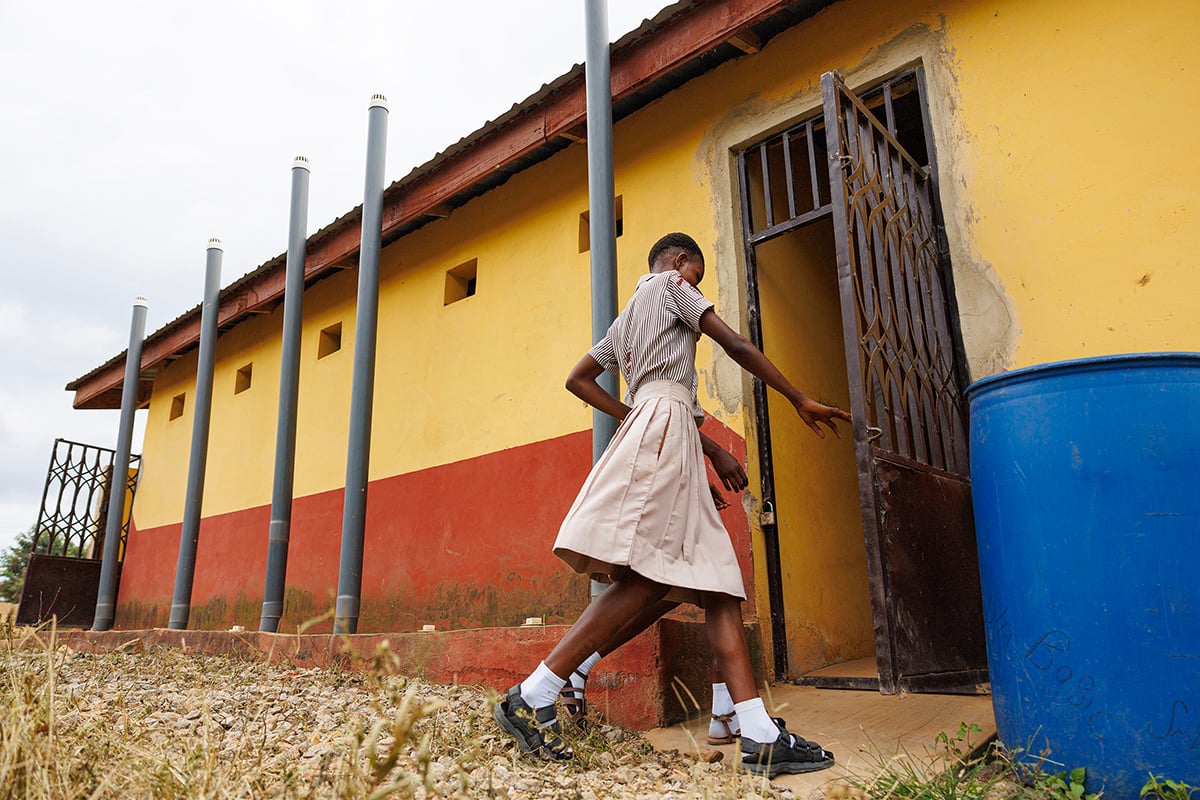
The Rotaractors also addressed menstrual health needs to keep girls in school.
Reflecting on their status as one of the first large-scale global grants sponsored by a Rotaract club, the Rotaractors and their Rotarian partners all expressed a desire to see this effort serve as a model for future endeavors. “Rotary clubs should allow the Rotaractors to be more involved because they have the energy to carry out activities, and this will create more impact in our communities,” Asamoah says.
Hughes says that pairing Rotary and Rotaract clubs together on projects, as is done in Ghana, is vital for the future. “These young leaders in their 20s and 30s are the future of Rotary,” he says.
Lam, who is now applying to medical schools and planning to return to Rotaract wherever she lands, remains optimistic about the future of Rotaract-led global grant projects. “When Rotarians actively invest in Rotaractors, not just as participants but as capable co-leaders,” she says, “it strengthens the sustainability and scalability of global grant work.”
This story originally appeared in the November 2026 issue of Rotary magazine.
Top image from left: Emmanuel Boakye-Dankwah, James Asamoah, both of the Rotaract Club of Kumasi; Kwame Annor of the Rotary Club of Obuasi; Godfred Acheampong of the Rotaract Club of Obuasi
Rotary clubs have had years to develop expertise in designing and implementing projects with the backing of Rotary Foundation global grants. In 2022, Rotary began allowing its youngest members, Rotaractors, to apply for these grants, which support large international projects with sustainable, measurable outcomes in Rotary’s areas of focus. Raising up Rotaract leaders to take on these projects will vastly increase Rotary’s impact worldwide and, in many respects, help ensure the organization’s future.
Here are some practical steps gleaned from Rotarians’ experience mentoring Rotaractors on the water and sanitation global grant in Ghana.
Involve Rotaract members in all of a district’s efforts.
Kwame Annor, president of the Rotary Club of Obuasi in Ghana, says his district has made it a priority to invite Rotaractors to meetings and bring them along on projects. Before they took on leading roles in this global grant, the Rotaractors in Ghana had performed various roles on Rotary club-led projects. “Whatever the district leadership is planning, they make sure they plan along with the Rotaractors as well,” Annor says.
Pair Rotary clubs with Rotaract clubs.
“The lesson we have learned is that the Rotaract club, wherever they are, needs to have a Rotary club to mentor them,” says Walter Hughes, a member of the Rotary Club of Salem, Virginia. “Having some local leaders to train the Rotaractors is really valuable.”
Get buy-in at the district level.
Says Annor, “It is key to get district commitment. The Rotaractors cannot stand on their own if the district is not committed to allowing them. They don’t do a different thing; they do what we are doing. So we need to empower them, we need to allow them to own up and be responsible for their own decisions as well.”
Don’t patronize.
“The missing part is when you have Rotary members thinking that these young people are still kids,” Annor says. “If you think they cannot make decisions and be responsible for those decisions, then you find it difficult to let them go.”