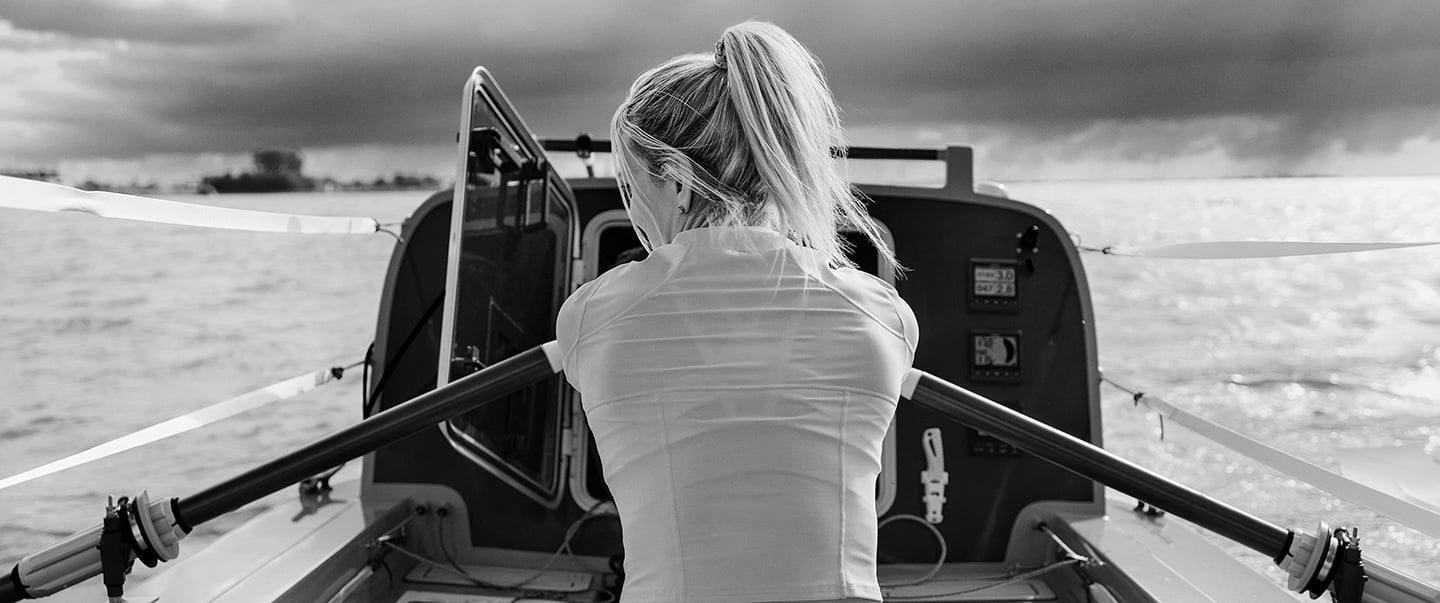
For love of water
Endurance athlete Katie Spotz takes on her toughest challenges yet — rowing the world’s largest ocean and the global water crisis
by Ida Lieszkovszky | Photography by Grace McConnell
11 Nov 202610,000 miles, 8 months, 1 woman to raise $1 million to help 100K people in Fiji access clean water
In February 2010, Katie Spotz was in the middle of the Atlantic, by herself. She had reached the midpoint of her solo row across the ocean, an accomplishment she thought would energize her. Instead, she felt depleted. “When I reached halfway, I felt like I gave everything and I couldn’t imagine doing that again,” she says.
It was just her, her boat, her wet clothes and supplies, and water as far as she could see. The weather had been unrelentingly sunny, the waves reaching no more than 5 feet for most of her journey up to this point — a grinding sameness. Her only company was a Wilson tennis ball gifted to her by a Rotary club in her home state of Ohio, a humorous echo of Wilson the volleyball, the silent companion cherished by Tom Hanks’ character in Cast Away.
She recalls thinking that, at that moment, she might be the person who was farthest from any other human being on the planet. “It made the ocean feel even bigger, feel more daunting,” she recalls.
She had embarked on a journey most people wouldn’t dream of, rowing more than 1,000 nautical miles over 36 days, and had reached the point where most people would give up. Katie Spotz is not most people. She finished that journey and, at age 22, set a record for the youngest person to row solo across an ocean.
Now 39, she’s ready for a bigger challenge. This December, if all goes as planned, the Rotarian will set off on a solo, unassisted row of 10,000 miles over eight months across the Pacific Ocean in an attempt to set a record for the longest nonstop solo ocean row by a woman. She’s also hoping to raise $1 million to bring clean water access to 100,000 people in Fiji. “I definitely feel called to this,” she says. That was not always so.
This past spring, I met up with Spotz at a coffee shop in downtown Cleveland near her home. She grew up in Mentor, about 20 miles northeast of the city, close to the shores of Lake Erie, where her love of water began as a child swimming on summer days until the sun went down. Today, when she’s not out to sea, she’s at home here in Cleveland, planning her next adventure and assembling giant puzzles for fun. Friends and family keep bringing her back here, she says, plus it has everything she needs to train, including a state-of-the-art rowing facility.
Over the last 20 years, Spotz has become a world-renowned endurance athlete. She’s competed in marathons, ultramarathons, triathlons, and Ironman competitions. She’s biked across South America. While preparing to cycle across the United States in 2011, she broke her pelvis and wrecked her bike in a training accident. Determined to compete anyway, she entered the race using a three-wheeled handbike. She once ran 11 ultramarathons in 11 days. She had ACL surgery and then went on to run a 200-mile ultramarathon just three years later, placing first among women and third overall. She’s pushed her body to its absolute limits and kept going.
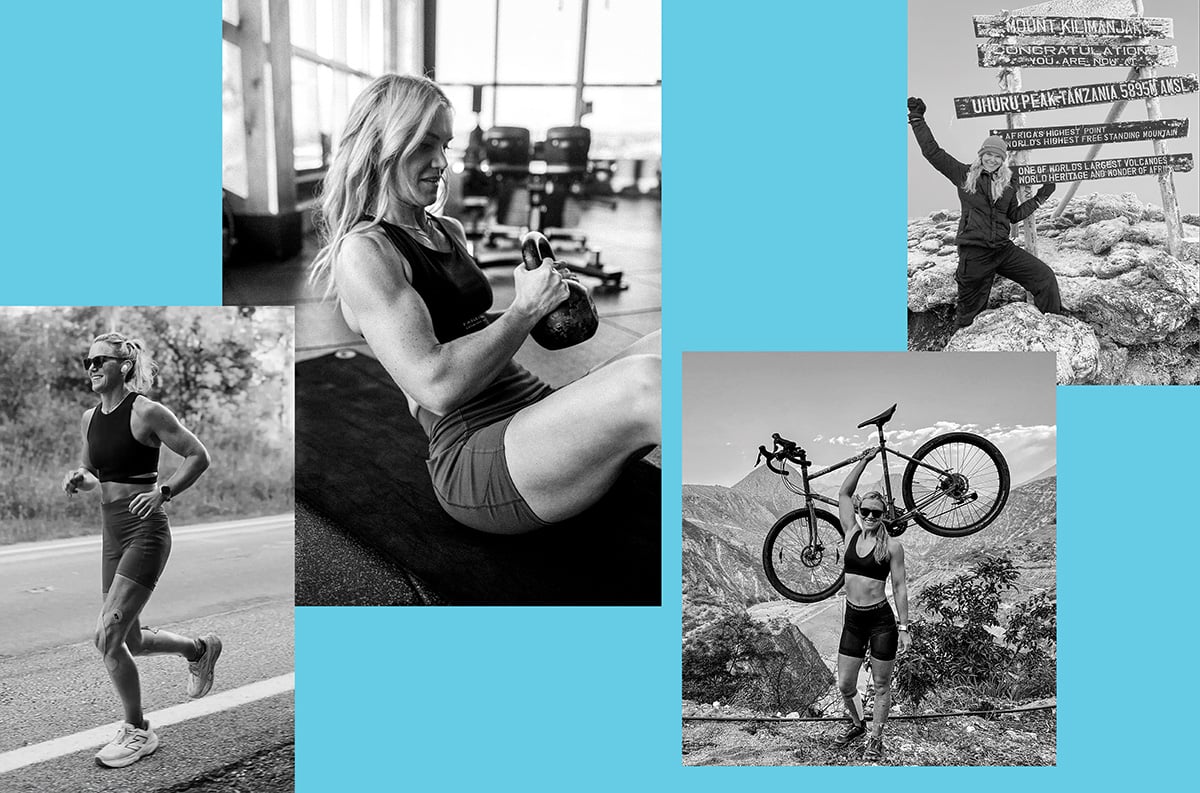
On land and on water, Spotz has completed more than 30 grueling endurance challenges, including climbing Mount Kilimanjaro in 2025.
Credits: (Weights, running) Grace McConnell; (Bike, Kilimanjaro) Courtesy of Katie Spotz
All of this has come as a bit of a surprise to friends and family, and to some extent to Spotz herself. Over tea, she tells me that as a kid, she was a benchwarmer. “I was physically there but mentally I wasn’t,” she says. “In soccer I’d be confused on what side of the field; in baseball I’d be picking dandelions. I didn’t really have that kind of drive.”
She tried all sorts of sports but was never the star athlete. Her longtime friend and teammate on the high school swimming and tennis teams, Annie Poluse, remembers Spotz as genuine and hardworking, the type of friend who was always planning fun outings like pool parties or going to see fireworks. “We would just have fun together,” Poluse says. “We would sometimes just be silly together, like typical high school kids.”
Poluse says Spotz didn’t show a ton of interest in sports and was one of the slowest swimmers on the swim team. Sports seemed to be about spending time with friends and having fun rather than collecting trophies and ribbons.
Toward the end of high school, when Spotz had to take a gym class to graduate, she reluctantly signed up for a walking and jogging class, hoping to walk her way through the semester. It was there, at age 17, that she ended up running her first mile. It wasn’t a particularly fast mile, but she did finish it, a thought-provoking accomplishment. “The biggest lesson I learned from that is just because you think you can’t do something doesn’t mean you’re right, and I realized how much I was my greatest limitation,” she says.
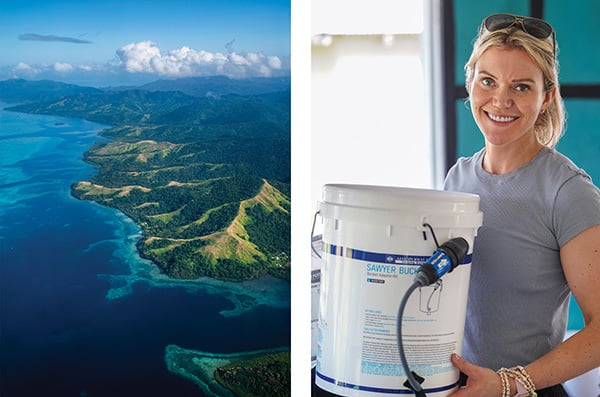
Katie Spotz, a member of the Rotary Club of Cleveland, will use her Pacific row to raise money to expand access to clean drinking water in Fiji. Credits: (Fiji) Getty Images; (filter) Courtesy of Katie Spotz
Then, she got to chatting with someone on a bus about endurance sports. He told her about a friend who had just rowed the Atlantic. “It captured my imagination like nothing else,” she recalls. With all the endurance challenges she’d done, rowing was something new. She went home and immediately set to work figuring out how she could cross the Atlantic.
She joined her college rowing club, mapped out a safe route, and bought a specially designed boat named Liv. There were some inauspicious moments. During a practice row on Lake Erie, four months before her start date, she got sucked into shore and pinned against the rocky cliffs. “That was rock bottom, literally and figuratively,” she says. Fortunately, she had time left to patch the holes in her boat and her confidence.
Once Liv was fixed, Spotz had to get it over to West Africa and load it with meals and supplies to sustain her for the 70-day journey westward. She decided to use the attention she was getting to raise funds for people in need of clean drinking water.
She also started working with a sports psychologist to prepare for the mental aspects of the journey. “My first concern was, is this a crazy person? I don’t want to be involved with an irresponsible person who’s going to drown in the ocean,” recalls Jack Lesyk, director of the Ohio Center for Sport Psychology. He quickly realized she was anything but typical, in addition to being well prepared. Spotz had already spent time cloistered at a Buddhist meditation retreat to prepare for all the time she’d be spending by herself, researched ocean rowing extensively, and spoken to people who had completed similar challenges.
During their meetings, they would talk through the challenges Spotz could face, including the sustained solitude, potential collisions with other boats, getting detached from her own boat, storms, seasickness, loss of appetite and weight, physiological changes, and the risk of injury. They divided her journey into phases and worked through what she could expect, what could go wrong, and how she could deal with it.
They also talked about how to handle media attention and the post-adventure blues after returning to “normal” life. “I think most people would be quite unable to do it,” Lesyk says. “Something about her personality or her genetic makeup, I don’t know, but most people wouldn’t even think about doing something like that.”
Spotz launched her boat in Dakar, Senegal, in early January of 2010 and landed in Georgetown, Guyana, in mid-March. Her journey made headlines around the globe and raised over $100,000 for clean drinking water projects through the Blue Planet Network.
Much like the waves she was riding, the trip had its highs and lows. One day she woke up to an alert that a giant tanker was dangerously close and watched in fear as it passed by. Initially she was afraid to jump into the water, a fear she had to overcome to keep cool in sweltering heat and clean the barnacles from her boat. Large tuna would occasionally rock her boat, and she was keenly aware of the whales, dolphins, octopuses, fish, and sharks that lurked beneath her.
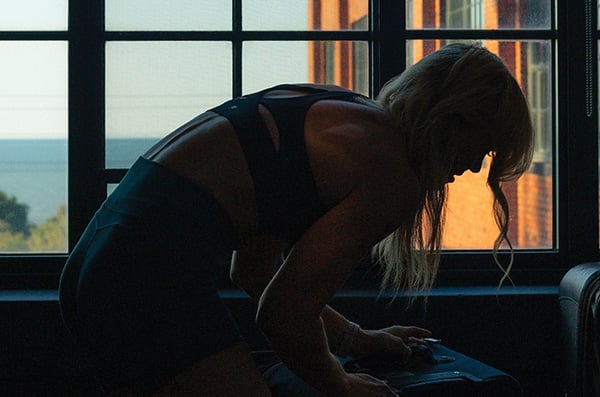
There was that discouraging moment midway, when she ran out of sleeping medication and found it hard to rest. But there were also moments when the night sky lit up with stars, and the ocean beneath her glowed with bioluminescent plankton. “Truthfully I feel like a fish out of water everywhere except the ocean, that’s kind of the place I feel most alive, at peace,” she says. “You feel almost a sense of safety because you can see everything for miles. It’s like you can see until the ends of the Earth, and I don’t think we get the chance to feel that small that often.”
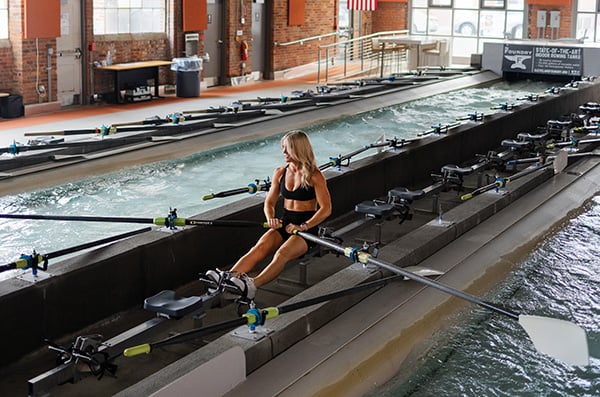
Spotz does much of her training at the Foundry, a state-of-the-art rowing and sailing club in Cleveland. At the Foundry one day this spring, Spotz is wearing a Barbie-pink workout set as she trains at an indoor rowing tank. The rowing machine sits between two tanks of water in which artificial waves mimic open water conditions and currents. The large windows let the bright sun pour in, just steps from the Cuyahoga River. It’s also a place where she connects with like-minded athletes. As she pulls on the oars, Spotz chats with another ocean rower who was part of a team in 2025 that completed the World’s Toughest Row-Atlantic. Organizers of that annual race from the Canary Islands to Antigua proudly tout the “sleep deprivation, hallucinations, blisters, sores, tears, and pain” that participants must endure, apparently selling points for this unique breed of athlete. But the sport requires more than a high tolerance for discomfort.
Rowing is not like running, which is largely intuitive. Rowing, on the other hand, relies on coordinated leg, back, and arm movements that have to be adjusted based on what the water is doing. “It’s kind of like when you’re focusing on a puzzle,” Spotz says mid-stroke at the Foundry. “I might not be thinking sentence thoughts, but I’m very focused, and so that amount of focus does keep me engaged.” Spotz makes it look easy. She moves with an effortless grace that belies her incredible strength, like a ballerina in pointe shoes.
In August 2025, Spotz started planning her Pacific row. She holed up in front of a computer for months, plotting a safe path at a time that would avoid cyclone season. As a U.S. Coast Guard veteran, Spotz is acutely aware of the dangers. She settled on a December departure and a route from Lima, Peru, to Cairns, Australia.
After decades as an endurance athlete, she’s got the lung capacity for the job already, but she started working on what she calls “prehab,” physical therapy-esque exercises intended to prevent injury. If she breaks a rib or tears a muscle out on the ocean, it will take more than a day for aid to reach her.
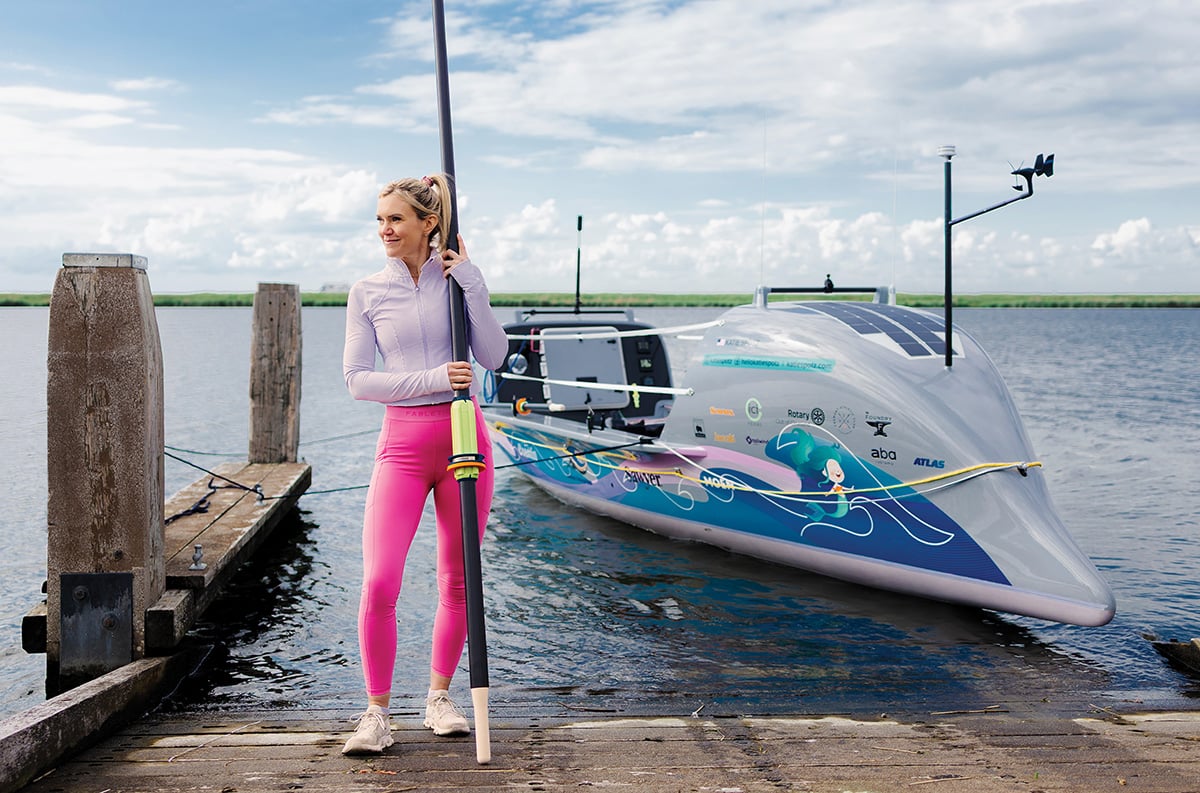
Her “boat guy” is Mark Slats of the Ocean Rowing Company in the Netherlands, which built her custom 24-foot boat. It’s made of the same material as race cars and is wrapped with sponsor logos. It’s self-righting to combat the 40-foot waves that will come at her. In May, Spotz traveled to the Netherlands to test the boat, including its ability to self-right. In a video shared on social media, she wears a helmet inside the inner cabin as one of the boat builders tips the craft upside down. “I’m on the ceiling,” she says, shrieking with a huge grin. “Oh my God, that was really fun.” Slats, an ocean-rowing legend in his own right, will also be a main point of contact for her, especially if repairs are needed.
Fiji is made up of about 330 islands in the South Pacific, one-third of which are inhabited. Its palm trees and white sandy beaches make it a popular tourist destination. But away from the main islands and resorts, access to clean drinking water can be a serious challenge. “When we think of the water crisis, we probably don’t think of Fiji,” says Katie Spotz, a member of the Rotary Club of Cleveland. “There are some places in Fiji that are very hard to reach, very expensive to reach, and oh yeah there’s cyclone season, so there’s a lot of factors that make it very difficult to get clean water.”
Only 42 percent of the population — and just 27 percent in rural areas — have access to safely managed drinking water, according to UNICEF. Contaminated water can spread disease and lead to missed work and school. The search for clean water can also be an economic burden.
On some of Fiji’s remote islands, clean water has to be delivered by boat, an expensive and time-consuming endeavor. Other challenges to safe water supplies range from storms and climate change to aging infrastructure.
Through her Pacific row, Spotz is aiming to raise $1 million for clean drinking water projects in Fiji. She’s partnered with the nonprofit Give Clean Water and the Sawyer Foundation with a goal of distributing Sawyer water filters to 20,000 homes, expanding access to clean drinking water for 100,000 people. Working with Fiji’s Ministry of Health, Give Clean Water’s ultimate goal is to help Fiji become one of the first developing countries to achieve universal nationwide access to clean water.
Spotz is an ambassador for Sawyer, and the company is sponsoring her Pacific crossing. “We’re so honored that Katie would choose Give Clean Water and that she would choose Fiji to give back,” says Darrel Larson, a California Rotarian and the founder and director of Give Clean Water. Larson is also the international director of humanitarian programs at Sawyer.
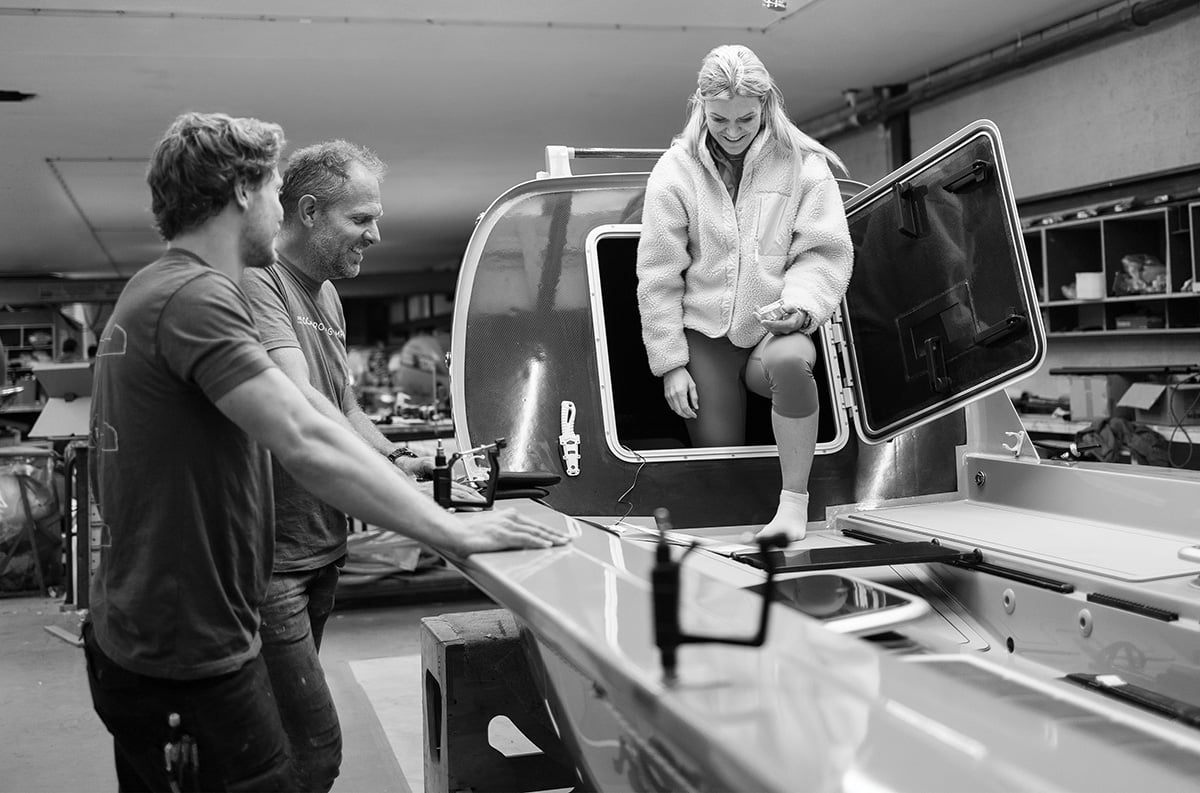
Spotz inspects her boat, a custom-made 24-foot craft designed to be self-righting to combat the 40-foot waves she’s expecting.
She also has a “weather guy” who will help her navigate what nature throws her way, including the impact of what’s expected to be a record-breaking El Niño. Her 3,000 items of food, including freeze-dried meals, chocolate bars, energy bars, and snacks, were packed months in advance.
Spotz has tracking and communication equipment to help avoid collisions and a safety harness to keep her tethered to her boat. Topical patches will help with seasickness and medication with sleep. Entertainment will be provided by her favorite podcasts and music, especially Britney Spears and Sia. Satellite internet service will keep her connected to her team and family.
She’ll also be in regular contact with Darrel Larson, the founder and director of Give Clean Water, the nonprofit organization she has partnered with on water projects in Fiji. Larson is a member of the Rotary Club of Oceanside, California. He and Spotz visited Fiji together this past spring, traveling to one island to distribute water filters and to another to check on filters that had been previously distributed. They hope that with the money raised they can provide clean water access to everyone in the island nation. “She’s an amazing human being and she has a heart of gold,” Larson says.
Spotz has had a long relationship with Rotary herself, speaking to clubs in and around Cleveland, including the Rotary Club of Chagrin Valley (Chagrin Falls), which sponsored a Rotary Foundation scholarship that helped her earn a master’s degree in social entrepreneurship at Goldsmiths, University of London. She joined the Rotary Club of Cleveland in 2025.
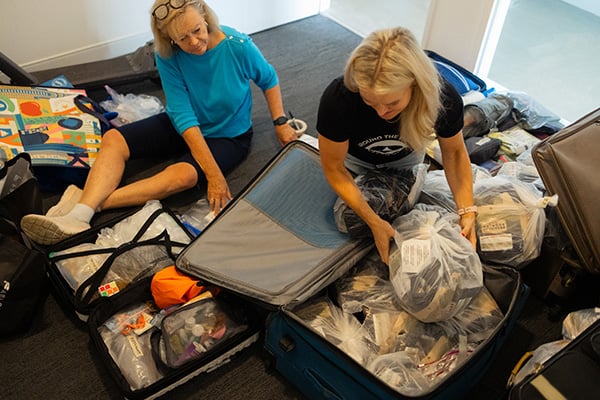
Spotz’s mother, Mary, watches her pack. “There comes a point where you just have to know this is what they want … and far better to be with their dream than against it,” Mary Spotz says.
Spotz is both at an advantage and a disadvantage as she looks ahead to her Pacific crossing. On the one hand, she knows what to expect. On the other, she knows what to expect. “There’s no conquering of any oceans,” she says. “You’re out there with a humble posture, with hope and gratitude. If the ocean wanted to take me it could do that in a second.”
Out on the water, her hands will be blistered from rowing, and her body will develop sores from the constant exposure to salt water. She will be alone for eight months. That’s a long time without human contact, even for a self-described introvert. On the Atlantic, she cried when she saw an airplane and again when she ran out of Snickers bars. Still, her greatest fear is to not do it. “It’ll be hard to row,” she says. “But it would be very hard to be 70 or 80 looking back on my life wondering what if?”
The first time Spotz told her family she was going to cross an ocean, they didn’t really take her seriously. When it became apparent she wasn’t kidding, they reluctantly got on board. Her dad and a brother met her in Guyana when she arrived. Her mom wrote her letters for every day of the journey. “There comes a point where you just have to know this is what they want and you could be with them or against them, and far better to be with their dream than against it,” Mary Spotz says.
This time, they knew she was serious. Mary is filled with a mix of anxiety and pride. She marvels at her daughter’s bravery and beams at the good that her daughter can do in the world. But it’s also hard for her to look at Lake Erie. The endless water reminds her of her daughter, alone on the ocean.
The exact day of her launch — likely late December or early January — will depend on the weather. Spotz will have a live tracker updating her progress, and she’ll also be posting on social media.
The Rotary Club of Cleveland will hold events ahead of her launch and when she gets back. “We’re all just blown away by what she is about to take on and all in the name of helping people she doesn’t even know,” says Tina Ingraham of the Cleveland club. “That’s so Rotary.”
The Chagrin Valley club also plans to hold events for Spotz and will be sending another tennis ball along for company. Spotz also has a crocheted mermaid and shark. And 240 letters from her mom, one for each day at sea.
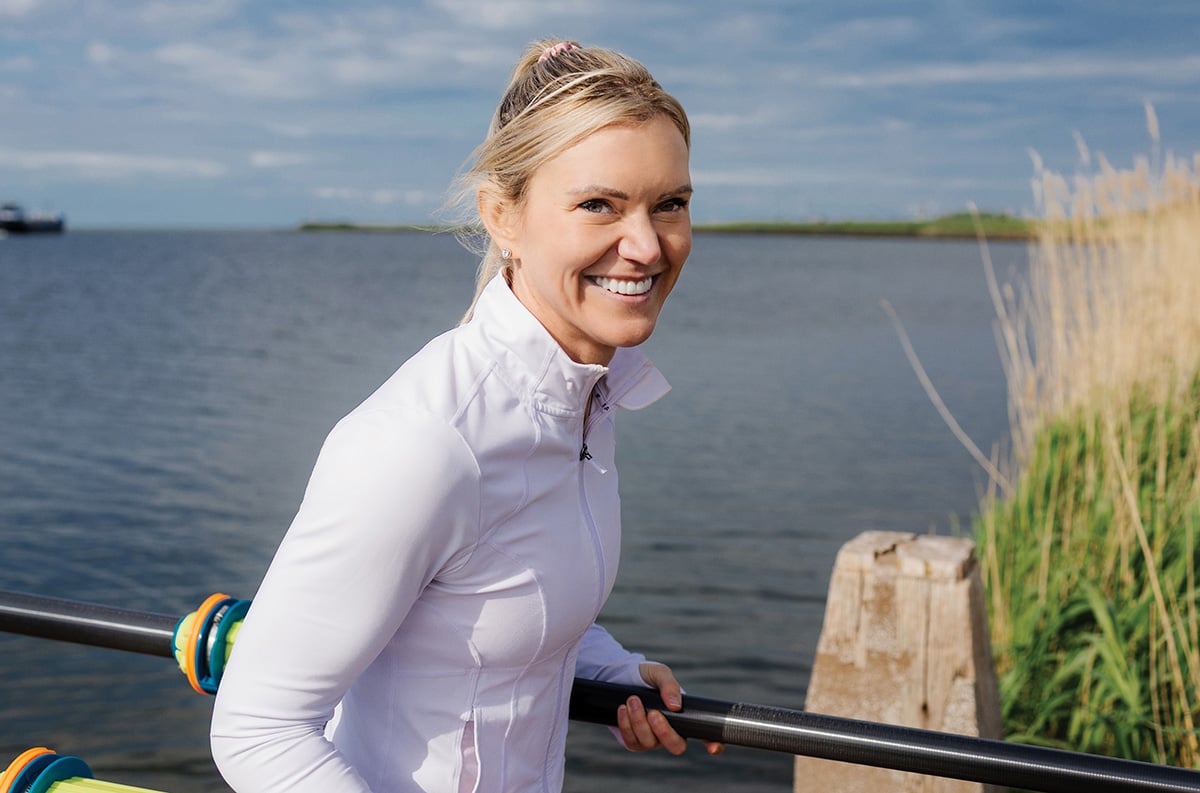
When she reaches the Australian shores, Spotz plans to rest and indulge in some watermelon, her favorite food. She will have earned it after months of living alone on the ocean, rowing 12 hours a day, and eating freeze-dried food.
She won’t rest for long, though. She’s already got her next adventure lined up. Within months of finishing the voyage, she intends to bike through Australia and then row from Darwin to Singapore. Eventually, she plans to ride her bike all the way back to Dakar.
That’s right, Dakar, where she launched her first ocean-crossing expedition almost 17 years ago. And with that achievement, she will complete her ultimate goal of circumnavigating the globe purely using human power — biking, swimming, kayaking, and rowing.
Sometimes people ask Spotz when it will all be enough. “I love doing this,” she answers, “so I was hoping forever.”
This story originally appeared in the November 2026 issue of Rotary magazine.