
From the soul: Otis Redding's legacy
The late singer's family is lifting up today’s young musicians
by Jewel Wicker
23 Sept 2026It’s midday on a Saturday in April and the Otis Redding Center for the Arts in downtown Macon, Georgia, is buzzing. In front of a crowd gathered on the lawn, one teenage musician after another strides onto a stage built into the side of the building. A girl wearing a “Let’s Go Girls” T-shirt sings while strumming a pink acoustic guitar. A boy steps on a wah-wah pedal as his fingers slide down the fretboard of his Gibson Les Paul electric. Vocalists take easy command of the microphone, nailing original songs and covers. With each act, the spectators cheer.
This day of student performances, food, games, and public tours is a birthday party for the center, which opened last year and is home to music education programs organized by the Otis Redding Foundation, a nonprofit established nearly two decades ago by the late singer’s family.
Inside, staff members lead curious families through the building. The guests wander around, taking stock of it all. “That’s the man right there,” one woman says, pointing to a display of vinyl records that includes Redding’s album Love Man.
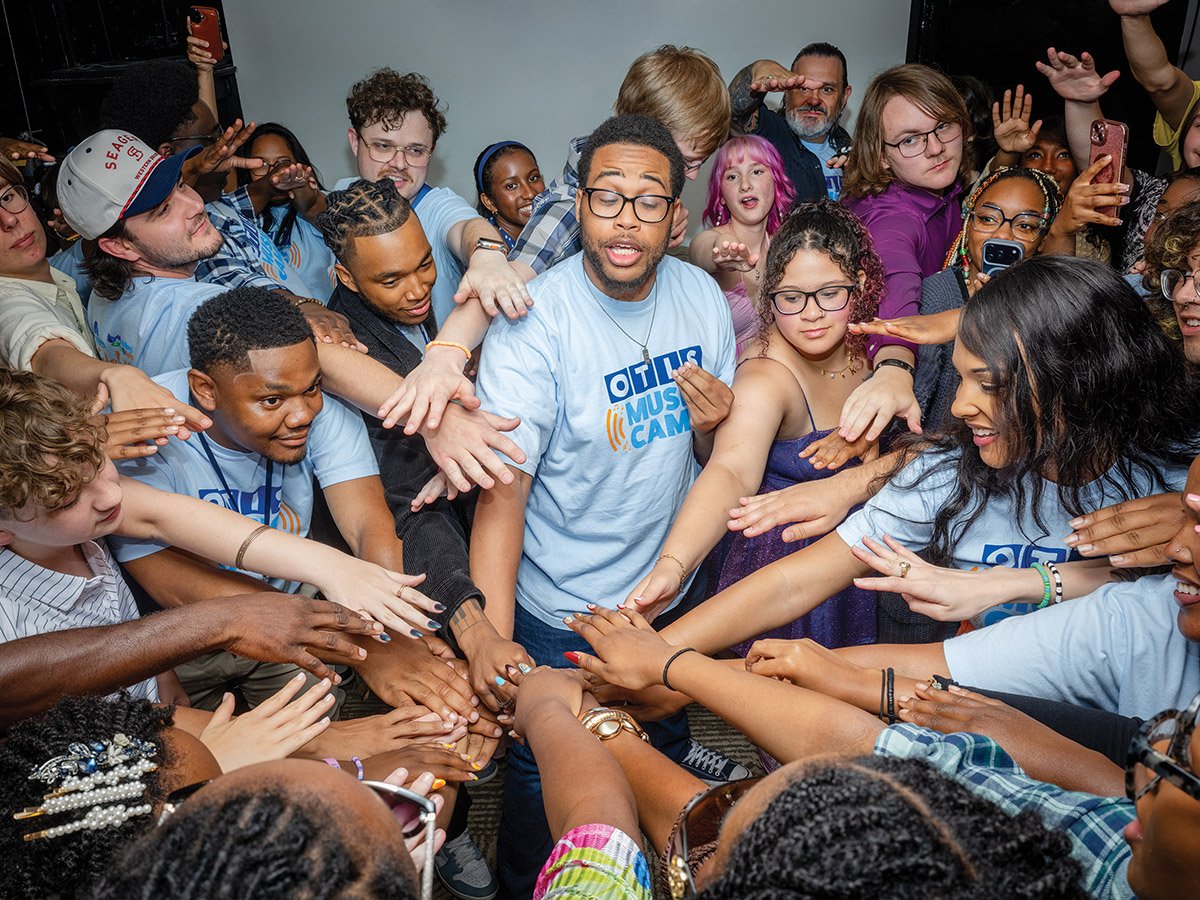
This year’s Otis Music Camp students get ready for their grand finale performance.
The center is vibrant, full of images of Redding, as well as colorful decor designed to inspire kids. There are practice rooms, instrument-filled music labs, a digital technology lab, a recording studio, and even a zen room filled with tactile objects to help calm an anxious child.
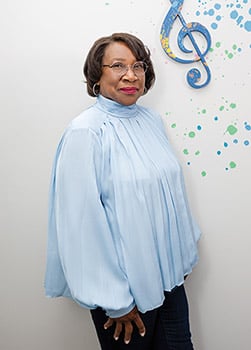
Rotarian Karla Redding-Andrews, the late singer’s daughter, is the executive director of the Otis Redding Foundation.
In a downtown full of buildings that date to the 19th century, the Center for the Arts is a distinctly modern edifice, a sprawling 15,000-square-foot facility encased mostly in rectangular glass panels. One bright white facade angles to reveal a stage where performers can entertain visitors either inside the building or out on the lawn. It’s a musical portal, designed to bring outsiders into the work the foundation is doing and also to deliver to its students opportunities far beyond Macon.
Working behind the scenes is Karla Redding-Andrews, the daughter of Otis Redding and a member of the Rotary Club of Macon. Although she’d never planned to follow in her father’s musical footsteps, she has taken on the role of promoting and protecting his legacy, serving as the executive director of the foundation that honors him.
To the world, Otis Redding is a soul music legend, whose songs still resonate. Between 1962 and 1967, he recorded dozens of them, including “Pain in My Heart,” “That’s How Strong My Love Is,” and a soulful cover of a swing-era hit, “Try a Little Tenderness.” It was Redding who wrote and sang “Respect” before Aretha Franklin reimagined it as a feminist anthem.
On 10 December 1967, Redding was traveling to perform in Madison, Wisconsin, when his plane crashed into a lake just miles short of the runway. Seven of the eight men on board the flight, including Redding, died. He was 26.

Singer Otis Redding performing at the Monterey Pop Festival at the Monterey Country Fairgrounds on June 17, 1967 in Monterey, California. Image credit: Elaine Mayes/Getty Images
Shortly before the tragedy, Redding had been working on a new song — a somber, reflective ode to the passage of time. “(Sittin’ on) The Dock of the Bay” was different from anything Redding had previously recorded. After his death, the song felt eerie. Like a premonition. As it begins, crashing waves can be heard in the background, evoking both a sense of ease and grief. The song ends with Redding whistling, seemingly carefree and at peace.
In 1968 “The Dock of the Bay” became his first and only song to top Billboard magazine’s pop chart. Two decades later, Redding was inducted into the Rock & Roll Hall of Fame, where he is lauded today as a “titan of soul.”
For Karla Redding-Andrews, “The Dock of the Bay” is a haunting reminder of what she lost. Every day, she feels her father’s presence on the 600-acre Big O Ranch, about 20 miles north of Macon, where she and her husband live. It’s also where she spent her childhood.
Otis Redding purchased the expansive property to provide a safe, comfortable space for his family while he was on the road performing. When he returned, he would pack his giddy children into the family car for a trip to Baskin-Robbins, where they would sample every flavor of ice cream. Karla’s mother, Zelma, demanded structure and routine. But when her father was home, the house was bursting with a sense of adventure and spontaneity.
Karla, who was only 5 when her father died, doesn’t remember much about his musical career. Instead, she says that her fond memories are filled with images of Otis as a family man.
She remembers his core values, too. Philanthropy had always been a priority for both her parents, Karla says. “He was already giving scholarships to kids for continuing education. [My parents] didn’t even have enough money to be doing that. But they did it anyway.”
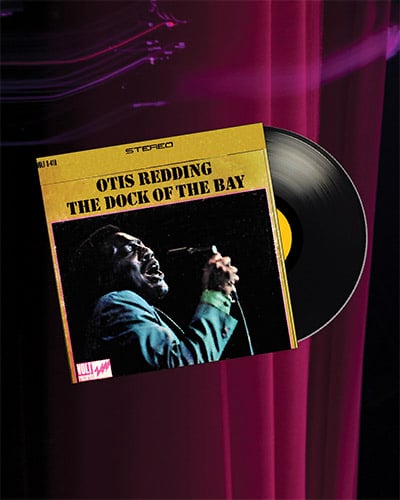
Otis Redding’s “(Sittin’ on) The Dock of the Bay” became a major hit after his death. Image credit: Vinyls/Alamy
The year before Otis died, he hosted a music camp for hundreds of area schoolchildren at the Big O Ranch. Karla recalls the busloads of kids arriving on the property. “They were just falling off the bus, and Dad was greeting every one of them with a high five,” she says. The kids learned about music and civic responsibility from Otis and other local celebrities.
The Redding family says Otis intended for the camp to become an annual occurrence. Although he’s not here to see it, his family is fulfilling that goal.
For years after Otis died, Zelma Redding was committed to protecting her husband’s legacy, honing her business skills to ensure that the family maintained legal control of his music catalog. After starting several small businesses, she founded the Otis Redding Foundation in 2007. Its first offering was an annual music camp for about a half dozen kids at the Georgia Music Hall of Fame in Macon.
Since then, the foundation has expanded its programming. Today, more than 50 students ages 12 to 18 attend the three-week Otis Music Camp, now held at the Center for the Arts, each June. The camp allows them to write and record original music and ends with a concert at the Piedmont Grand Opera House, where they showcase their work.
In addition, the foundation now offers a multidisciplinary arts camp for younger children, workshops on music education and production, and private lessons in voice, piano, guitar, and more.

Karla and her mother, Zelma Redding, at the 2024 dedication of Otis’ star on the Hollywood Walk of Fame. Image credit: Monica Schipper / Getty Images
Justin Andrews, Karla’s elder son and the foundation’s director of global initiatives, says that Otis Music Camp attendees also learn about things like financial literacy, entertainment law, and marketing. Having learned the music business firsthand, he and Karla want to ensure students know that a career as a musician is not the only path to industry success.
Over the past 19 years, the foundation has served more than 1,000 kids. One of them is Dakarai B. Williams, a rapper and DJ who performs under the name DKOMX. Williams was 13 when he was first introduced to the Otis Music Camp by kids he’d come to know as his “cousins.”
“I went to [a] performance, and it was just life-changing,” he says. “Seeing my play cousins up on stage, and they were singing and rapping and doing all the musical things. From that point on, I was like, oh yeah.” Williams went on to attend the camp five times, and in recent years he’s come back to serve as a coach.
Sixteen-year-old singer-songwriter and guitarist Sam Behrend first attended the music camp last summer. Interested in music from an early age, he says “The Dock of the Bay” was one of the first songs he learned to play on guitar. Still, it wasn’t until he attended the camp that he became serious about pursuing music.
The camp splits kids into groups based on the genre they’re interested in. In the pop room, Behrend worked with coaches to refine and record his songs. “There’s not many places in Middle Georgia where you can really get that kind of feedback and write a song in three weeks,” he says.

At the Otis Music Camp concert at Macon’s Piedmont Grand Opera House in June, performances ranged from tender ballads to high-energy raps. Poet Bradley (left), Lila Divis (Right).
After last year’s camp, Behrend stayed connected with the foundation as part of a group of alums that has performed with the Macon-Mercer Symphony Orchestra and opened for singer-songwriter Jason Isbell in Nashville. He also takes private songwriting lessons at the center.
Even before the Otis Redding Foundation officially launched, the Redding family found ways to help students who showed a promising future in music. In the mid-2000s, Roderick Cox was a Macon high school student who wanted to study music in college but couldn’t afford his own instrument. Zelma Redding bought him a $2,500 French horn to allow him to pursue his passion. Then, as he became interested in conducting, the family helped fund his tuition to study in Europe. Cox now lives in Berlin and is musical director of the Opéra Orchestre National de Montpellier Occitanie in France.
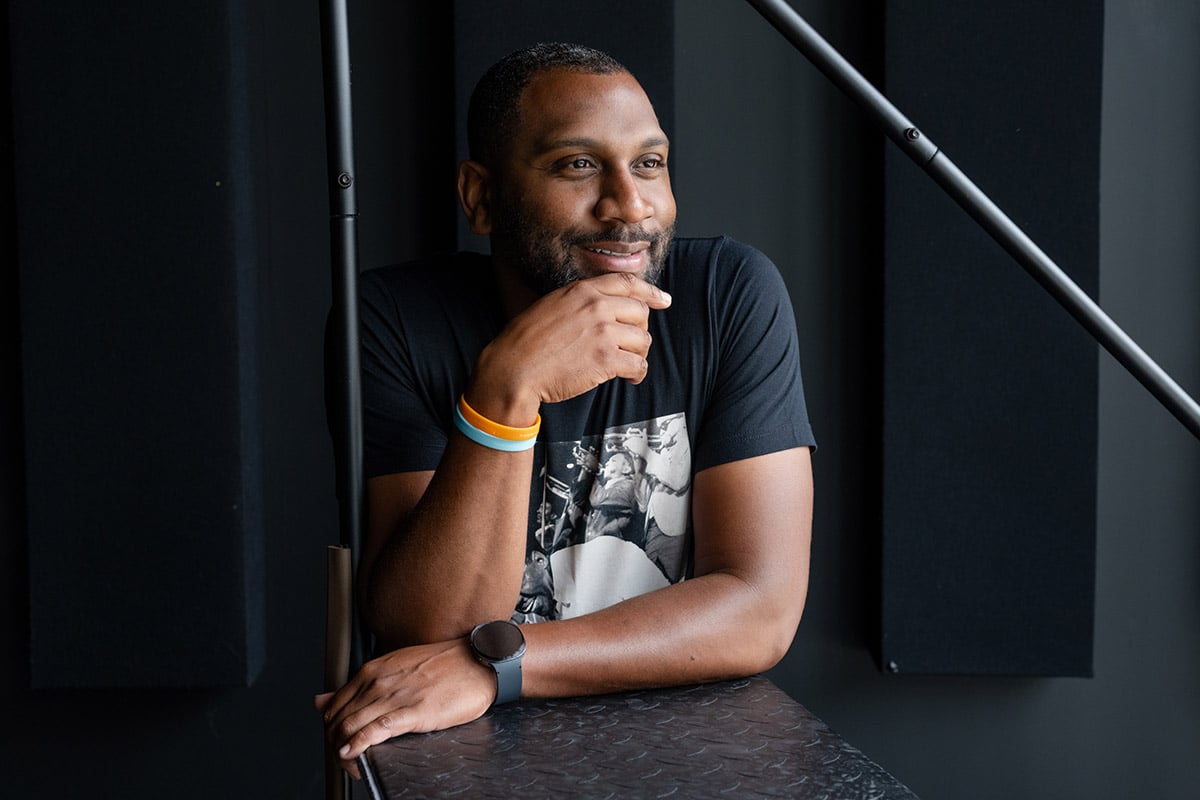
Justin Andrews, a grandson of Otis Redding, is the foundation’s director of global initiatives.
“I was sort of the test case, I suppose, for the organization,” Cox says. “And I’m very happy to have been a part of that.” He has returned the favor by serving as a camp coach and a foundation board member.
Initially, Karla didn’t want to join the family business. Being known as Otis Redding’s daughter was tiring. “I didn’t feel like I was my own person,” she says.
After graduating from Georgia Southern University in Statesboro, she sought a fresh start, relocating to Atlanta to work as a marketing manager. But after Justin was born in 1988, Karla and her husband moved their family back to the Macon area. With her mother, she opened Karla’s Shoe Boutique a block away from the building that once housed her father’s office.
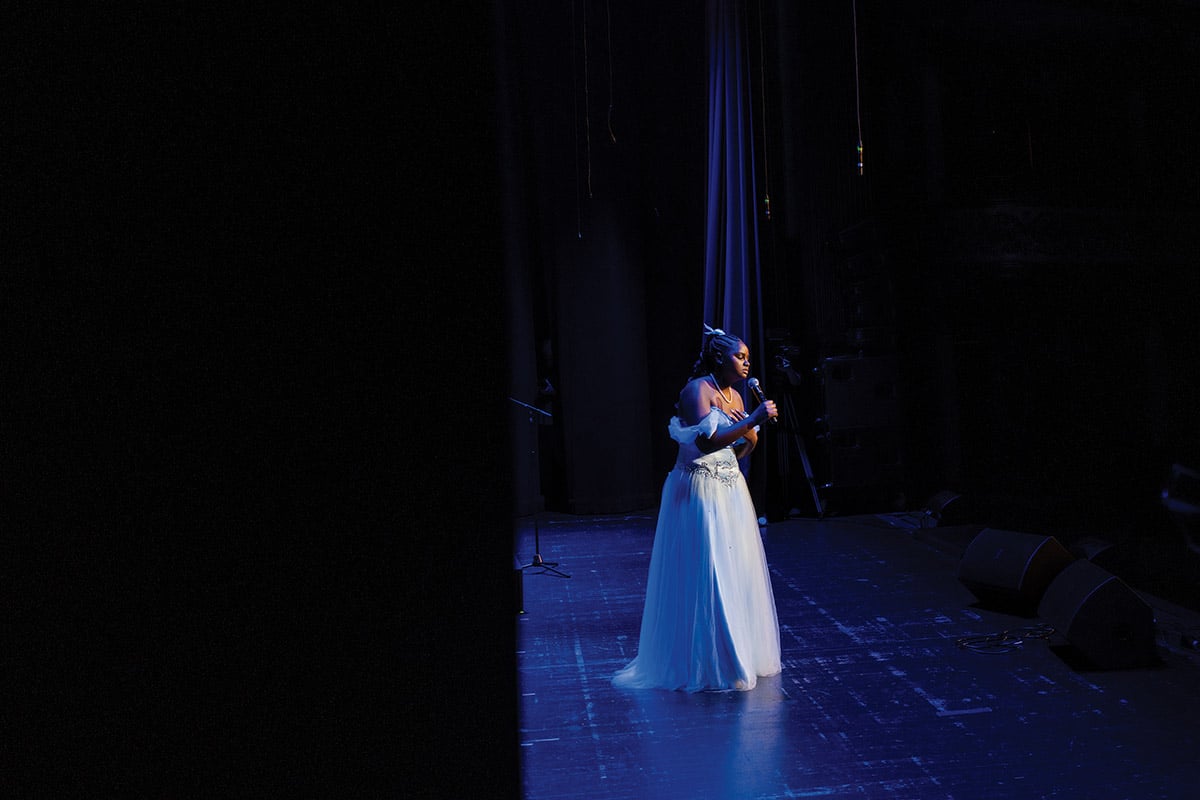
Hannah Stewart performs. The concert provided students with a fairytale ending to their camp experience.
“We are making sure that downtown stays vibrant,” Karla says. “And, really, I think we’ve been a big part of why it’s remained so great the way it is.”
After returning to Macon, Karla began to pay attention to the effort her mother put into managing her father’s estate. “It was a constant thing for her,” Karla recalls.
Inspired by that dedication, Karla helped Zelma start the foundation. As executive director, she leads a staff of nine employees and dozens of contract workers who help run the organization’s programs. Meanwhile, Justin oversees partnerships for both the foundation and the estate — and together they look for opportunities to promote the foundation’s mission.
Ten years ago, Karla joined the Rotary Club of Macon. Its members are “all the people we do business with, who support us,” she says. “They’re like friends to us.”
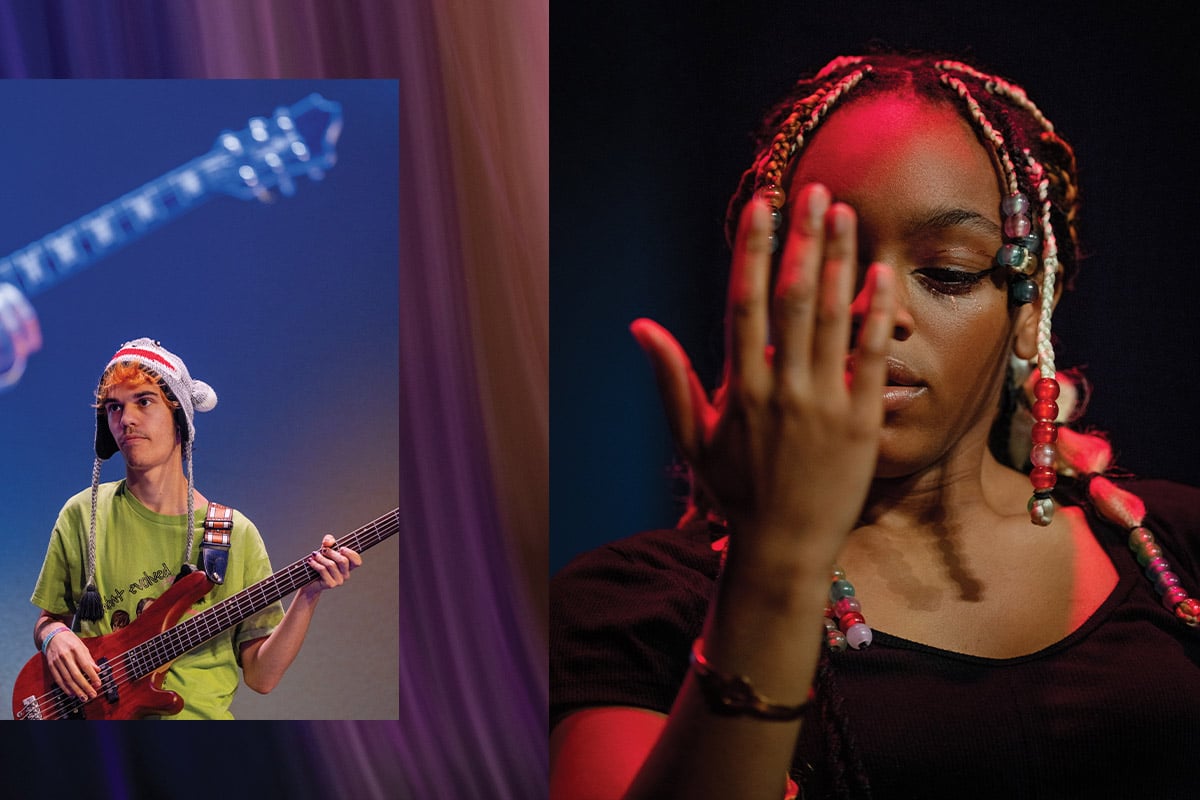
Michael Bobbitt (left) and camp coach Jessica Wornum (right).
At first, she admits, she was hesitant to join the club, uncertain whether she’d be welcomed as a Black woman. “I told Justin, we’ve got to do this,” she recalls. “We can make a difference and be members of this organization, and we should.”
Rebecca Grist, the Macon club’s 2025-26 president, admires Karla’s work with the foundation. “She’s always been somebody I’ve looked up to as a great example of how you take a legacy and make the absolute most of it,” Grist says.
Today, Karla and Justin, who joined the club in 2021, speak at other Rotary clubs in Georgia about their community endeavors. And shortly after opening the Center for the Arts last year, they hosted the Macon club’s annual spring picnic at the facility, opening the doors to their fellow Rotarians who had supported them along the way.
In Grist’s view, Karla and Justin are ideal Rotary members. “They are living out exactly what Rotarians are called to do in serving others,” she says.
It’s been nearly 60 years since Otis Redding’s death. But the conversations Karla has with locals in Macon are a frequent reminder that her father lives on in the memories of those who knew him. “I walk these streets all day, and every day somebody has a story,” Karla says. “Every single day.”

DoSharian Bowen performs his original song “I Won’t Break.”
People show her autographed items he signed back when there used to be a gas station on Mulberry Street. They recall Otis leaving his office, clearly having somewhere to be, but always willing to slow down to acknowledge a fan. Sometimes, Karla says, the people she meets don’t even realize they’re speaking with his daughter. They just want to share a fond recollection of their hometown hero with a fellow Maconite.
As the years go by, though, fewer people will have personal memories of Otis. That’s what makes the family’s work to uphold his legacy so important.
A former clothing store in Macon once owned by the Reddings is now a museum dedicated to the singer, filled with memorabilia from Zelma’s personal archives. Inside the space are capsules that display items from Otis’ personal and professional lives: a photo of him at his desk in his office, receipts for the ranch, handwritten lyrics of unreleased songs, even a briefcase recovered from the wreckage of the plane crash that killed him.
While the museum preserves the past, just down the street the Center for the Arts looks toward the future. Zelma, who at 83 remains the foundation’s president, bought the property in 2021 and donated it to the foundation. Over the next few years, the foundation raised more than $11 million to build the center on the site.

Campers come together onstage for a rollicking medley of popular hits of the past.
At the anniversary celebration in April, the center’s potential impact on the next generation is evident. As families tour the building, kids run through the halls. They’re curious, rambunctious.
In one room, Justin holds up a carbon-fiber trumpet, explaining that the design allows kids to play the instrument without worrying they’ll break it. As if on cue, a child drops a trumpet, prompting laughter.
Outside in the hall, another child jumps up and down. He calls out excitedly: “We want to come back here.”
This story originally appeared in the September 2026 issue of Rotary magazine.