A vaccine legacy
Alongside Rotary, Canada is a proud top contributor to the fight against polio. Valarie Wafer is stepping up to champion that work and shares the latest developments.
by Rotary International
1 Jul 2026District 7070 in southern Ontario has had a storied history of supporting Rotary’s polio eradication campaign. The late Dr. Ken Hobbs, of the Rotary Club of Whitby, was instrumental in the launch of the polio eradication campaign in India, and Dr. Bob Scott, of the Rotary Club of Cobourg, was the long-standing chair of the International PolioPlus Committee. “These two, honestly, were legends and change-makers,” says Valarie Wafer. And so when Wafer joined Hobbs’ club in 2005, polio naturally became top of mind for her too.
In 2012, Wafer travelled to India to participate in her first National Immunization Day. “It’s one of those memories that stays with you for a long time,” she says. It had been one year since the country had seen a case of polio. “When you’re there and you can see the sheer population and busyness of what’s going on around you, everyone felt if they could do it, the rest of the world could too.”
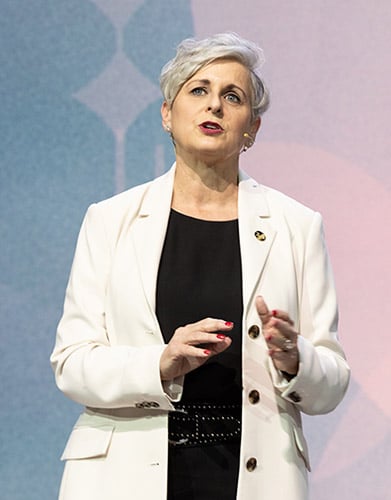
Image credit: Monika Lozinska
That’s something that continues to inspire Wafer, a past RI director and now a member of the Rotary Club of Burlington Lakeshore, as she takes on the role of co-chair of the International PolioPlus Committee this month. She will share leadership with Michael K. McGovern, who has served as chair since October 2014.
Rotary Canada talked with Wafer in April to find out more about her new role and Canada’s work to end polio. “The next year will be critical for me to build relationships with our Rotary partners and with Rotarians — the End Polio Now coordinators and every level of our volunteers,” she says.
What does the International PolioPlus Committee do and how does it intersect with the other partners in the Global Polio Eradication Initiative?
The GPEI has a number of subcommittees, and Rotary has representation on each one, whether it’s involving financial oversight, strategy, or solutions to overcome gender barriers to vaccination. But one of the main things the committee is responsible for is grants.
We meet with our partners once a year for an overall evaluation of where the program is, where the money needs to be spent, and where priorities are. We fund grants for the World Health Organization and UNICEF. Through our relationship with the Gates Foundation, Rotary raises US$50 million each year, with every dollar matched with two additional dollars from the Gates Foundation.
We approve US$150 million in grants in three segments during the year. It works like grants that Rotarians apply for: It’s given a grant number, and they have to account for every dollar and report on where the money has been spent. The grants cover things like vaccine procurement, social mobilization, operational support, outbreak response, and surveillance. After the International PolioPlus Committee, the grants go to The Rotary Foundation Trustees for final consideration and disbursement.
Updates from Valarie Wafer, the incoming co-chair of the International PolioPlus Committee
Pakistan: We’re seeing increased accessibility in certain communities and more vaccine acceptance. We’re seeing better microplanning and readiness for campaigns.
Recently, a lot of environmental [wastewater] samples are testing negative for poliovirus. There is definite hope. We know we can get this job done.
Afghanistan: There’s a ban on house-to-house immunizations and an inability of women frontline workers to participate, especially in the south. And there is ongoing conflict on the border of Afghanistan and Pakistan. Ensuring stool and environmental samples are shipped to a laboratory in a timely manner is a priority due to recent delays.
But I think that as long as we can get the job done in Pakistan, there are really positive indicators that Afghanistan will follow. Instead of doing house-to-house immunizations, they’re doing site to site. By getting the word out about the campaigns, they’re having a lot of success in drawing people to the sites to get children vaccinated. They’re being very inventive. They’re using some traditional leaders and grandmothers, who are very respected in communities and have more flexibility to approach people.
It’s decreasing as well. In 2025, we saw half the cases we saw in 2024. This year, cases are concentrated in Nigeria.
We’re seeing positive environmental samples pop up around the world. We’ve always said polio is a plane ride away. We certainly learned that concept during the COVID-19 pandemic. But finding these positive samples and being able to take steps to prevent outbreaks is positive. It means we haven’t dropped the ball. We are keeping our eye out, even in countries that haven’t seen polio for many years.
You recently visited Nigeria on behalf of the polio eradication program. Tell us about that experience.
Nigeria is accounting for almost half of this year’s cases of variant poliovirus type 2. Our mission was to address their readiness for an immunization campaign that happened right after our visit and to reinforce our partnership with the government.
They have a lot of challenges, and polio doesn’t always rise to the top of government priorities. So the integrated model of providing other things besides polio prevention — the plus in PolioPlus — really does help, things like vitamin A or diphtheria vaccines.
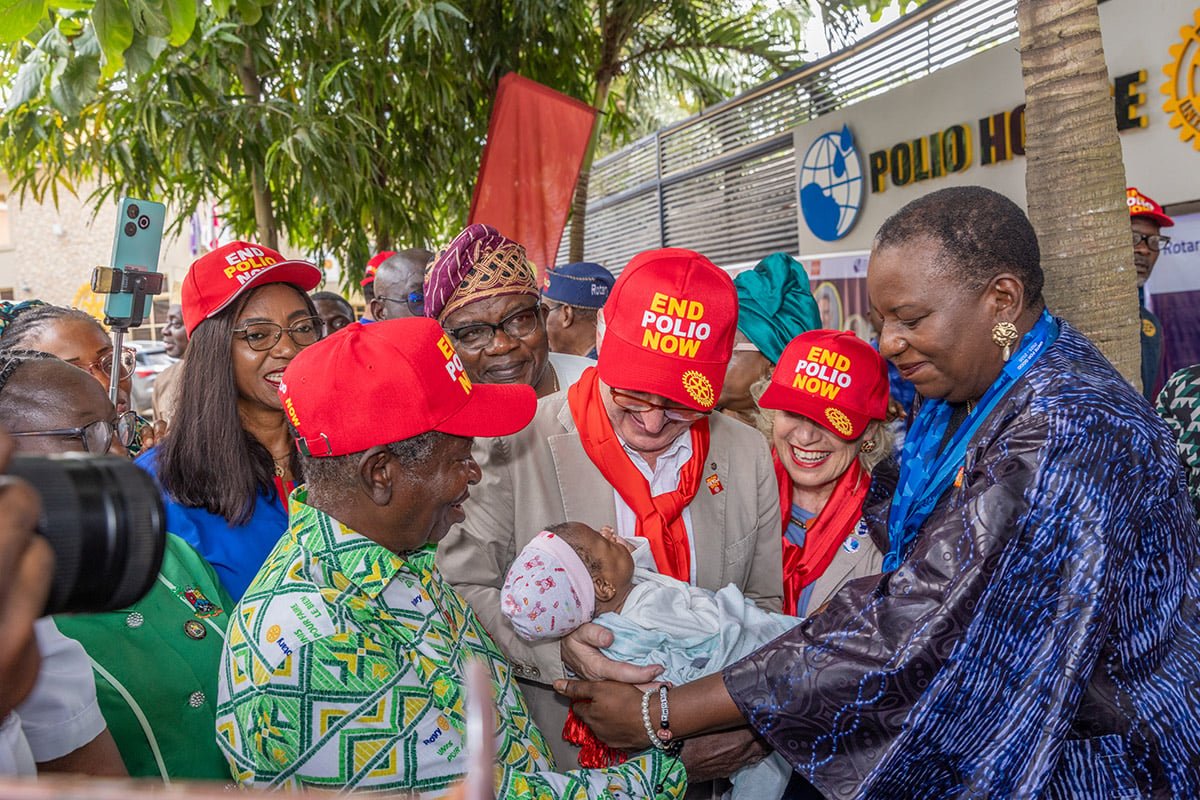
In February, Rotary leaders visited a vaccination clinic in Abuja, Nigeria. Image credit: Andrew Esiebo
I also had a chance to sit down with Rotary’s Nigeria PolioPlus Committee. The challenges are consistent in Nigeria. It’s insecurity. It’s vaccine-hesitant communities. It’s missed children and finding out why. We took a deep dive into some of the reasons and discussed where we can engage traditional leaders more. We talked about recognizing frontline workers and strengthening some of the security coordination with the government.
It was my first trip to Nigeria. I think it’s really important for my upcoming role to meet in person with a lot of people and understand some of their challenges, especially in the endemic countries and outbreak countries where we really need to get the job done.
The Canadian government has pledged more than $1 billion toward polio eradication, including a $151 million pledge in September 2024. How has polio managed to transcend partisan politics?
Canadians are very proud that we’re number four in the world of top public sector contributors to this initiative. It transcends partisan politics because polio doesn’t care about your politics or your wealth or where you live in the world.
We’ve also had a number of high-profile Canadian leaders who are polio survivors. Both former Prime Minister Paul Martin and his father, Paul Martin Sr., had polio. Paul Martin Sr. was one of the people who put polio on the government’s funding agenda — he was one of our health ministers a long time ago. Former Prime Minister Jean Chrétien was a polio survivor as well.
And I worked very closely with our 28th lieutenant governor of Ontario, David Onley, on employment for people with disabilities, one of his overarching themes in office. He was a very high-profile polio survivor because he was a TV newscaster, and at the beginning, they wanted to hide his disability. He said no, he wanted his full body shown on camera.
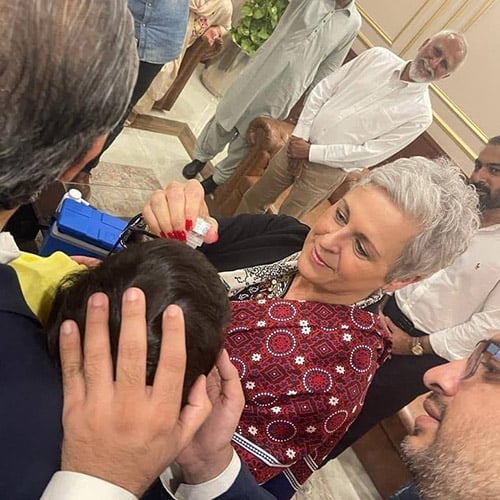
Wafer at an event in Karachi, Pakistan. Courtesy of Valarie Wafer
What kinds of outreach does Rotary do with the government to ensure ongoing support?
We have a small Canadian polio advocacy task force. We keep the relationship going across party lines all year, every year. We’re really proud of that additional donation [in 2024] that put Canada over the $1 billion mark. That was the product of engaging with our members of parliament, senators, and ministers. Rotarians are fantastic at making those connections. The polio advocacy task force can’t know all the officials across Canada, and so we reach out to our Rotarians on a regular basis. They have those personal relationships that they can reach out to at any time.
Each year, our task force goes to Ottawa and meets with Global Affairs Canada leadership, mainly in the last couple of years to express our appreciation for their investment in polio eradication.
We frequently hold a parliamentary reception in Ottawa around World Polio Day. It is well attended by MPs from the various parties. We have MPs, senators, and staff, and we share personal stories. Last year, we invited Randeep Sarai, the Canadian secretary of state for international development, and he didn’t just give a quick hello and leave. He gave us a personal story of how polio has affected his family, and his commitment. Recently, he was in Guelph, Ontario, and he met with four Rotary clubs.
We have also given the Polio Eradication Champion Award to former Prime Ministers Chrétien, Martin, Stephen Harper, and Justin Trudeau. These awards are very important so that when we want to engage in conversation, they remember who we are and that we’ve recognized their contributions.
What’s your message to Rotary members?
I would just really like to thank our Canadian Rotarians for their commitment to getting this job done. We’re not there yet, but we all have a role to play.
This story originally appeared in the July 2026 issue of Rotary Canada magazine.