From wildfires to wildflowers
A year after the LA fires, Rotary members focus on rebuilding community and optimism
by Laura Randall
1 Jul 2026A few weeks after last year’s Los Angeles wildfires, Claire Robinson got to work, not rebuilding her home but cleaning up scorched landscaping around the sheriff’s station in the hard-hit community of Altadena. Straightforward labor was Robinson’s way of coping and looking to the future. “I wanted to start making us feel better as a community as soon as possible, by cleaning up this civic area,” she recalls. “Volunteering was the only thing I felt like doing.”
More than a year later, the frames of hundreds of new homes are going up over the ashes, but that physical rebuilding is frustratingly slow and likely to take years. In the meantime, volunteers like Robinson are focused on an emotional rebuilding and holding on to a sense of community, tradition, and optimism.
She’s found plenty of like-minded neighbors, including Rotary members. For several years, the Rotary Club of Altadena has supported the nonprofit that Robinson manages, an urban conservation group called Amigos de los Rios. As the community began to recover last spring, club members presented her with a check for $2,000 to help the group continue its work, including adding green spaces to schools and watering mature trees that survived the fire.
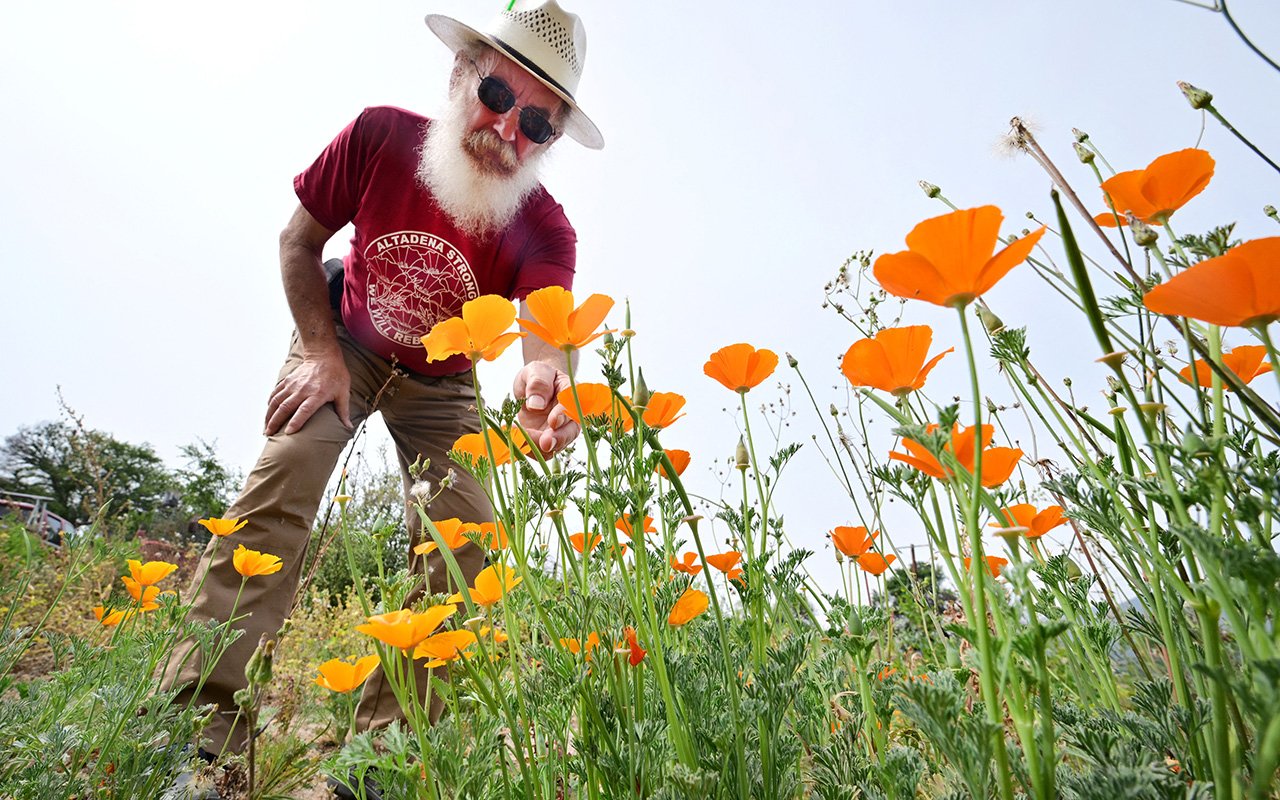
Altadena resident and Rotarian René Amy inspects the California poppies growing on the site of his former home in March, more than a year after it was destroyed in the Eaton Fire. Image credit: Frederic J. Brown/AFP via Getty Images
The club’s executive secretary, Mark Mariscal, who had also lost his home, told her, “Let’s get this in your hands right now. This is your community; this is our community,” Robinson recalls. “That meant a lot.” Now, Robinson is seeking corporate membership in the Altadena club for her employees.
Greening the burn-scarred hills is part of the real and symbolic healing here. Robinson is in the early stages of rebuilding her home, which was once filled with books and art. But the ash and debris that had covered her property have been replaced by patches of bright orange poppies and other native flowers, part of a massive seed-planting effort aimed at bringing hope and beauty to survivors. That effort, too, was led by a Rotarian who has turned personal loss into tireless service.
The Santa Ana winds tore through opposite ends of Los Angeles on 7 January 2025, reaching up to 100 mph and fueling two of the worst fires in California history. The toll is staggering: 31 dead, more than 16,000 homes and businesses destroyed, evacuation orders for at least 180,000 people, and billions of dollars in economic losses.

The worst-hit places were the Pacific Palisades and Altadena, outlying areas of LA on the edges of mountainous wilderness prone to fire. About a dozen Altadena Rotary members lost their homes, as did nearly all 13 members of the Palisades club.
Yet, members say they carry a cautious, at times joyful, optimism as they enter the next chapter of recovery. Priorities have shifted from finding shelter and distributing emergency goods to supporting small businesses and schools and organizing events to reunite dispersed residents.
The community is noticing. The Altadena club had 17 members join in the last year, bringing its total to 53, while Palisades membership has increased from 13 to 23. Not surprisingly, members cite connection and friendship as key forces. “That is one of the most beautiful things birthed out of this tragedy,” notes Jeff Lemen, a Palisades Rotary member who lost his childhood home to the fires.
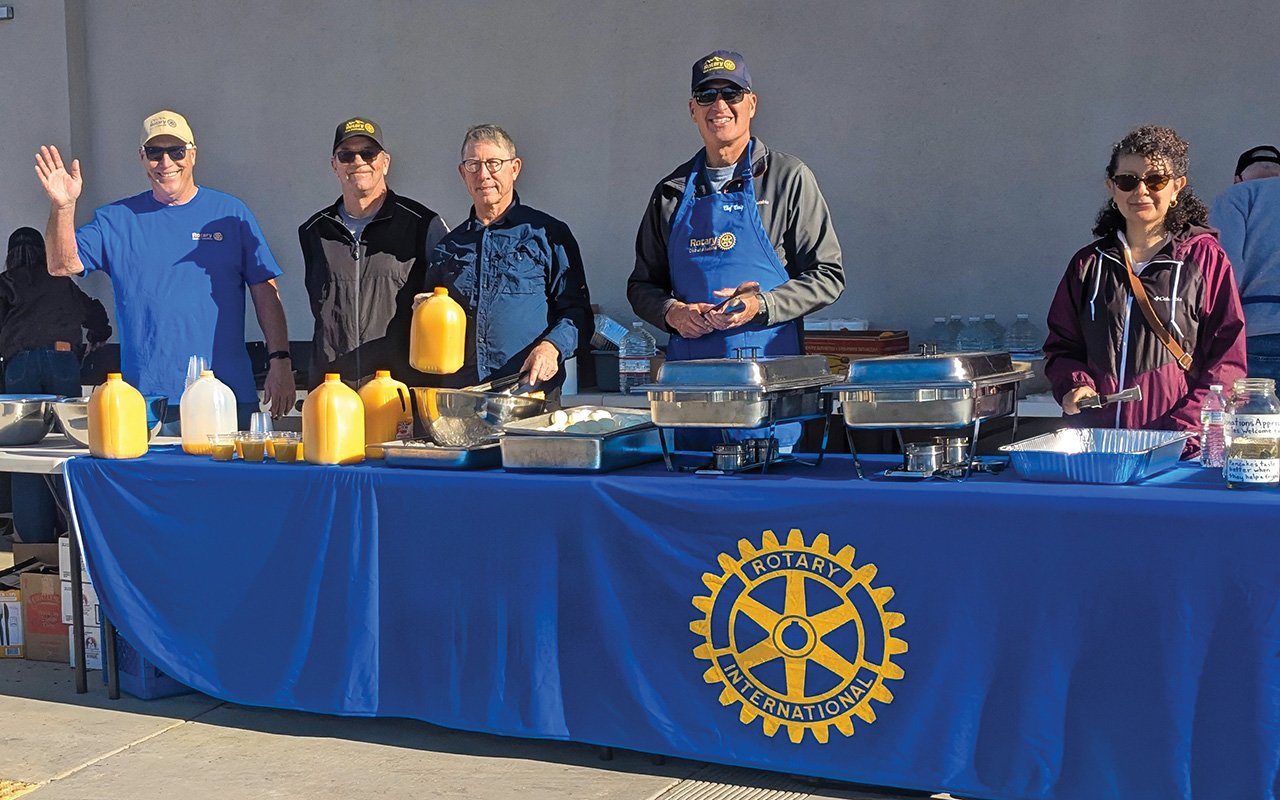
Through events like this breakfast, Rotary is seeking to reunite dispersed residents. Image credit: Laura Randall
In the Palisades, the Rotary club has prioritized support for rebuilding commercial infrastructure and schools, says Lemen. The club has committed funds to install an outdoor classroom at an elementary school and replace lunch tables and benches at a high school that had to hold classes in a former Sears building for almost a year.
In Altadena, there is a focus on returning to normalcy, says Club President Brad Roeber. When the historic outdoor amphitheater that hosted a popular series of Rotary club-led concerts burned, members made sure the shows went on last summer in another park. Rotarians from clubs all over Los Angeles showed up to help, and turnout was high and ebullient. “We made sure that the community didn’t miss out on any of this,” Roeber says.
It was that sense of community and trust that led Deb Halberstadt to join Rotary in Altadena after the fires. When she and her husband, Jon Hainer, lost their home, family and friends stepped up with generous donations, and they found themselves with more than they felt appropriate to accept given their insurance benefits. Halberstadt realized Rotary knew how to work with other groups to identify needs and get supplies like air purifiers, blankets, and mobile hot-spot devices into the right hands fast. She also found an outlet in the weekly meetings, with their exchanges of happy news and information on insurance and other relevant topics. “The group is far more powerful than any individual trying to help in a disaster situation like this,” she says. “That was a huge factor for me.”
Though the majority of Altadena and Palisades residents remained displaced, many returned for vigils on the anniversary of the fires. The Altadena event took place in the parking lot of a grocery store owned by Rotarian husband and wife Jose and Sandra Valenzuela. The store’s lot had become a distribution hub for relief supplies after the fires. Under a banner reading “Altadena Strong — We Will Rebuild,” thousands gathered to hug, sing, and share a moment of silence. “We were expecting 600. In the end, just shy of 3,000 people showed up,” Sandra Valenzuela recalls. “It was a sight to see. Nothing mattered at that moment. We were all one. We’re here for each other.”
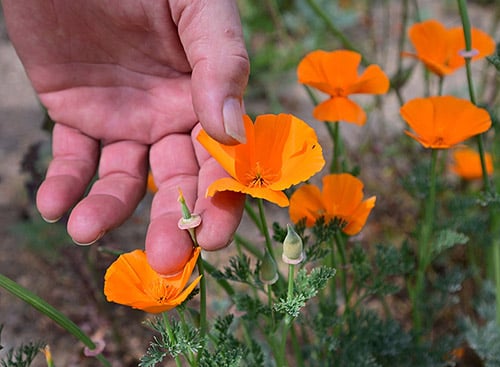
Rotarian René Amy has sown 250 million poppy seeds to bring color to this somber landscape and boost spirits. Image credit: Frederic J. Brown/AFP via Getty Images
And then came the poppies. Seeking to lift spirits and beautify the scarred landscape, Altadena club member René Amy launched an ambitious poppy-planting project last fall. A century ago, the orange state flower covered the hills of Altadena every spring. The bloom was so vast, according to Veronica Jones, a Rotarian and president of the Altadena Historical Society, that the area was known as “the Altar Cloth of San Pasqual,” the Spanish friar known for kneeling in prayer in fields of wildflowers.
Amy got the word out, and 750 individuals and businesses signed up to have their lots “poppified.” He spent a couple of months scattering 250 million seeds across Altadena in his faded red pickup truck, one of his few treasures to survive the fires. Scouts and conservation groups pitched in, while the Altadena Rotary club, businesses, and Amy himself provided funds and supplies.
On a drive through his neighborhood in early spring, Amy was thrilled to see clusters of poppies emerging in yards and on sidewalk dividers and scattered across hillsides. “As someone who lost property, I understand what all this means,” he says. “Even the slightest act of kindness makes a difference.”
A few blocks away, Halberstadt and Hainer have begun settling into their new home. Instead of undertaking a complete rebuild on their property, they opted to sell it and buy a standing home nearby. It hasn’t been easy, but they’re drawing comfort from small things like hanging art in their new home.
Gazing from the backyard at sweeping views amid sounds of hammering and construction, Hainer amends a suggestion that there is cautious optimism. “I feel outrageously optimistic,” he says.
This story originally appeared in the June 2026 issue of Rotary magazine.