A restoration plan for Texas coastal waters includes rain gardens
A Rotary‑supported restoration plan uses rain gardens to reduce pollution and help revive Texas coastal waters and vital fisheries
by Patrick Tyler
1 Jan 2026It’s one of the last expanses of wild Texas coastline, a huge area of saltwater estuaries sheltered behind a narrow landmass in the Gulf of Mexico that forms the world’s longest barrier island. One of those stretches of water, Baffin Bay, juts in from a coastal lagoon to cover 60,000 acres. Endowed by nature with high salt concentrations, these waters nurture sea grass growth and safe spawning grounds for species that underpin one of the most fertile fisheries in the U.S.
Here, the spotted sea trout and red fish are king. This fishing paradise draws anglers from all over the U.S., contributing millions of dollars a year to the coastal economy. On the commercial side, black drum fish are a pillar of an industry that puts prime fillets in restaurants near and far.
From the air, though, the problems with Baffin Bay come starkly into view. In my aging airplane I travel frequently to this corner of Texas, flying low over Baffin Bay’s waters on my final approach along the coast to Port Mansfield, 50 miles to the south, near the border with Mexico. Algae blooms, including one in the 1990s believed to have been the longest ever recorded anywhere — it lasted a staggering seven years — cloud the water to a chocolate milk-like density, preventing sunlight from reaching the seabed grasses. Those grasses serve as the lungs of the food chain, and without them, Baffin Bay in recent decades has suffered from extensive fish kills, species depletion, and other alarming symptoms of environmental distress.
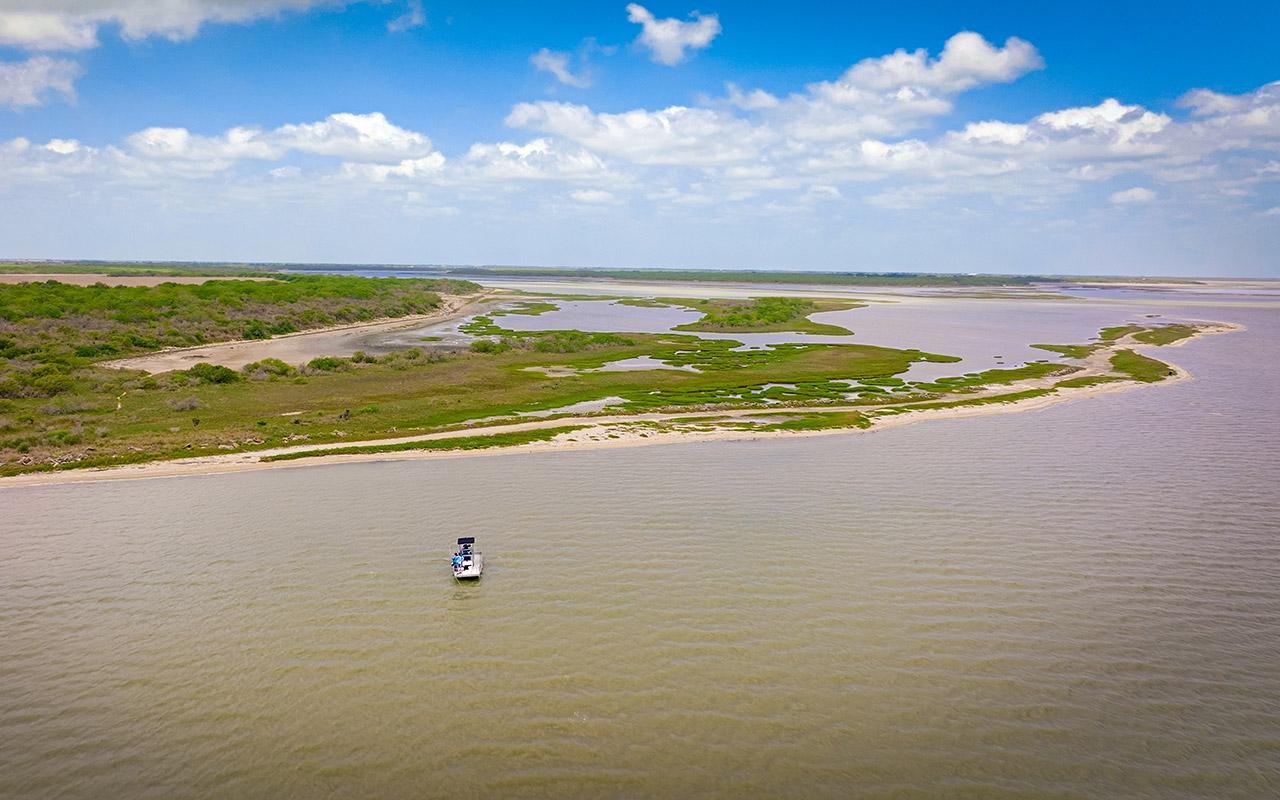
Images credit: Courtesy of Harte Research Institute
“All of a sudden we started seeing brown tide and for as long as two years at a time, the visibility would have been less than 6 inches in the water,” says Jim Scoggins, a lifelong fisherman on Baffin Bay. Years ago he could dip his fishing rod into the bay and see the gold-plated lure at the tip of the rod 7 feet down. “It was that clear,” he says.
The source of the bay’s troubles lies inland with stormwater that picks up nutrients in the fertilizers and manure from farms and the region’s sprawling cattle ranches — food for algae blooms. Contaminants also come from the small towns popping up along U.S. Route 77, and the bustling city of Kingsville.
The fragile watershed is also home to busy corridors of migratory birds and butterflies and rich ecosystems of native plant life. Those plants, it turns out, may be one small part of the solution to these woes.
Efforts to restore Baffin Bay began more than a decade ago when commercial fishers, recreational anglers, guides, other business owners, and scientists came together to voice concerns about the degradation. Volunteers then embarked on a citizen science initiative to test water quality and help identify the sources of pollution.
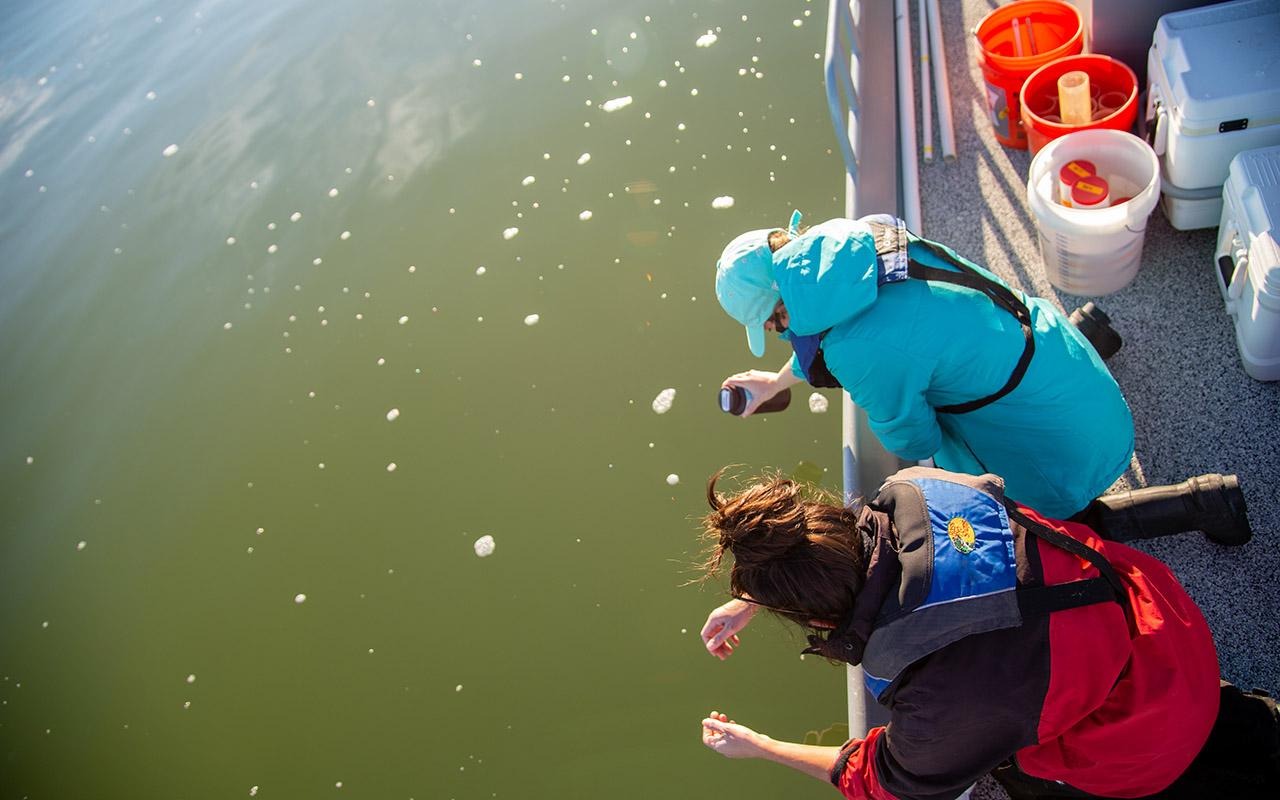
Researchers collect water samples in Baffin Bay. Rigorous monitoring, including by citizen scientists, has helped identify possible sources of pollution.
Courtesy of Harte Research Institute
The findings led to a formal watershed protection plan in 2022 and the birth of the Bringing Baffin Back initiative. The plan’s solutions include large-scale infrastructure projects such as replacing failing wastewater treatment plants and aging septic tanks, which can contribute to significant bacteria and nutrient loading in the watershed. But it also looks to nature itself as an antidote. It calls for protecting and restoring wetlands to filter water naturally and for educating landowners on beneficial soils and vegetation in riparian, or transitional, zones to act as a protective barrier between developed land and bodies of water.
Going a step further, the plan encourages smaller efforts that, if scaled up, could have a real impact too. One of those initiatives is led by a highly motivated schoolteacher with help from the Rotary Club of Corpus Christi.
Rosana Ryan, a science teacher in the small town of Sarita, 40 miles south of Corpus Christi, has spent her career trying to get her students outdoors, away from computer screens and other distractions, to engage with the world they live in. She built an outdoor classroom where her kids could plant, feed, and harvest flowers and vegetables. The students collect and measure weather data, especially important along this hurricane coast. And now they have begun to study pollution-control measures, namely something known as rain gardens.
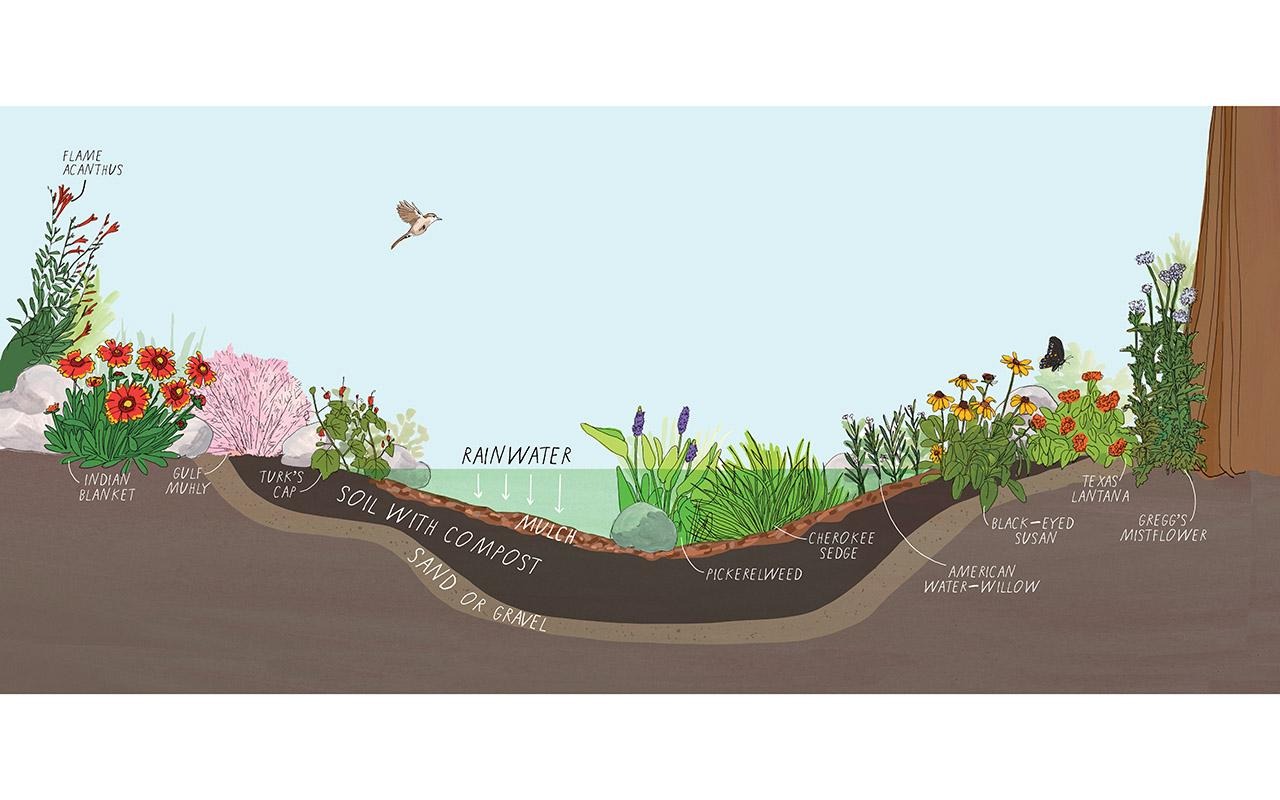
Illustration by Julia Rothman
Rain gardens are made by digging out shallow depressions and lining them with permeable soil and deep-rooted native plantings. Located strategically, they can channel water running off rooftops, parking lots, and streets before it enters waterways. By mimicking patches of meadow or forest, rain gardens can absorb around 30 percent more runoff than a typical lawn, helping prevent flooding.
Spread throughout a watershed, such projects can have a measurable impact. Contaminants picked up by urban and agricultural runoff are the leading cause of water pollution in the United States, according to the U.S. Environmental Protection Agency. Rain gardens can filter out 90 percent of those chemicals and 80 percent of sediments before returning stormwater deeper into the soil where it can recharge groundwater. One more bonus: Rain gardens create habitat for birds and pollinators.
When Ryan learned of the idea, she was fully on board. “I have always been very receptive to any project that will engage my students,” she says. The principal at her school, Kristen Tinsley, apparently feels the same way because the two of them welcomed a construction crew in October 2024 to begin excavations in the schoolyard for the Sarita Elementary Rain Garden.
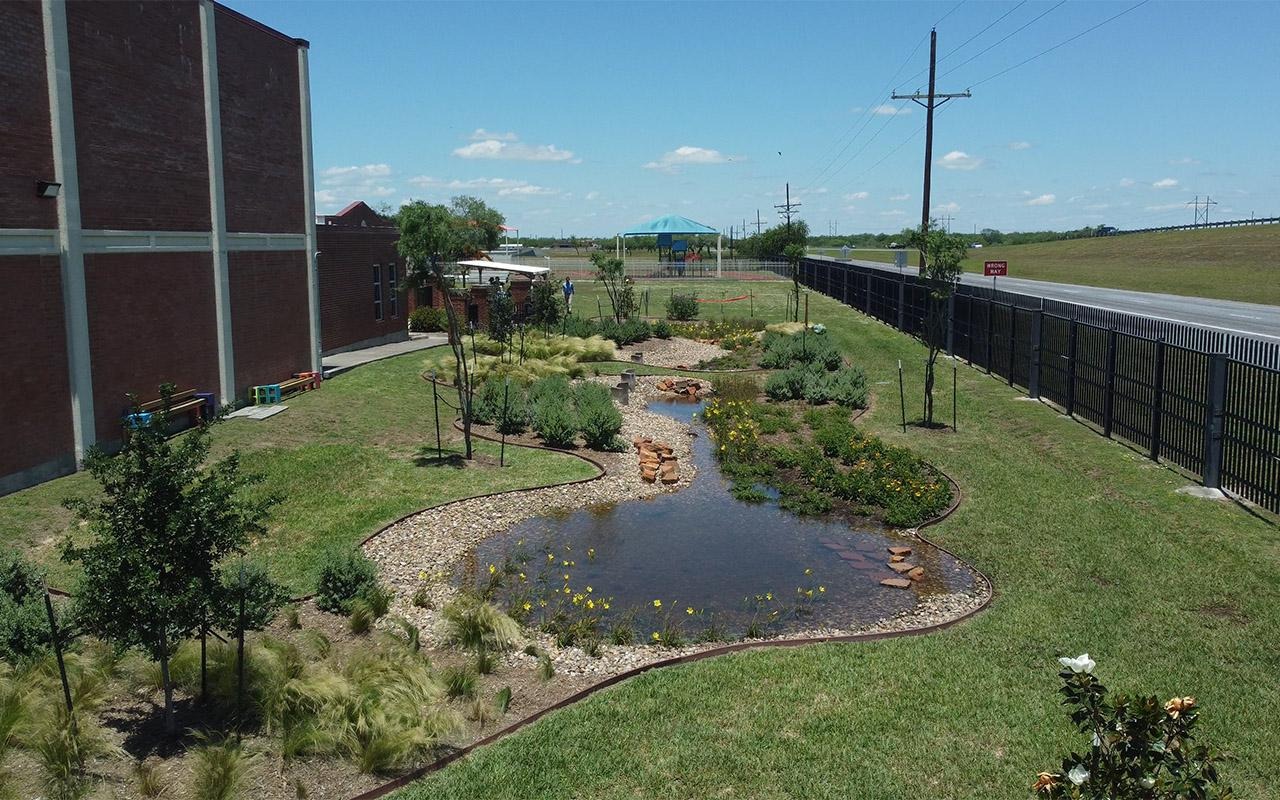
Courtesy of Coastal Bend Bays & Estuaries Program
Rotary members from the Corpus Christi club pitched in and happily got their hands dirty planting the educational tools they hope can be scaled up in the fight to save Baffin Bay. Aided by $90,000 in funding from a Rotary Foundation global grant, they cut the ribbon in May 2025 on the first rain garden in the watershed designed to become a teaching model for South Texas communities.
Baffin Bay, the folklore says, takes its name from the much larger Baffin Bay on the west coast of Greenland that’s named for William Baffin, a British explorer. It is said that a young sea captain named Mifflin Kenedy sailed the Baffin Bay waters in the Arctic during his youth in the mid-1800s. Later settling in Texas, he built a ranching empire in partnership with Richard King of the famed King Ranch, the largest in the U.S. Somehow, the Baffin Bay name came with him.
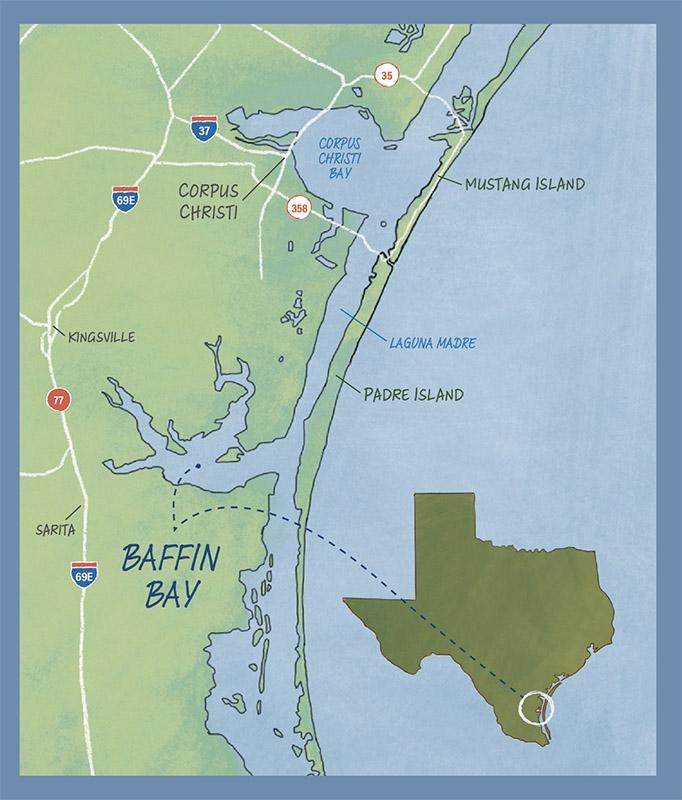
Illustration by Madison Wisse
The area, then known as the Wild Horse Desert for its once vast herds of mustangs, was one of the first battlegrounds of the Mexican-American War in 1846. During the Civil War, it became an economic lifeline for the Confederacy, whose cotton farmers hauled their product through the area to Mexico to trade for gold and weaponry from British entrepreneurs.
Over time, that frontier once crisscrossed by Native Americans, Spanish explorers, and Mexicans gave way to powerful ranching empires. The city of Kingsville grew up about 10 miles inland from the bay. The railroad came, some industry, and a U.S. Navy aviation training station. At its height in the 1970s and ’80s, the city was home to some 30,000 people. Today, it remains the most sizable population center in the area, though smaller communities, too, like Sarita and Riviera benefit from the influx of seasonal residents, anglers, and a large Border Patrol station off Highway 77.
Not far from these settlements, though, when you step with fishing pole in hand into the shallows where Baffin Bay meets the Laguna Madre, the world unfolds as an endless and pristine waterscape out to the shoals of Padre Island, the great barrier whose sand dunes protect the lower Texas coast. It is tempting to just stand there and marvel at the scale and the majesty of it all.
Today, the area is a major draw for its world-class fishing, as well as birding and beachcombing, particularly along Padre Island National Seashore and its 66 miles of coastline, one of the last intact coastal prairie habitats in the country. Fishing for business and for sport contributes around $75 million annually to the local economy.
“To put it mildly, Baffin Bay is a national treasure,” says Scoggins, the fisherman. “It’s not just a bay; it’s a national treasure and people have got to start realizing that.”
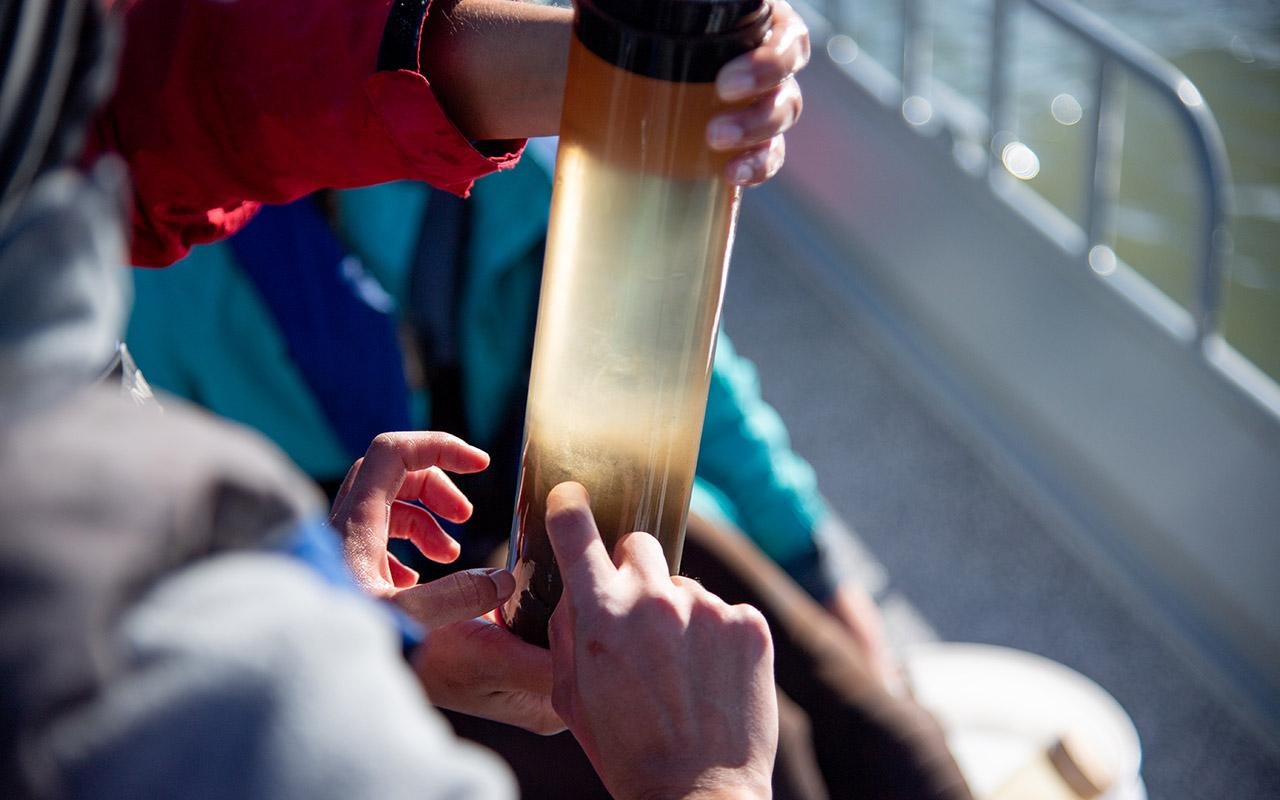
Researchers collect sediment cores. Their findings are guiding efforts to reduce pollution loading throughout the watershed.
Courtesy of Harte Research Institute
The science of what is happening is not complex. Stormwater is commonly full of contaminants that can damage fragile ecosystems. These include high concentrations of nutrients like nitrogen, phosphorus, and ammonia, which are found in chemical fertilizers and undertreated sewage. These nutrients supercharge the growth of algae, browning the water and blocking sunlight from reaching the seabed, threatening the vast landscapes of grasses that support the tiny shrimp and clams that feed the large fish species.
Net surveys of black drum fish show periods of starvation during and after algae blooms, rendering the commercial species inedible and therefore unsellable at times. Locals even started calling black drum “jellyfish” because of their malnourished, softened flesh.
Professor Michael Wetz, a marine biologist at the Harte Research Institute at Texas A&M University-Corpus Christi, has spent more than a dozen years mapping and measuring the decline of Baffin Bay while also helping to organize a group of interested parties that includes students, fishers, environmental advocates, educators, area government officials and, now, Rotary members. Their Bringing Baffin Back campaign, loosely modeled on the rescue efforts in Florida to restore Tampa Bay, has helped to organize the community coalition to develop pollution reduction strategies for municipalities, homeowners, industry, and agriculture.
Rotary members brought to the table their extensive network of clubs and partners, pulling together the final threads for the project’s global grant funding. Their work also led to the discovery of the rain garden’s enthusiastic hosts at Sarita Elementary, most notably Rosana Ryan, the science teacher.
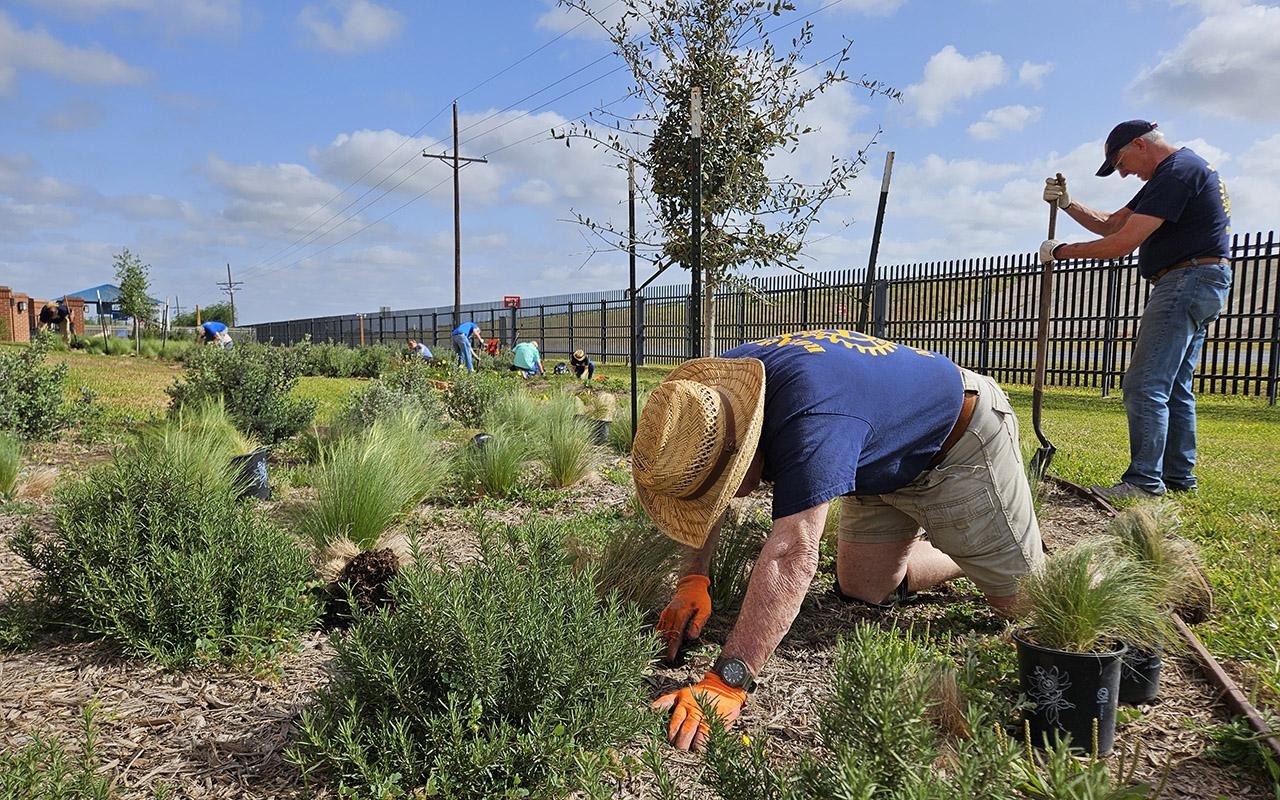
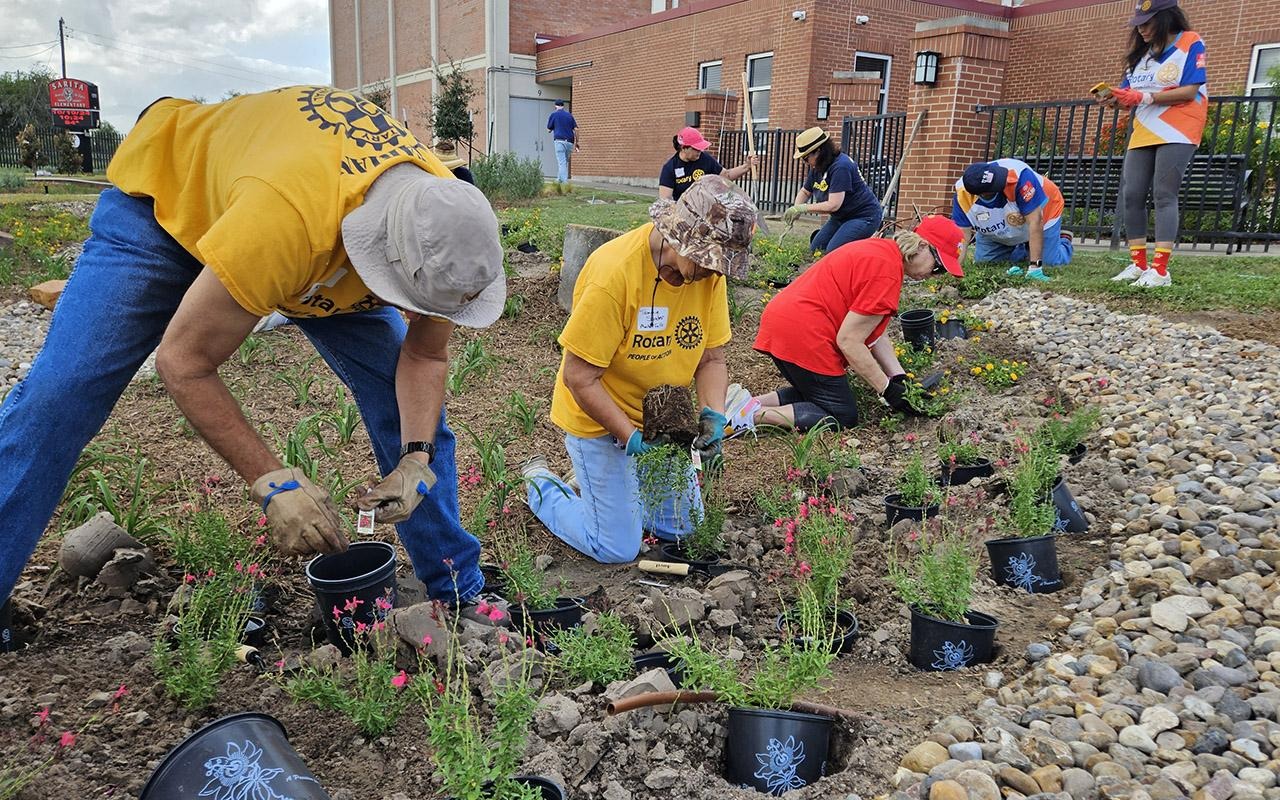
Rotary members from Corpus Christi and other clubs happily get their hands dirty planting the rain garden at Sarita Elementary School.
Courtesy of Coastal Bend Bays & Estuaries Program
One organization Rotary brought on board is the Coastal Bend Bays and Estuaries Program, whose environmental education staff is already organizing teacher and student field trips to Sarita for close-up inspections of the rain garden approach. With Rotary funding, workshops for elementary and high school teachers will bolster environmental education up and down the Gulf Coast.
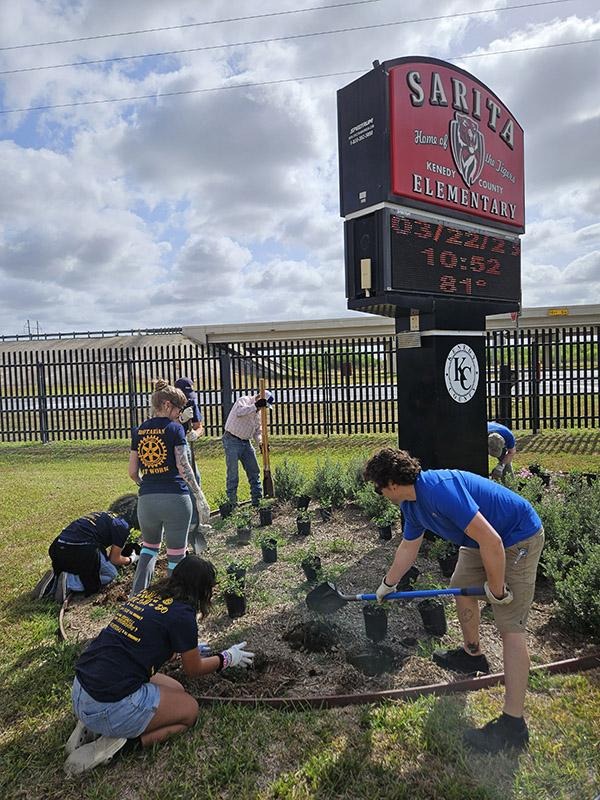
Courtesy of Coastal Bend Bays & Estuaries Program
Adrien Hilmy, a Coastal Bend project manager, knew of Ryan’s zeal for science. Rotary members were equally impressed. Together, they briefed school officials on the scope and scale of the educational opportunity that the Rotary grant would make possible. Ryan and the school principal, Kristen Tinsley, who is also the superintendent of the Kenedy County school district, agreed.
“Teaching expands the views of students about the water cycles on Earth — shortages and droughts, the effects of heat sources on water in the formation of hurricanes,” says Hilmy. Organizers hope students will take from this project that “you’ve got to have a system in place” to manage stormwater and protect water quality.
“The main challenge of the Baffin Bay area,” Hilmy says, “is that no single project is going to solve the problem. Rain gardens are a relatively low cost means to treat water at the source. Their trees, bushes, and other plants absorb excess water through their extensive root systems. This is a replicable approach: small scale projects repeated over and over again throughout a watershed.”
The Corpus Christi Rotary club was fortunate to have Arthur Zeitler, a past district governor but also a lawyer and past regional Rotary Foundation coordinator. While the club had been funding other people’s conservation projects for years, the rain garden project took its 200-plus members into new territory.
A few years earlier, the club had joined the lobbying effort inside Rotary to establish an environmental protection category for Foundation funding. After The Rotary Foundation Trustees formally adopted the environment as an area of focus in 2020, Zeitler helped his club take advantage of the new opportunity. “The consensus that was building was that we needed to be more involved in the environment with larger, hands-on projects,” he says.
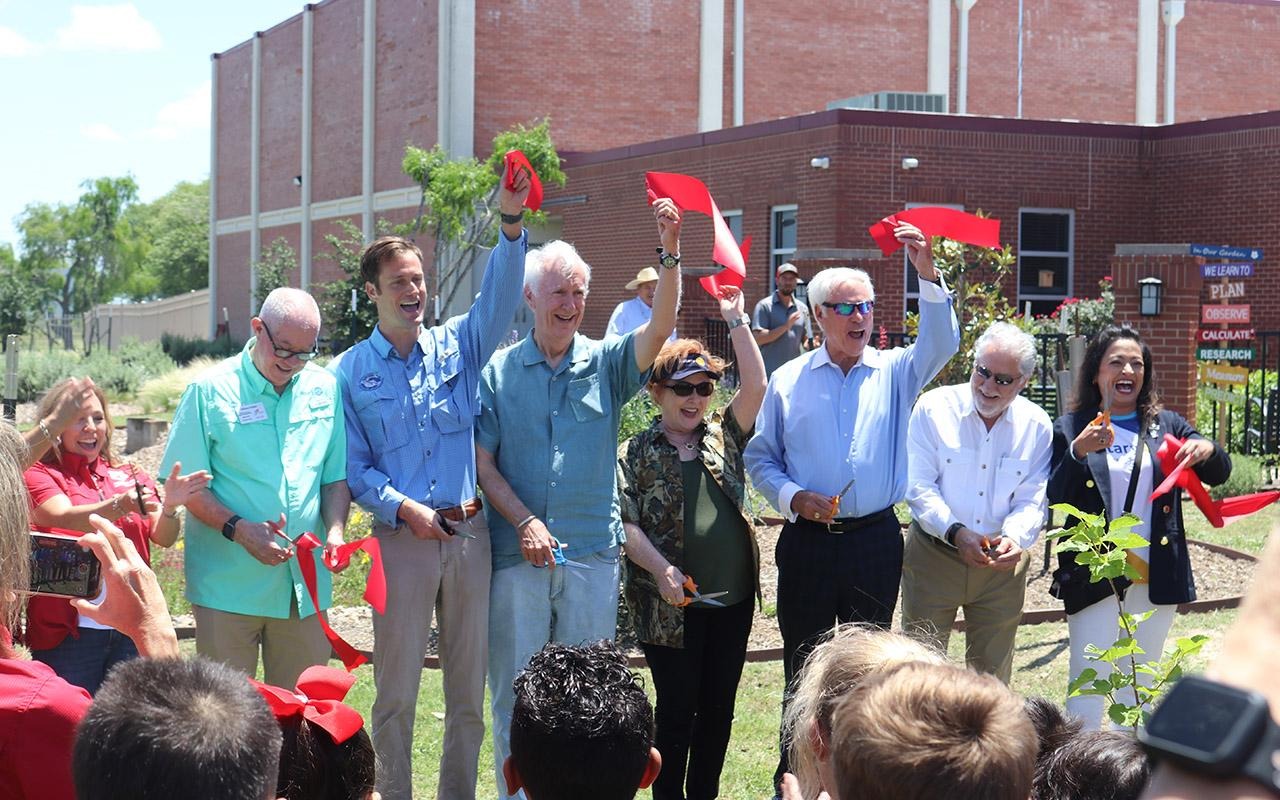
Aided by a Rotary Foundation global grant, members cut the ribbon in May 2025 on the first rain garden in the watershed, designed to become a teaching model.
Courtesy of Coastal Bend Bays & Estuaries Program
Zeitler knew the grant process and, after a brief search, he contacted the Rotary Club of Los Altos Quetzaltenango in southwestern Guatemala to become the international partner. The two clubs had in the past supported school and water system improvements in Guatemala. Other funding came from clubs and districts across Texas and from districts elsewhere in North America.
After securing the $90,000 grant, the work began at Sarita Elementary to design a rain garden that could be carved into the school’s campus on Highway 77, the main north-south artery along the coast.
Though the Corpus Christi club had cleaned up beaches, planted trees, and supported many conservation projects, it had never organized a multinational Rotary project of this size so close to home. Its members speak with pride about donning their wellies, grabbing their shovels, and getting their hands dirty giving life to the Sarita rain garden. “The club members thought it was a great idea and jumped right on it,” says Marge DeWitt-Crocker, a recent past president.
“We are very proud to be involved in this project,” adds Zeitler. “Our rain garden prototype is the first one in our watershed.” And, importantly, it requires a “shift in the philosophy” of real estate developers and building code managers to modify how they plan for and manage stormwater runoff in a manner that protects streams, rivers, lakes, and bays. Rain gardens are relatively easy to incorporate in new developments and can be added to the yards of homes, businesses, and city property. A backyard rain garden can cost as little as $5 to $30 per square foot, add to property value, prevent flooding, and lower water bills. Already, one teacher workshop has been held and two smaller rain gardens sponsored by others are planned at area schools, Zeitler says.
Courtesy of Coastal Bend Bays & Estuaries Program
Hilmy from the Coastal Bend Bays and Estuaries Program says the challenge for advocates has been to avoid laying blame or engaging in rancorous debate about who is responsible for the decline of Baffin Bay and instead rely on positive messaging that will draw all parties into a collaboration to bring Baffin back. “The goal is making incremental improvements across all sectors,” Hilmy says. So far, there’s strong community support for that.
Beyond the big concepts, this project was personal for the 47 Rotary volunteers from seven clubs who showed up in Sarita to plant purple sage, lantana, black-eyed Susan, and other native south Texas plants. Some of them drove more than 200 miles to participate. Interest was so high they had to introduce a waiting list. DeWitt-Crocker points to the excitement of a project with both educational and environmental impact: “Restoring nature and inspiring young minds is what this project is all about.”
This story originally appeared in the January 2026 issue of Rotary magazine.