Museum worthy
From the iron lung to gene sequencing, a new Rotarian learns about polio’s scientific legacy
by Erin Gartner
11 Nov 2026It’s an arresting sight. In a corner of a museum stands a child-sized iron lung, one of the imposing steel cylinders that at the peak of the polio epidemics of the 1940s and ’50s encased paralyzed children up to their necks and forced air into their lungs. They have been described ominously as coffin-like, but they were a miraculous technology, keeping thousands of children breathing with a mechanical whoosh until, in the best case, the tiny patients regained enough strength in their chest muscles to breathe on their own.
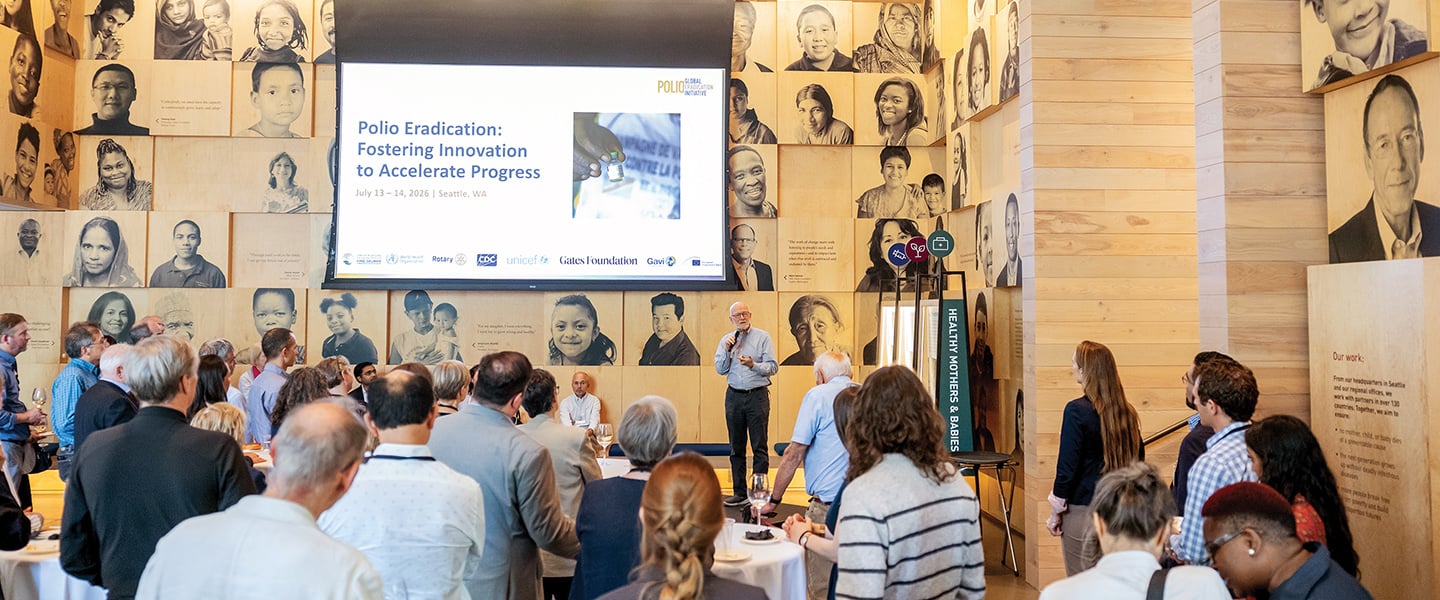
The machine — now a relic of a nearly forgotten era before polio vaccines — was part of a unique exhibit this summer at the Gates Foundation Discovery Center in Seattle. Titled the Museum of a Polio-Free World, the displays offered a look at the science and innovation that have brought the world to the brink of eliminating a disease that once paralyzed 350,000 people a year.
Rotary and its partners, including the Gates Foundation, have reduced polio cases by 99.9 percent, and the exhibit offered a glimpse into a future in which polio is nothing but a memory preserved in museums and history books.
As a relatively new Rotary member, I was eager to visit and learn more about this legacy. I know little about the disease, which was eradicated in the United States in 1979, the year I was born. My only real exposure has been through textbooks and Hollywood movies. In other parts of the world, though, it’s not a distant memory at all. Wild polio remains endemic in two countries — Pakistan and Afghanistan — where bringing vaccines to children is still a challenge.
I’m lucky to be visiting the exhibit in July, as about 90 scientists and global health experts are here for a conference on what’s next in polio eradication, allowing me to pull experts aside for explanations. As I weave among them, one of the newest technologies on display catches my eye: microneedle array patches. Placed on a person’s body, the patches use hundreds to thousands of tiny projections to painlessly deliver a drug or vaccine just beneath the skin. They aren’t yet being used for polio vaccines, but their potential is clear.
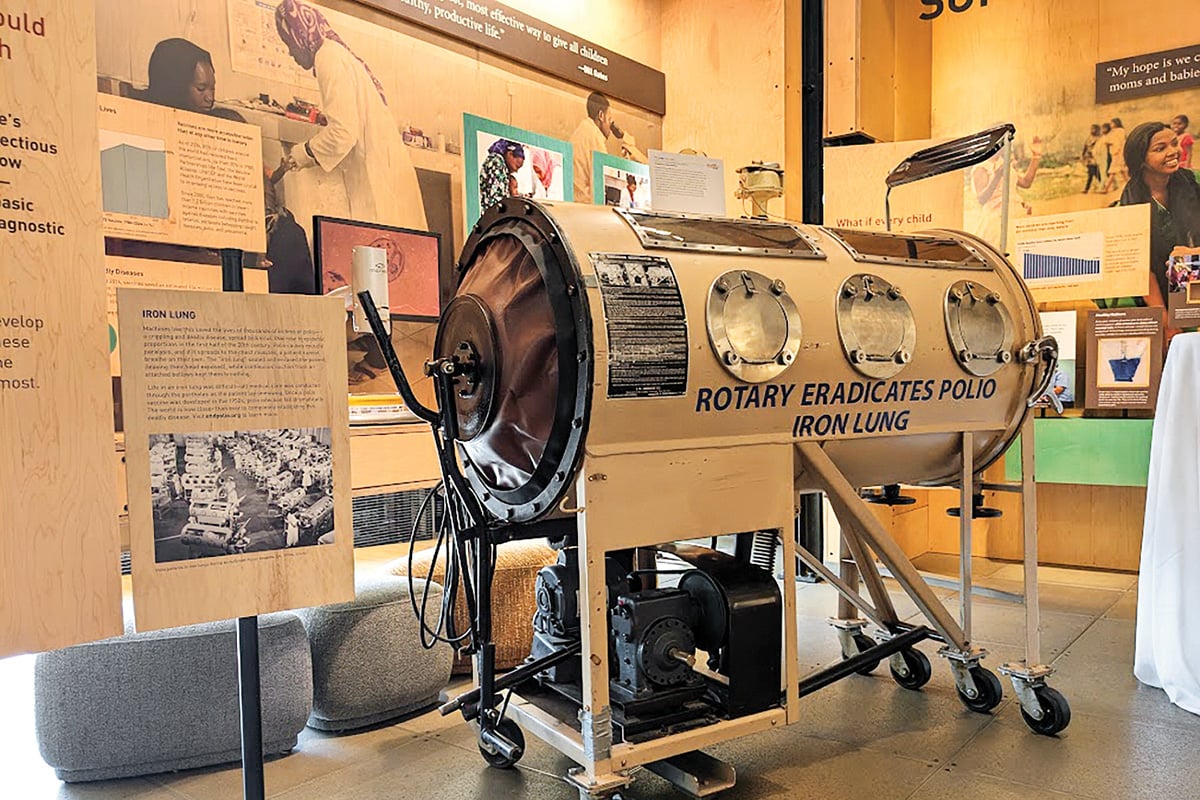
An iron lung is among items on display at the Gates Foundation Discovery Center.
Image credit: Erin Gartner
To learn more, I track down Kristen Earle, a senior program officer in vaccine development at the Gates Foundation. She’s involved in the clinical testing of the patches for measles and rubella vaccines in Gambia. The patches’ microscopic projections are made of or coated with a dried form of the vaccine. Those microneedles painlessly pierce the outer layer of the skin, delivering the vaccine directly to immune cells underneath. “They look like little Band-Aids, with a small button on the back that goes into the skin,” Earle says. “Any vaccines that are dry are more stable — they’re a powder.”
As a result, Earle says, the patches can go without refrigeration for at least three days, a major advantage over other types of vaccines. “What that means, potentially,” she says, “is that a healthcare worker could put the patches in a backpack and hop on a motorbike to travel to a remote village.”
As I wander the exhibit, I wonder what it’s like for longtime researchers to see decades of advancements all in one place. “It’s a miracle, really,” says Dr. Walt Orenstein, a past director of the U.S. National Immunization Program at the Centers for Disease Control and Prevention. “People don’t understand how terrible a disease polio is.”
Orenstein, who also worked as a polio eradication expert at the Gates Foundation, says he clearly remembers getting his polio vaccination as a child in 1955, when the shots first became available. For him and others with a living memory of the disease, completing the difficult “last mile” of eradication carries a personal dimension.
“The final mile of eradication demands continual innovation,” says Dr. Ann Marie Kimball, a former senior program officer for epidemiology and surveillance at the Gates Foundation. “Science has brought millions of children to the threshold of a polio-free world, and science will help us cross the finish line.”
Kimball, here today as Rotary’s representative to the assembled members of the Polio Research Committee that provides guidance to the Global Polio Eradication Initiative, is a member of the Rotary Club of Bainbridge Island, just west of Seattle. In her keynote address, she stresses the importance of Rotary clubs worldwide. “We have over a hundred clubs in Pakistan,” Kimball notes. “Those clubs have partnered with clubs around the world to bring safe water to Pakistan — a key component in polio eradication.”
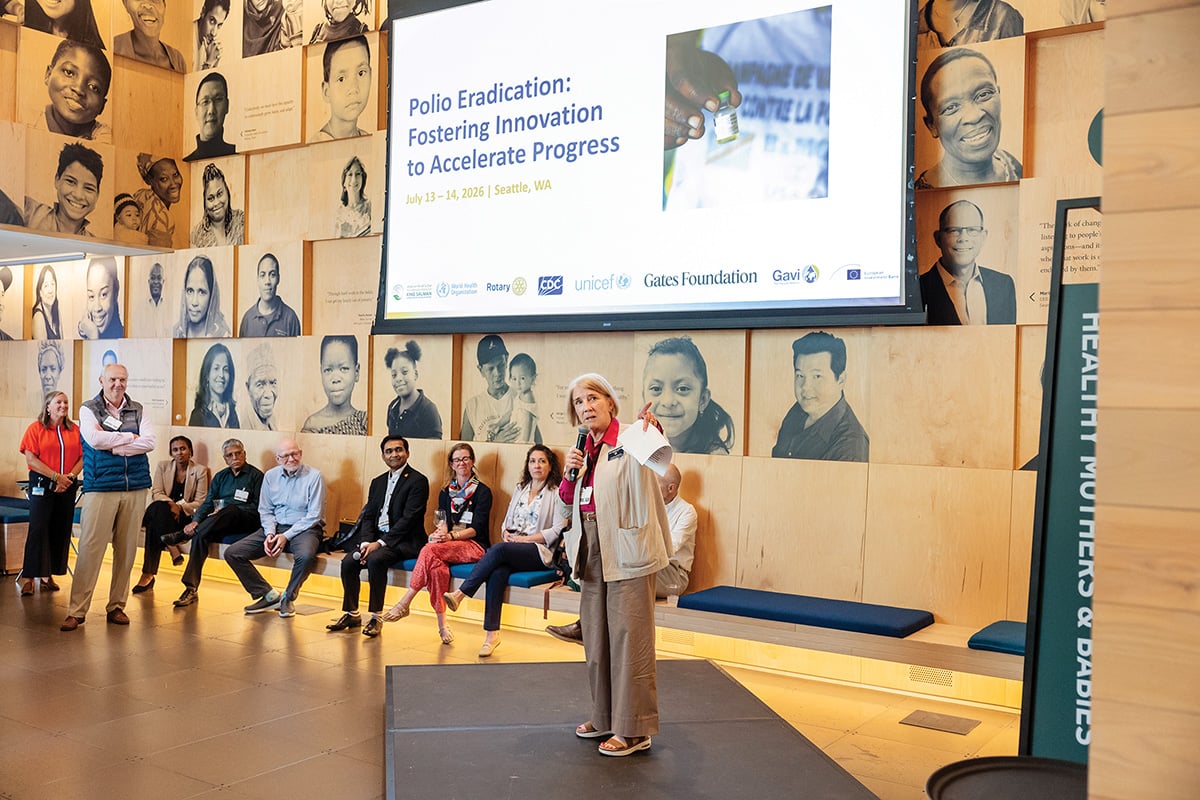
Rotarian Ann Marie Kimball, a former senior program officer for epidemiology and surveillance at the Gates Foundation, addresses the conference.
Courtesy of the Gates Foundation
In addition to the wild polio found in Afghanistan and Pakistan, outbreaks of variant poliovirus still occur, particularly in parts of Africa. Those outbreaks are caused by low immunization rates that leave some people vulnerable as the weakened form of the virus in oral vaccines is shed in the environment and, in rare instances, circulates long enough to become dangerous.
One of the technologies on display in the exhibit is reducing those variant outbreaks — a next-generation version of the oral vaccine in which the weakened virus is left more genetically stable and less likely to revert to a dangerous form even when it circulates over time in areas of lower protection.
Behind the scenes, disease surveillance is another area of innovation that will be key to closing the last mile and guarding hard-won gains — and not just in laboratories far from the front lines. One of those innovations is on display here. Sitting on a table draped in white linen, the device looks like a misplaced TV remote. “It’s like a little lab,” explains Isobel Blake, an infectious disease epidemiologist at Imperial College London.
Using a process called direct molecular detection and nanopore sequencing, the portable sequencing kit identifies poliovirus genetic material in stool samples. It is far faster than traditional methods in which samples have to be sent to one of a handful of labs to grow the virus in a cell culture, which can take several weeks. “If you can shave off two weeks, that has a huge impact,” Blake says. “And it’s very scalable. We’re still learning about it, but it has the potential to transform the program.”
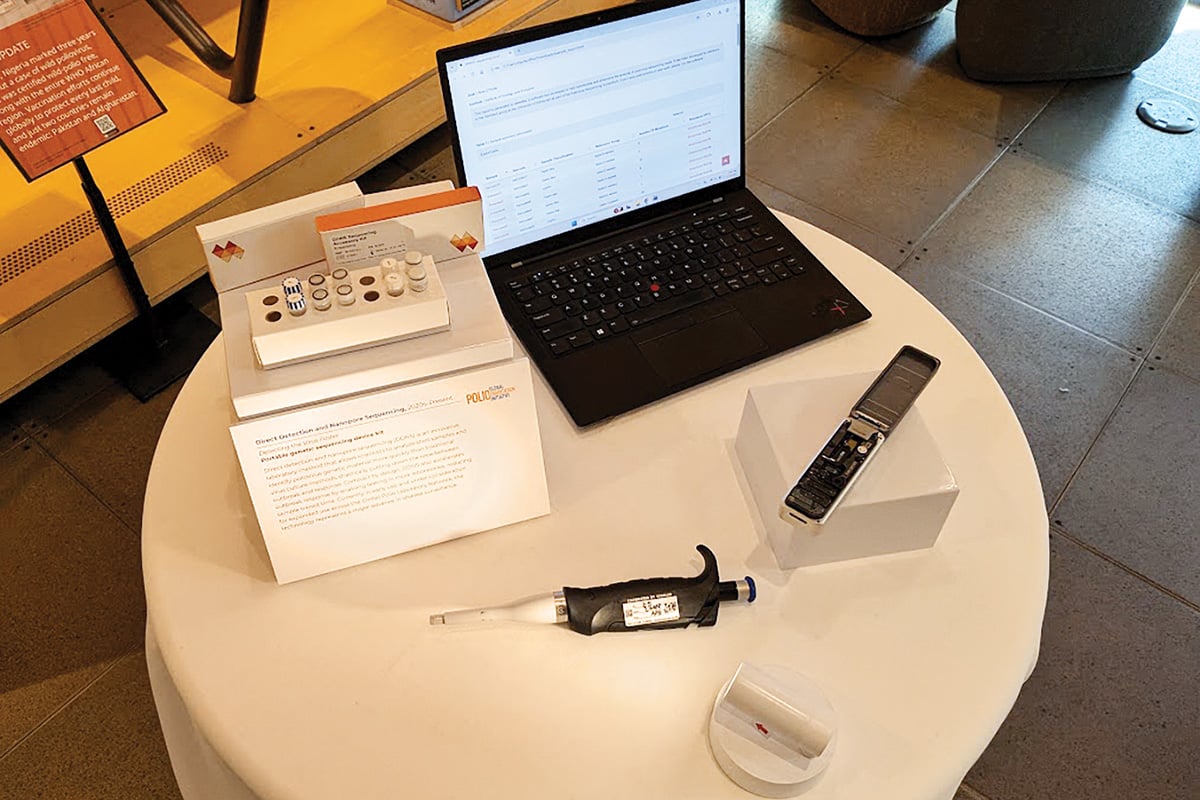
A portable sequencing kit can identify poliovirus genetic material in stool samples far faster than traditional methods.
Image credit: Erin Gartner
Armed with that quick information about the type and origin of the sampled virus, disease detectives can then help mount a quicker and more targeted outbreak response. It’s got other benefits beyond polio. “We are using similar targeted sequencing approaches to detect other viruses in wastewater, including vaccine-preventable diseases and viruses with pandemic potential,” says Nicholas Grassly, one of Blake’s colleagues at Imperial College London’s Department of Infectious Disease Epidemiology.
Prevention can be a hard sell, Orenstein acknowledges, as that work is largely invisible. Exhibits like this one, though, remind people of what’s at stake. After all, most people, including me, have never met anyone with polio. My only experience, as a journalist, was writing an obituary in the late 2000s for Martha Mason, a North Carolina woman who was paralyzed by polio at age 11 and lived most of the next six decades confined to an 800-pound, 7-foot iron lung.
In front of the iron lung displayed in Seattle is a black-and-white photo taken in 1953 at the height of the polio epidemic in the United States. Rows of iron lungs encase sick children lying on their backs. Some tilt their heads to look at the photographer, while others gaze into the small mirrors perched above their faces so they can see around them.
Technology has brought us a long way, but getting to the finish line will require determination and action. “Vaccines don’t save lives,” Orenstein emphasizes. “Vaccinations do.”
This story appears in the November 2026 issue of Rotary magazine.