Blood brothers
After the loss of a friend, I made it my mission to become a regular blood donor
by Bill Martin
24 Nov 2026Chris looked healthy. A former gymnast, he remained active for decades, playing on multiple sports teams and running in 5Ks, until two heart attacks changed everything. Doctors scheduled his potentially lifesaving heart surgery, but the operation never happened.
Chris was ready. The operating room was ready. The surgeons were ready. Blood was available — but the platelets were not.
Transfusions of platelets, cells in the blood that form clots, are essential for trauma care, many types of cancer treatment, and heart surgeries, where they prevent and stop bleeding. But they have a shelf life of only a few days, making shortages both common and difficult to overcome.
Chris’ surgery was postponed; he waited for days and spent his 64th birthday in the hospital. Before platelets arrived, he suffered a third — and fatal — heart attack. He never received the surgery that might have saved his life. Chris left behind a wife and a son in college, whom he didn’t get to see earn his engineering degree. His death was not from a knife, gunshot, fire, or car accident; it was from a lack of platelets.
Until Chris’ death, in 2022, blood donation had always seemed to me like a nice thing to do if a little abstract. Afterward, I understood it as something people could die without. By becoming a platelet donor, I finally understood the meaning of Rotary’s motto, Service Above Self.
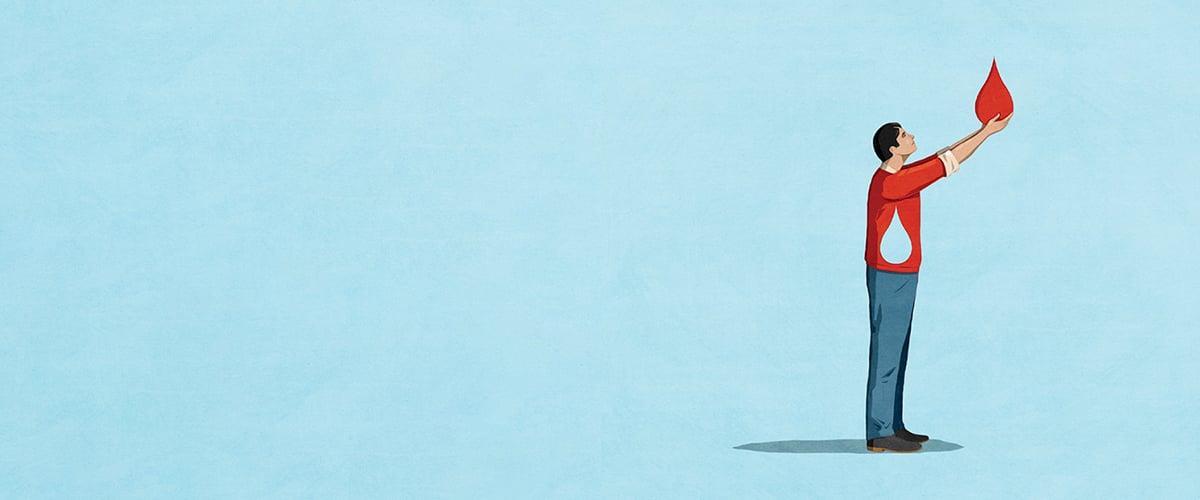
Illustrations by Andrea Ucini
For weeks, I found myself wondering whether someone, somewhere, had simply been too busy to donate that week. I wasn’t angry at anyone. Before Chris died, I hadn’t understood the consequences either. It finally became obvious. One accident victim, one person in need of heart surgery, one leukemia patient — each could require multiple donors. Blood disappears much faster than most people realize. Suddenly the shortage that claimed Chris made sense.
When you consider how much blood is needed, it becomes clear that large amounts of blood must be continually donated.
In July, for only the second time ever, the American Red Cross declared a blood supply crisis after donations plunged to the lowest summertime levels in four years. At the same time, demand for blood rose, as it typically does in the summer due to an increase in trauma cases. While urging people to book appointments, the Red Cross also attributed the recent decline in donations to extreme heat, poor air quality from wildfires, and widespread foodborne illnesses, revealing how tenuous donation routines can be. The largest single provider of blood products in the United States, the Red Cross was down to a one-day national supply of type O positive blood, the blood type most commonly transfused, and had to limit its distribution.
This is not just an issue in the U.S. Whether in Texas, Canada, or England, blood centers describe the same problem: a lack of donors. Many people simply don’t think of blood donation as a regular practice. For those who do, life has a way of disrupting even our best habits. Getting back into the routine takes effort. I know. I donated faithfully for years until a new job, COVID-19, and a move to East Texas interrupted my regular visits. Even when I started donating again, I did not preplan my annual donations. Eventually, I realized I shouldn’t wait for the blood bank to remind me. For me, it’s deeply personal. I know what can happen when people don’t show up.
Chris and I grew up in different Chicago-area communities and first crossed paths at the University of Illinois, where we had at least one class together our senior year. After graduating, we ended up accepting job offers from the same semiconductor company headquartered near Dallas and became friends.
Chris was quick-witted, smart, and could talk himself out of any bad situation. He could walk into a room and with one sentence have everyone laughing. I always thought of him as the kid with his hand caught in the cookie jar and the appropriate facial expression to match. One morning, I arrived early at work to find Chris moving my officemate’s furniture into the nearby men’s bathroom and about to move mine when I stopped him. Word of this antic quickly spread throughout the building with visitors coming to chuckle at the makeshift “office.” Chris’ personality made every project more enjoyable. Over the years Chris and I remained friends, even as our careers took us to different companies and cities. Chris eventually moved back to Dallas and we saw each other more frequently.
Chris’ death changed how I viewed blood donation. It also changed how often I donated. Over the years, whenever my work schedule allowed, I would donate whole blood, which is the most common type of donation, usually about a pint of blood from a vein in your arm. It takes just 30 minutes and you can donate every 56 days up to six times a year, though I doubt I maximized my annual donations then. Now, I couldn’t stop thinking that a shortage of willing donors — not medicine — had cost Chris his life.
In 2021, the blood center in Tyler, Texas, where I donate asked whether I would consider becoming a platelet donor. Unlike whole blood, platelet donations take longer but can be donated more often, every seven days up to 24 times a year. The first donation felt intimidating, but after a few visits the routine became familiar. Donors are connected to a machine that separates platelets and returns most of the remaining blood back to the donor. Both forms of donation matter. Whole blood donors are critical, and platelet donors are equally important because platelets expire within days and are in constant demand at hospitals. They strengthen cancer patients, who often develop dangerously low platelet counts as a side effect of treatment. Other patients need platelets to survive major surgeries. And they help people with a range of blood disorders.
People often ask how I can spend two hours donating platelets every few weeks. My answer is simple. Once you’ve watched someone die waiting for something you could have helped provide, it changes how you think about your time. As a Rotarian, if I was eligible to donate platelets more often, why didn’t I?
Around that same time, I partnered with my Rotary club, a local church, and the nonprofit organization Carter BloodCare to organize community drives for whole blood donations. Chris’ story is always at the heart of my pitch. One Rotary club I spoke to recently teamed up with another club to organize its first drive in about 10 years. Together, our community blood drives have collected hundreds of units of blood — enough to help roughly a thousand patients. Every donation represents one person taking half an hour to provide blood so that someone else may receive another chance at life. In addition, I joined the Rotary Action Group for Blood and Organ Donation, which shares ideas, resources, and successful practices from clubs around the world. Rotarians who want to organize community blood drives don’t have to start from scratch.
Chris taught me what happens when blood isn’t available. More recently, Teresa, my friend of 30 years, showed me the opposite outcome. Teresa had been diagnosed with leukemia, and she spent years undergoing chemotherapy, supported by repeated blood and platelet transfusions. Unlike Chris, Teresa survived because every part of the system worked. Skilled physicians were ready — and donors had already provided blood and platelets that would be needed. Teresa knew that I regularly donated platelets, and during her treatment she thanked me and encouraged me to continue donating. Today, I schedule platelet donations whenever I’m eligible and plasma whenever possible, knowing that each donation may help someone I’ve never met. The experience is far less intimidating than many expect.
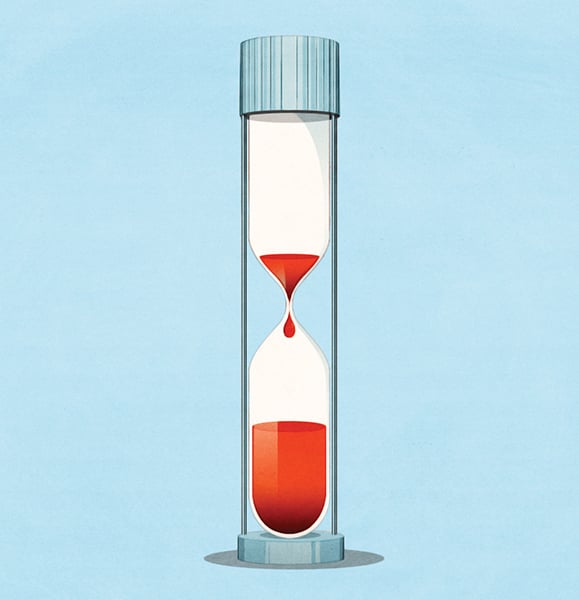
Whenever I donate, I think about Chris waiting in a hospital room for platelets that never came.
Over time, I began recognizing many of the same platelet donors. They all quietly show up for people they’ve never met. For many of us, donating becomes part of who you are. You become part of a quiet community consisting of donors and phlebotomist staff, all with the same goal. During a recent visit, I finally became acquainted with another frequent platelet donor. We’d never met outside the donor center, yet after years of seeing one another every few weeks, we had become part of an unusual community connected by reclining donation chairs instead of neighborhood streets. In his 60s, he was boasting how much better he felt after being prescribed a blood pressure medication and was shocked that this medication did not prevent him from donating. He is just one of many regular donors I’ve come to know.
We have some fun, too. Every July, the East Texas communities of Marshall and Carthage compete in the MASH Bash blood drive, named for the U.S. Army’s Mobile Army Surgical Hospital, or MASH, medical units that were immortalized in the old movie and TV show. During my three-hour visit this July, donors entered the convention center in waves. We were greeted by smiling volunteers and a festive atmosphere with balloons. Each donor received a MASH Bash T-shirt to proudly wear. You might be wondering which city won this friendly competition to turn out more donors. The real winners were the Texas hospitals and their patients.
This is a sobering reality: According to America’s Blood Centers, only about 3 percent of eligible people in the U.S. donate blood despite great need. Put another way, that’s 97 percent of people who do not donate. Carter BloodCare alone requires approximately 1,600 donations every day to meet patient needs across Texas.
Blood donation has taught me that no physician, surgeon, or hospital can save lives without donors who choose to act before an emergency. Sometimes it simply requires showing up, rolling up a sleeve, and giving your time.
For me, donating costs only a few hours and a brief needle stick. For someone receiving that lifesaving gift, it can mean another birthday. Another anniversary. Another chance to watch a child graduate. Another chance to say I love you.
I can’t change what happened to Chris, but he showed me what service can truly mean. Every time I sit in that donation chair, I know someone else’s friend may receive the platelets Chris never did.
Bill Martin is a member of the Rotary Club of Quitman, Texas, and a 2026-27 assistant governor of District 5830.
This story originally appeared in the November 2026 issue of Rotary magazine.