A conversation between friends
NPR’s Scott Simon talks with the writer Ann Patchett about her latest novel, books and bookstores, and her father’s poignant relationship with Rotary
20 Nov 2026
Few contemporary novelists have captured the complexities of family, friendship, and the ties that bind as beautifully as Ann Patchett. Over the past three decades, she has become one of America’s most beloved and celebrated writers. Bel Canto, her fourth novel, won the PEN/Faulkner Award, and her 2019 book, The Dutch House, was named a finalist for the Pulitzer Prize. Patchett also co-founded Parnassus Books in Nashville, Tennessee, and she’s become a passionate advocate for books, authors, free speech, and independent bookstores.
Patchett’s newest novel, Whistler, is a deeply moving story about memory, family, and the people who shape our lives. At its heart is an unexpected reunion between a woman and the stepfather she loved as a child. Like so much of Patchett’s work, Whistler reminds us that kindness, love, and friendship often become the forces that make us who we are.
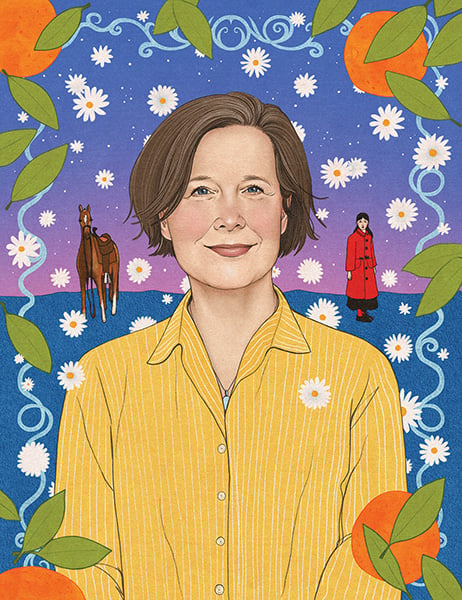
Illustrations by Natalie Foss
Those themes resonate in a special way with Rotary. Ann’s father, Frank Patchett, was a longtime Rotarian, and in a touching essay she wrote for this magazine in 2014, she reflected on what Rotary meant to him. And while she praised Rotary’s historic effort to eradicate polio, she argued that the organization’s greatest achievement might be the lifelong bonds that grow from serving others together.
This summer I spoke with my friend Ann Patchett about Whistler and a host of other topics. You’re welcome to listen in while we talk. — SCOTT SIMON
Ann, your wonderful new novel is called Whistler. What’s it about?
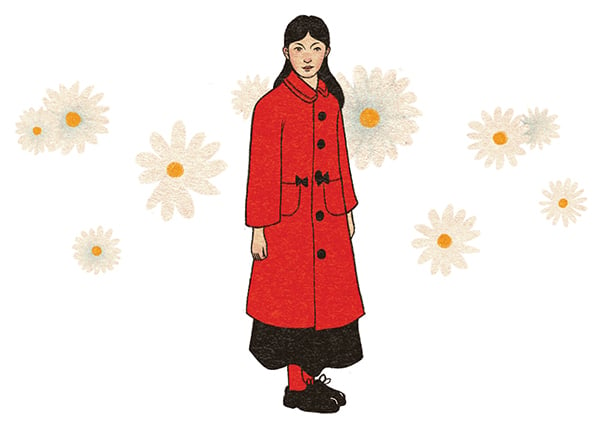
Well, Scott, its protagonist, Daphne Fuller, is 53 years old. She and her husband, Jonathan, are spending the day in the Metropolitan Museum of Art in New York City. Jonathan notices that someone is following them and looking at Daphne. Jonathan goes to talk to this man and he turns out to be Eddie Triplett, who for a short time was Daphne’s stepfather and whom she hasn’t seen since she was 9 years old. As the book unfolds, it’s about Daphne and Eddie’s past, their present, and their future together.
When Daphne was a girl, she and Eddie shared an intense experience, didn’t they?
When Daphne’s sister was in the hospital, Eddie was taking care of Daphne, and they were in a car accident on a snowy night. They went down a hill into a ravine, and no one knew that they were missing. They were really in a lot of trouble in this car together, and that scene of that experience comes up throughout the book and develops in a parallel way with their present story.
In that present story, Eddie’s at an important point in his life, isn’t he?
He is. He’s thinking about retiring.
He’s thinking about his health and his future. But Eddie is a happy guy. He has a lot of friends and he’s greatly beloved. He is enjoying his life and he’s enjoying his work. Daphne is not filling a hole in his life. It is expanding forward into an even greater life.
And what about Daphne? Is she rediscovering a part of herself that she had sealed off?
Daphne is a happy and well-adjusted person, and she comes to realize over the course of the novel that a lot of that has to do with her relationship with Eddie. That it was brief, but that if there is one person in your life as a child who really loves you and sees you and understands you, that even if it’s not a long relationship, it can set the course for your life. It could have been a teacher, a neighbor, or the parent of a friend. I just decided to make it a banished stepfather.
Inevitably it occurred to me to think of the terrific article, “My Three Fathers,” that you wrote for The New Yorker in 2020. In it we learn that your parents divorced when you were young and that your mother subsequently remarried twice. So you had a father and two stepfathers, just as Daphne does in Whistler. To what degree did your own experience work in your creative process?
It worked insofar as I know what it’s like to have a stepfather and to be very close to one stepfather. But boy, oh boy, Eddie is not my stepfather. Yes, I am drawing on experiences, but they are not the same. In the same way, my sister and I were in a very bad car accident when I was a child, and when I gave my sister the manuscript of the book and she started to read it, she got to the car accident scene. She put it down, called me, and said, “I’m sorry. I have no interest in reading about this car accident.” Later she picked the book up again and called me, and she said, “Oh my gosh, this isn’t our car accident at all.”
And so that’s kind of the way it is. Yes, I understand how significant a stepparent can be, how significant a car accident can be. And so, yes, you’re drawing on experience, but the characters are having a different relationship to those experiences.
And Whistler, the horse, does make a brief but significant appearance.
Right. But if you like books about horses, this is not the book for you. The horse is in the novel for about five pages. But it turns out a lot of people don’t like books about horses, in which case, this absolutely is the book for you.
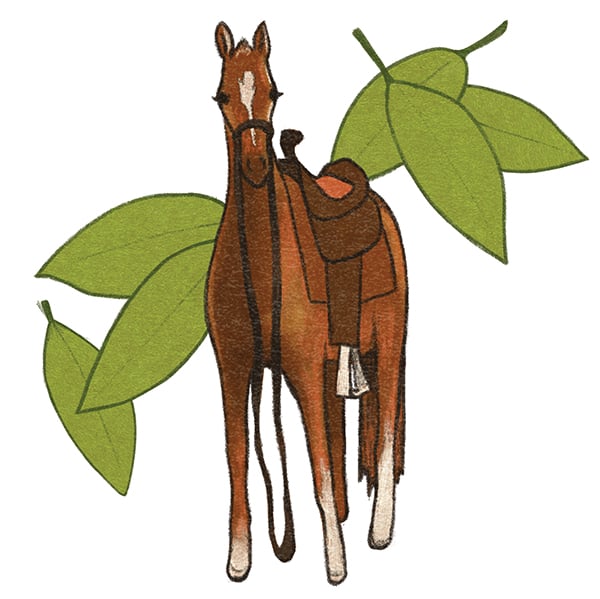
And there’s a beautiful cover with a horse on it, so if you do like horses ...
There you go. The cover was done by my friend Noah Saterstrom here in Nashville. He painted the cover of my 2019 novel, The Dutch House, as well.
What is it about animals? What do they unlock in us?
I thought about this a lot when my beloved dog, Sparky, died. I thought, “Why is this so hard? Why is this so incredibly painful?” And it’s because we had never had a fight. I was never once mad at Sparky. If he threw up on the couch, I said, “I’m so sorry you don’t feel well.” If he — well, he never ate a shoe, but he could have. He could have had anything he wanted. I never raised my voice to him. He was never mad at me. We never had a fight and made up, ever. We were just 100 percent always there.
And to bring it back to Whistler, that’s true with Daphne and Eddie too. It’s the kind of friendship they have. And I’ve had so many friendships in my life where I’ve never once had a fight with that friend. Never, never, never. We could maybe disagree about a movie, but it would be inconceivable that we would fight. It was just love. And so I think that’s what the animals bring: unconditional love.
As you said, Whistler begins with a chance encounter at the Metropolitan Museum of Art in New York City. You and Marti Fischer, your friend from Sarah Lawrence College, recently returned to the Met for a short video featured in the museum’s Meet Me at the Met series. I was struck by a particular sentence in that video. You said, “Art happens not from the artist or the writer or the reader or the viewer, but it’s chemistry. It’s like love.” How does a writer create that chemistry?
You can’t, in the same way that you can’t create the chemistry of love by yourself. You bring your half. It’s always amazing to me as a writer that I can get a horrible review of a book that I’ve written, and the next day I get a review that says, “This is the best book I’ve ever read.” I know as a bookseller that there are books that one person loves and one person hates. The book doesn’t change, right? What changes is the chemistry between the reader and the book. As writers, all we can do on our end is to do the best work we know how to do. I don’t think that a lot of people are doing it just to pay the bills. It is absolutely a calling of the heart.
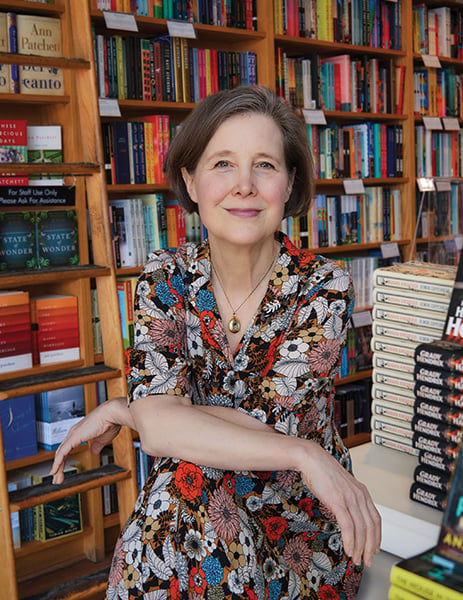
Image credit: Emily Dorio, Courtesy of Ann Patchett
What made you open Parnassus Books in 2011?
The bookstores had closed, and somebody had to do it. You don’t want to live in a city that doesn’t have a bookstore. We took over a tanning salon in a strip mall and took out all the tanning beds. I was the co-owner, but my partner retired five years ago. I bought her out. I’m the owner now. I own that bookstore. I thought of it as a civic responsibility, and it has turned into an enormous joy. I mean really, the great joy of my life. I have done more for the humanities in this country as a bookseller than I will ever do as a writer.
Give us some idea of what that entails. There are so many books that come out and only so many you can put on the shelves — and these days you also have to make room for coffee mugs. You have to make a thousand different practical decisions in any given period of time, don’t you?
No, I have to make just a couple of practical decisions, which is who to hire. And I hire spectacular people who then go out and execute all those decisions. I am not a micromanager. I really trust these people, and they are wonderful. And the other thing is, because I have a robust career as a novelist, all the profits that the bookstore makes are divided equally among the staff. If you are working the cash register or you are the head manager of the store, you get the same amount of profit every quarter.
In one of the pivotal scenes of the book, Eddie says to Daphne, “There are so many people who are going to want to help you.” We don’t read that in a lot of contemporary literature.
And yet it’s true. I see it so much in life. You look at the world from a distance and it’s a boiling morass. But if you look at the world that you actually live in up close, there’s so much goodness — the small acts of kindness that people show one another, which is what’s very well represented in Rotary. People getting together and saying, “How can we be kind? How can we help? Let’s put our heads together and not only be nice to each other as a group, but also, how can we look out to the larger world and figure out polio, water supplies — things that we can do to help others?”
Your father, a legendary Los Angeles police captain, was a longtime member of Rotary, and your sister was also a member. What did Rotary mean in your family?
Service and connection. My father grew up, as my sister and I did, in the Catholic Church, and priests and nuns reinforced the idea that we are put here to serve one another in a community. My father didn’t always stick with the church, but he found that element of service and community in Rotary.
Your father’s involvement with Rotary extended beyond the Wilshire Rotary Club of Los Angeles, where he was the club’s president in 1992.
Yes, after my father and stepmother retired, they moved to a little town called Fallbrook, California. My father immediately joined the Rotary club there, and he had many healthy, happy years as a member. And then he developed a disease called progressive supranuclear palsy, a degenerative neurological disease that’s a little like Parkinson’s. He was in a wheelchair and seriously disabled, but my stepmother had a van and my father had a motorized wheelchair, and he would always go to the Rotary meetings.
One of the things about progressive supranuclear palsy is you can grab someone’s hand, but it’s almost impossible to let go. You have to pry the person’s hand off your hand. I can remember going to those Rotary lunches with my dad and people coming over to shake his hand and then not being able to get their hand back, and they were all just fine with it. They were so patient and so kind and would come and sit with us. That’s one of those cases where the chips are completely down and you know who your friends are. And those people from Rotary were still very much his friends.
This story originally appeared in the November 2026 issue of Rotary magazine.