
.jpg?h=1875&iar=0&w=3959)
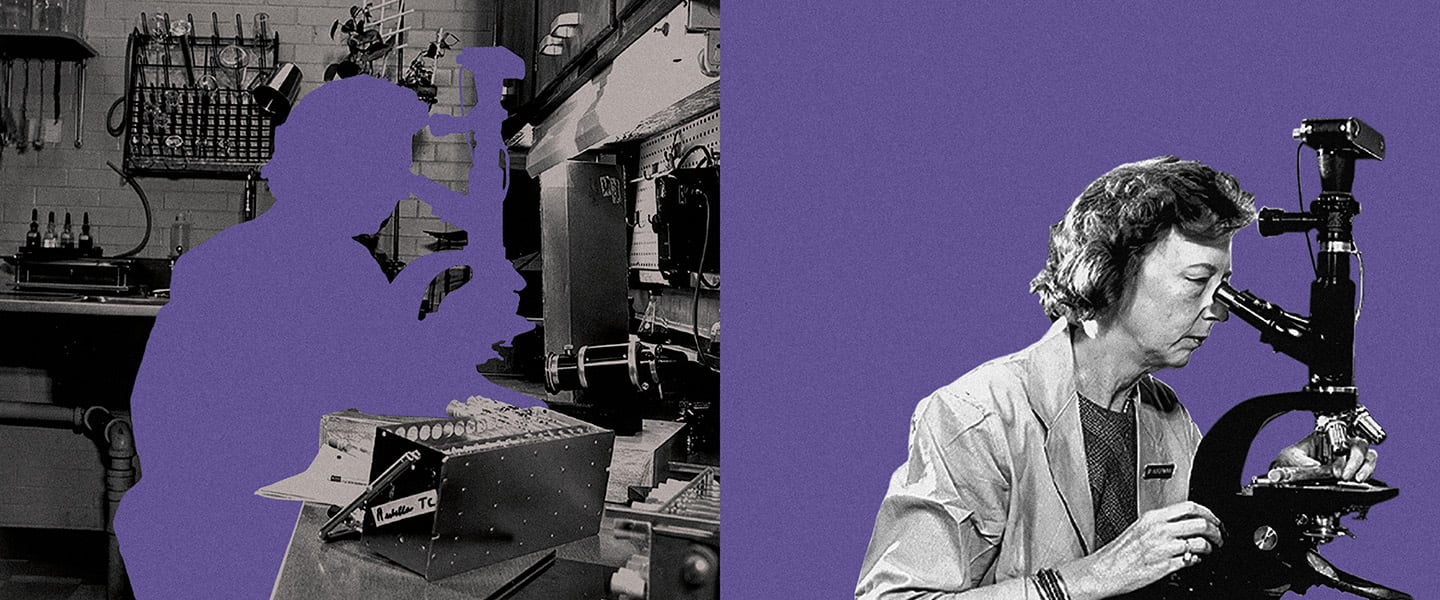
Picturing polio pioneer Dorothy Horstmann
For years, she stood in the shadow of great men like Salk and Sabin. Now she’s ready for her close-up.
by Geoffrey Johnson
2 Oct 2026“For one often catches a glimpse of them in the lives of
the great, whisking away into the background, concealing,
I sometimes think, a wink, a laugh, perhaps a tear.”
—Virginia Woolf
In the spring of 1944, even as a world war raged in Europe and Asia, a silent and unseen assailant crept into North Carolina’s Catawba County. Its first reported victim was a 17-month-old blond girl from Hickory named Linda Kiser. After falling ill in early June, the girl had been rushed to the hospital in nearby Charlotte by the county’s public health nurse.
On 7 June, a front-page headline in the Hickory Daily Record announced the dire diagnosis: POSSIBLE POLIO CASE TREATED.
It was in fact polio, and little Linda would not be the last case. In the weeks that followed, the illness spread from Catawba into neighboring counties, and children showing symptoms of polio inundated Charlotte Memorial Hospital and the North Carolina Orthopedic Hospital in Gastonia.
A coalition comprising medical caregivers, skilled craftsmen, community members, and even prison work gangs sprang into action. On 21 June, a children’s summer health camp on Lake Hickory was evacuated, and its sole stone building was augmented by tents and hastily constructed buildings. A U.S. Army hospital donated dozens of cots and mattresses, and over three days, the Catawba County Health Camp was transformed into the Hickory Emergency Infantile Paralysis Hospital, accepting its first patients on 24 June.
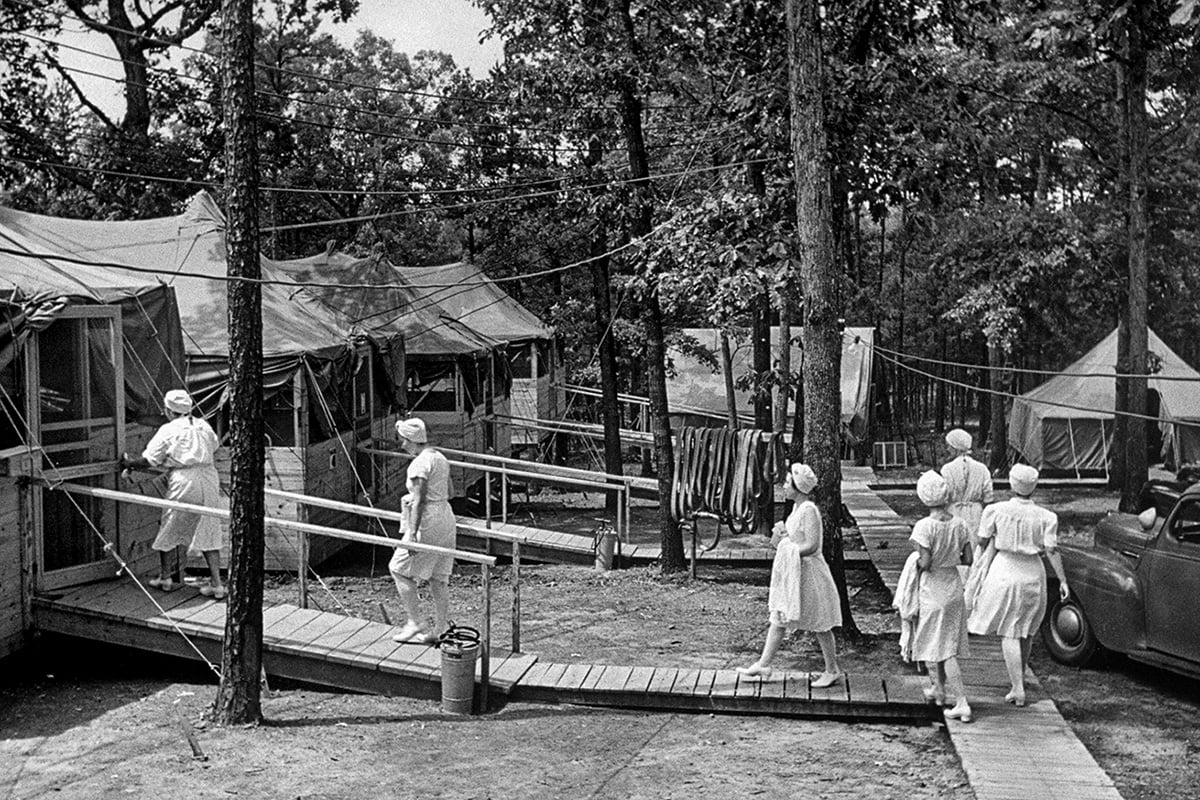
Scenes from the polio hospital that miraculously sprang up overnight in Hickory.
Image credit: Alfred Eisenstaedt/The LIFE Picture Collection/Shutterstock
Ralph McDonald, state chairman of the National Foundation for Infantile Paralysis (later known as the March of Dimes) marveled at what had been accomplished in so short a time. “It is just about a miracle the way the camp is being developed,” he said. “How it has been achieved, I don’t know,” added Stone Crane, an assistant disaster relief director for the American Red Cross. “But the hospital is there to speak for itself, well-staffed and functioning satisfactorily.”
Wanting to see this miracle for itself, Life magazine dispatched its star photographer, Alfred Eisenstaedt, to Hickory. In late July, 14 of Eisenstaedt’s dramatic black-and-white photos appeared in the large-format weekly magazine under the heading “Infantile Paralysis,” and it’s here we first catch sight of Dr. Dorothy Horstmann.
In the world of polio research, where the field is dominated by the names of two men — Jonas Salk and Albert Sabin — Horstmann’s name is little known outside the discipline’s coterie of cognoscenti. But without Horstmann’s breakthrough discovery about the manner in which the polio virus moves through the body to attack the central nervous system, there might never have been a polio vaccine.
In 1944, however, Horstmann had, at best, only a theory. To satisfy her medical peers, she had to first demonstrate the validity of that theory. Which is what brought her and two of her associates from the Yale School of Medicine to Catawba County.
Horstmann appears in two of the photos in the Life magazine story. In the first she is collecting flies from a trap; the insects will be sent back to Yale and tested in an attempt to prove or disprove the theory that flies transmit the virus.
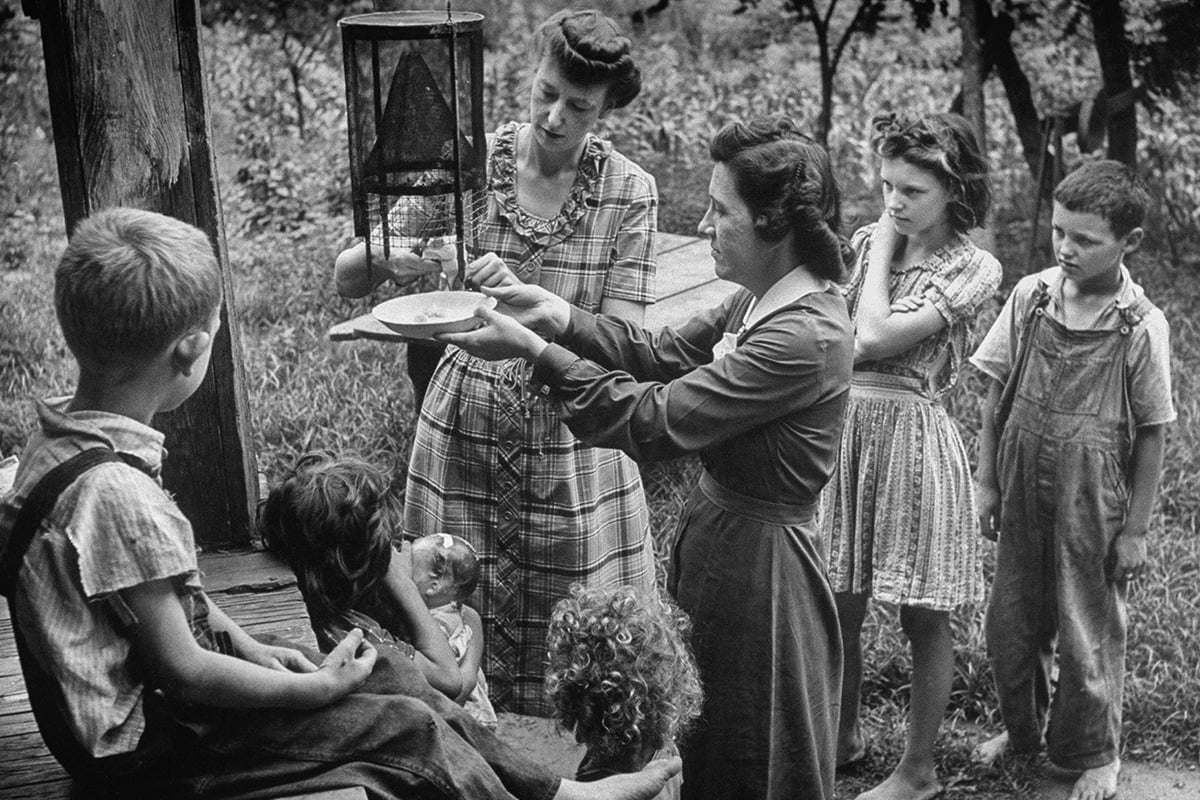
Horstmann (bottom, in plaid dress) collects flies for her polio research.
Image credit: Alfred Eisenstaedt/The LIFE Picture Collection/Shutterstock
The second photo is more pertinent to Horstmann’s particular line of research. It is also one of the most poignant images not only in the issue but in Eisenstaedt’s illustrious career. A boy lies on a cot, his close-cropped head lying on a pillow. At his bedside are three other children. One of them, a little girl, clutches a baby doll, and the trio stares solemnly down at the boy.
On the other side of the bed sits Dorothy Horstmann, drawing a specimen of blood from the boy’s left arm. Like the flies, the blood sample, one of many, will be sent to Yale. The boy has not been stricken by polio, but one of his siblings has, and Horstmann is eager to see if there’s any hint of the virus in the boy’s blood. Perhaps that’s the way polio travels through the body, though all evidence gathered up until this point suggests the contrary. Still, here in Hickory and in other parts of the country where polio rages, Horstmann will continue to take her samples and see what she can learn.
The emergency hospital remained open into 1945, by which time the polio epidemic had subsided. Over the course of those months, it treated 454 patients. Sixteen of them died.
On 5 March, the last remaining patients were transferred to Charlotte Memorial Hospital. Among them was 2-year-old Linda Kiser, but if you turn through the pages of the Hickory Daily Record, you will find that she recovered. Here she is earning a place on the third-grade honor roll, visiting Washington, D.C., on a class field trip, and directing a production of Little Women as a high school English teacher.
And Dorothy Horstmann? Look closely and you will catch glimpses of her too as she works assiduously, often in the background, at conquering the scourge of polio.
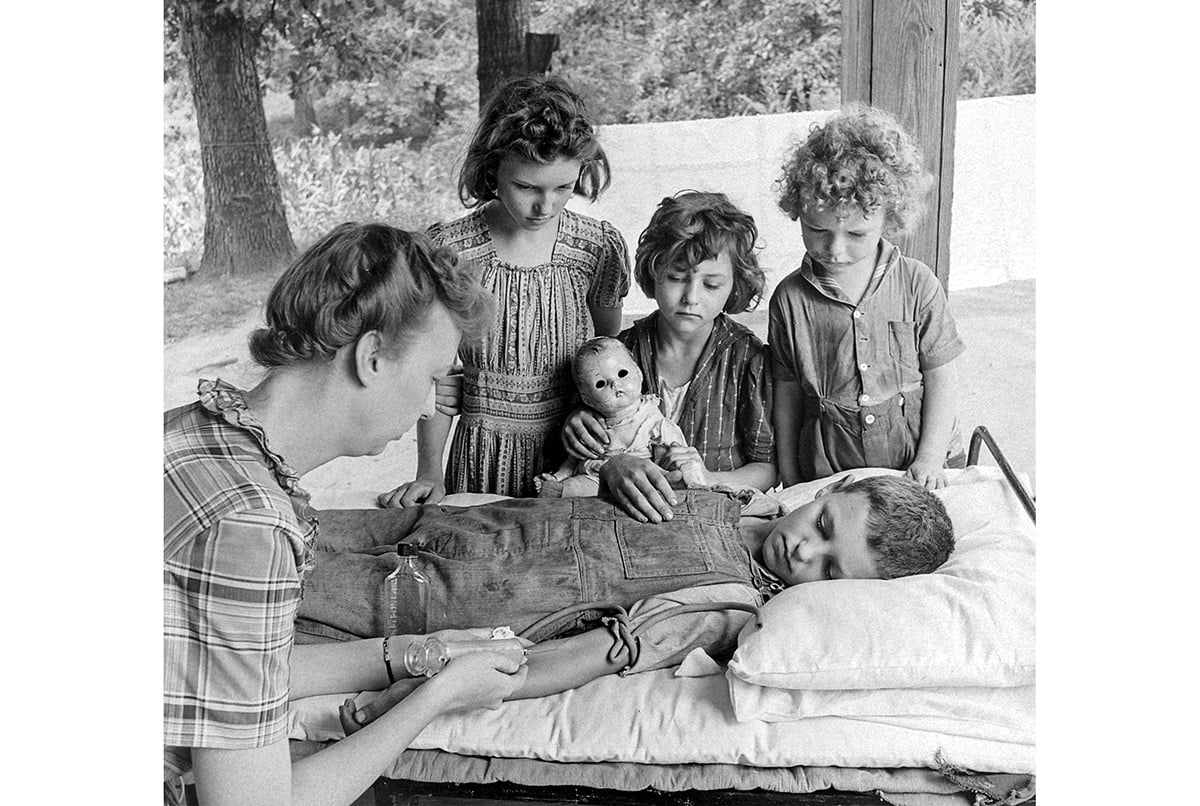
Horstmann takes a blood sample at the polio hospital in Hickory, North Carolina.
Image credit: Alfred Eisenstaedt/The LIFE Picture Collection/Shutterstock
The most vivid picture we have of Dorothy Horstmann comes in a book by Lynn Cullen called The Woman with the Cure. There you will find everything you could possibly want to know about this forgotten polio pioneer: her childhood in Spokane and San Francisco; her love of Beethoven’s Moonlight Sonata; her rise through the ranks of a profession populated almost exclusively by men.
We’re also somehow privy to her most intimate thoughts. Or are we? For as the disclaimer at the beginning of the book acknowledges, The Woman with the Cure is a work of fiction. It might be more precise to say it is partly a work of fiction. While some characters are invented, others are at least partially based on real people involved in the battle against polio. And while much of the biographical detail on Horstmann is real, some of it is pure conjecture.
In the afterword to her novel, Cullen explains: “While the Dorothy Horstmann you meet in this novel is based on what I could glean about her life from articles, letters, books, censuses, and oral sources, for this story she became my creation. … [A]t all times, The Woman with the Cure is a novel, not a biography.”
Which can be a source of frustration if, like me, you are trying to track down the real Dorothy Horstmann. I could find no conventional biographies of her, and having read Cullen’s novel, it is impossible to unread it. I’m left with the indelible impression of a diligent, compassionate, and brilliant doctor who also happens to be — in the novel’s portrayal — a remarkably tall, beautiful, irresistible goddess. This imagined Horstmann confesses to an unspoken, and unfulfilled, desire to have a child. There’s a concocted love story with a made-up Danish freedom fighter named Arne Holm, a man Horstmann forsakes in order to dedicate herself to the Aesculapian arts. “What would she sacrifice in order to save children around the world?” asked Cullen, speaking about the (doomed) Horstmann-Holm romance with the book blogger N.J. Mastro. “The sad thing is, a man would not have to make this choice.”
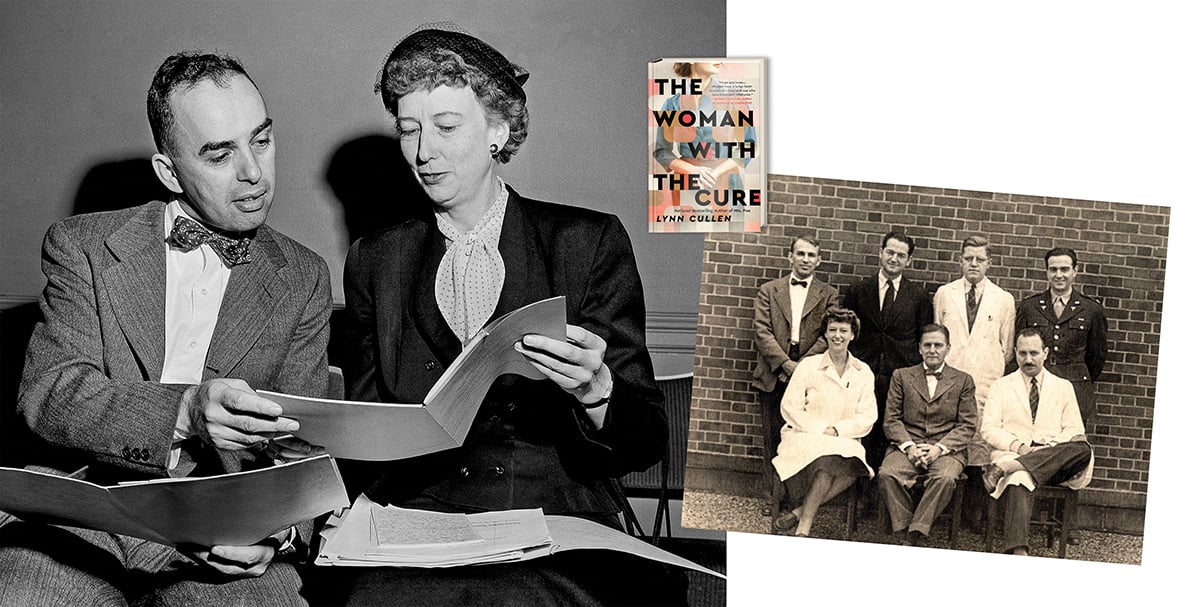
From left: Dr. David Bodian, who also conducted research on polio in the bloodstream, sits with Horstmann in 1952; Lynn Cullen’s novel conjures a fictional Horstmann; Horstmann poses alongside her colleagues at the Yale School of Medicine in this photograph from 1945
Image credit: (Bodian) AP/Ed Ford, (book cover) courtesy of Lynn Cullen, (group) Yale School of Public Health
The confounding mix of fact and fiction makes me question everything I learned about Horstmann through The Woman with the Cure. So let’s take a step back and look at what we know for certain.
Dorothy Millicent Horstmann was born on 2 July 1911 in Spokane, Washington. Forty-four years later, when Horstmann was enjoying her brief moment in the spotlight, The Tacoma News Tribune published — on its Society page — a story about a Washington girl who had made good. Or as the story’s headline put it, “Spokane Woman Worker in Salk Vaccine Find.”
The story provides some details that help bring Horstmann to life. It reveals that she financed her studies at the University of California, Berkeley (A.B., 1936), and the University of California, San Francisco (M.D., 1940), by giving piano lessons. There’s also this observation (revealing of the stereotypes of the time): “The very opposite of the popular conception of the woman scientist, she is not gruff, shy, raw-boned or stooped, but a tall, very attractive woman, with reddish blond curls, a nice smile, a memorable capacity for laughter and a very human approach to the laboratory, to the classroom and to the sickbed.”
Initially turned down for a residency at Vanderbilt University in Nashville, Tennessee, where the chief of medicine insisted on hiring only men — “I wasn’t exactly crushed, but I was disappointed,” said Horstmann — the aspiring doctor was surprised several months later to receive a letter from Vanderbilt offering her a job. Equally surprised was Vanderbilt’s medical chief when Horstmann reported for work: He had forgotten that his new hire was a woman.
From Vanderbilt she moved on, in 1942, to the Yale School of Medicine and its newly formed Section of Preventive Medicine; the section was led by Dr. John Paul, who 11 years earlier had co-founded Yale’s Poliomyelitis Study Unit. At Yale, Horstmann would make her most significant contribution to medicine: a discovery that would (according to a 2011 evaluation of her work) “fundamentally change the conventional wisdom of polio transmission and pathogenesis.”
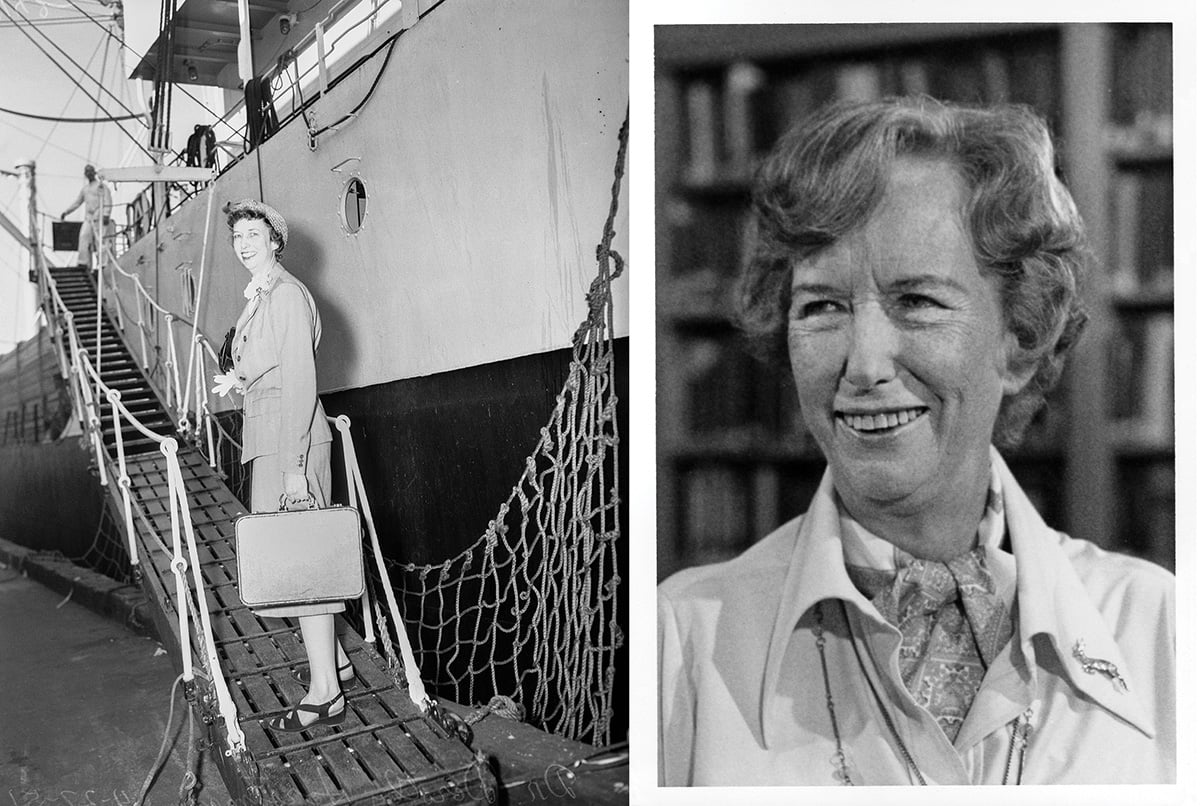
Left: In April 1951, Horstmann embarks on yet another voyage of discovery.
Image credit: (Boat) University of Southern California/Getty Images; (Portrait) William B. Carter
As doctors searched for ways to stop the spread of polio, they were frustrated by their failure to answer one crucial question. Horstmann posed that question herself in a retrospective look at that scientific quest: “[H]ow does the virus travel to the central nervous system?” she asked, and then provided the beginnings of an answer. “Invasion via the blood seemed a likely possibility, but attempts over the years to demonstrate viremia [the presence of a virus in the blood] … had yielded largely negative results.”
To validate that “likely possibility,” Horstmann and her colleagues traveled anywhere in the United States there was a polio outbreak; that’s what had led her to Hickory, North Carolina, in 1944. Those trips proved futile; the clue Horstmann was looking for showed up closer to home.
In 1943, polio broke out in New Haven, Connecticut, home to Yale University. On 12 August, a 9-year-old girl, identified for posterity only as E. Bun., was admitted to the hospital. She had a fever and complained of stiffness but showed no signs of weakness or paralysis. Still, doctors immediately took a blood sample from the girl, and on 14 August, a rhesus monkey was injected intracerebrally with a modified sample of the blood. On 16 August, Miss Bun was discharged from the hospital — and the inoculated monkey had a high fever and “exhibited,” to quote the research team’s account, “complete left facial paralysis and weakness of the extremities.” A day later, the monkey was mercifully euthanized.
Across five different outbreaks in 1943-44, Horstmann had taken blood samples from 111 suspected polio patients. The sample from the girl in New Haven was the only one in which the virus was detected. With this slim evidence that the polio virus could and did exist in the bloodstream, Horstmann continued her research, though it would be years before she could confidently announce proof of her discovery. In 1952, in a short paper entitled “Poliomyelitis Virus in Blood of Orally Infected Monkeys and Chimpanzees,” Horstmann demonstrated that a “possible explanation” for the failure to find the polio virus in the bloodstream of polio patients lay in the fact that medical detectives had arrived too late at the scene of the crime. For, she wrote, the presence of the virus in the blood occurs “early in the incubation period.” By the time a patient exhibited symptoms of polio, be it “paralytic or non-paralytic,” the body had already generated antibodies that eliminated any sign of the virus in the blood.
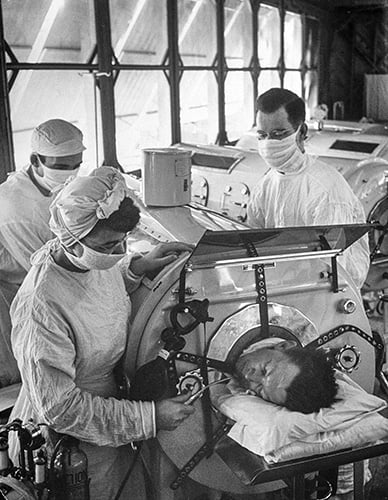
Scenes from the polio hospital that miraculously sprang up overnight in Hickory.
Image credit: Alfred Eisenstaedt/The LIFE Picture Collection/Shutterstock
The formal announcement of her discovery came on 15 April 1952 at the annual meeting of the American Association of Immunologists. As Time magazine reported, Horstmann had uncovered the “missing [step] in the widely held theory that polio passes directly from the alimentary tract to nerve fibers and thus to the nervous system.” Instead, as Horstmann postulated, “the virus goes from the digestive system to the blood stream, and from there, if not destroyed by antibodies, to the nervous system.”
To the great relief of parents everywhere, a clear pathway now existed to the development of a vaccine that could, by triggering the creation of antibodies in the blood, dramatically reduce, and one day eliminate, the omnipresent threat of polio.
But Horstmann wasn’t done yet. “There was,” as she said, “so much to be learned.”
There’s a photo, shot in the 1970s, that perfectly captures this aspect of her personality: the seated scientist in the laboratory staring so intently into a microscope that she may very well be unaware that someone is taking her picture. The photo was shot at Yale, where Horstmann spent the rest of her career, as other photos will attest: Dorothy, with her mostly male medical colleagues, occasionally flashing that smile for which she was justly famous.
Horstmann did more than sit for photos. In 1959, the World Health Organization sent her to the Soviet Union to assess the effectiveness of Albert Sabin’s oral polio vaccine, which had been introduced there before its approval for use in the United States. “On the basis of a report that she wrote,” recounted another of those male Yale colleagues, “the WHO licensed the Sabin vaccine without a large what we would call phase-three trial where you would prove the efficacy of the vaccine.”
In the middle of her career, Horstmann shifted her focus to pediatric care and played a crucial role in the development of the rubella vaccine. In 1961 she was named a full professor at the Yale School of Medicine — the first woman to achieve that rank at the school — and later became the first woman at Yale to occupy an endowed chair (named in honor of her late colleague and mentor, John Paul). She’d also serve as president of the Infectious Diseases Society of America and be elected, in 1975, to the National Academy of Sciences.
Horstmann retired from Yale in 1982. To commemorate her departure, the Yale Journal of Biology and Medicine published a special issue — a Festschrift — dedicated to Horstmann, primarily a collection of scientific papers on infectious diseases. But it included some personal reflections. In a fond recollection, Albert Sabin recounted the time in 1943 when he (then a major in the U.S. Army) and Horstmann were “having fun on the dance floor.” Rather vigorously it seems, for a young lieutenant tapped him on the shoulder and pleaded, “Major, take it easy.”
And John Enders, who won a Nobel Prize for his polio work, recalled the “excitement which all of us felt” 30 years earlier when Horstmann announced her breakthrough and the “widely held feeling that the virus grew solely in nerve cells had to be set aside.” The impact of that report, wrote Enders, “comes to me quite sharply even now, and to think about it is rejuvenating.”
Dr. Dorothy Horstmann died in New Haven on 11 January 2001. According to her obituaries, she had been suffering from Alzheimer’s disease, an especially sad ending for such a brilliant and vivacious woman. Eighteen years later, the Yale School of Medicine unveiled her posthumously painted portrait. It replaced the framed photograph, reportedly “in poor condition,” that had hung for many years at the school.
I’d rather return to Hickory and close with a different final glimpse of Horstmann. It’s late June 1944, and she’s standing, tall and relaxed, in front of the brick building that’s home to the town’s public health office. The photographer for the Daily Record has put her at ease, or perhaps, for this new arrival, the gruesome reality of the polio hospital alongside Lake Hickory has yet to set in. Her hands are loosely clasped below her waist, and best of all, she is smiling, eager to step from the frame and make her presence known.
This story appears in the October 2026 issue of Rotary magazine.