
Cross-generational club in Barcelona feels like extended family
by Hannah Shaw
21 Oct 2026In the heart of Barcelona’s Eixample district, students spill out of ornate school doors and young professionals move along broad, tree-lined avenues as scooters, buses, cars, and a sea of pedestrians flow past. Since it sprang into existence after the removal of Barcelona’s medieval walls in the 1850s, the Eixample (literally,“Expansion”) has been at the center of Barcelona’s experiments in urban planning. It’s been a place to create flourishing community-centered neighborhoods without class divisions, a place where all kinds of people come together in shared spaces.
True to that spirit, the members of the Rotary Club of Barcelona-Diagonal are focused on building bridges between generations to preserve the area’s Rotary clubs as vibrant hubs of service, ideas, and connection for their communities. Through scholarships, Interact and Rotaract clubs, summer camps, exchanges, and mentoring, the Barcelona-Diagonal club has spent years building connections with young people.
At the center of many of those efforts is Fernando Plaza, a pediatrician who has worked with youth programs since joining Rotary in 2008. “For our future in Rotary,” he says, “we have to work with young people and bring them into our clubs.”
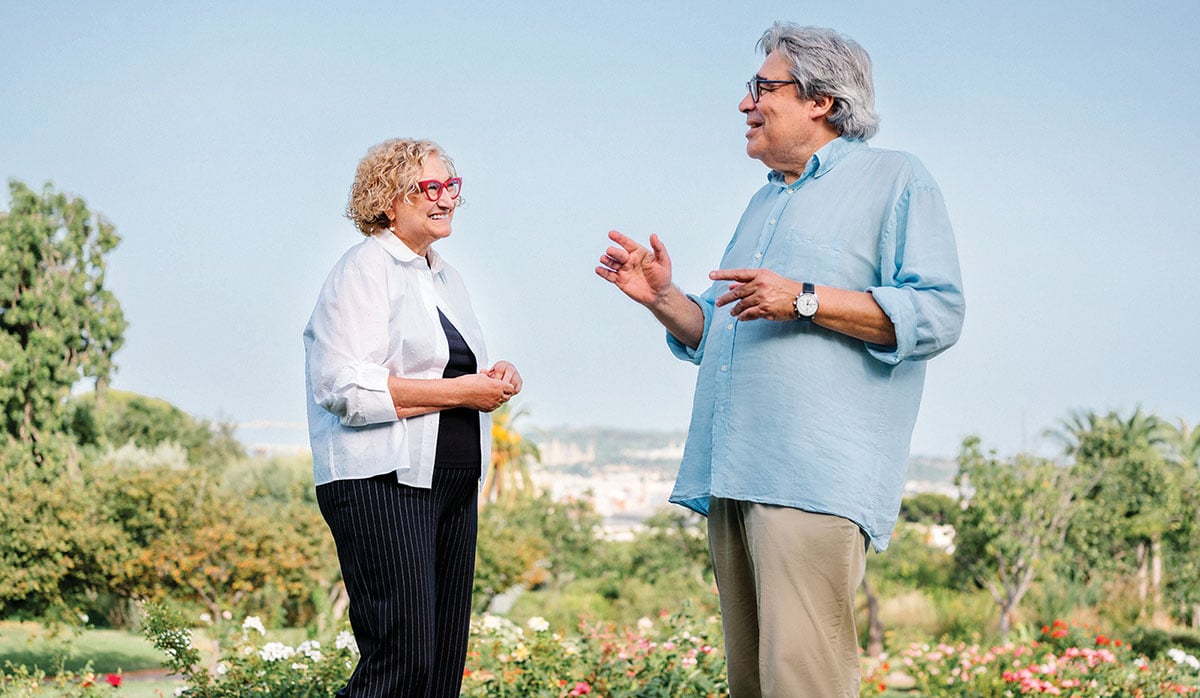
Members of the Rotary Club of Barcelona-Diagonal, including Marisa Caparrós and Fernando Plaza, amplify their impact by building bridges across generations with Rotaractors and others. “The young people need mentors,” Plaza says. “And we need their ideas.”
Image credit: Lydia Metral
Plaza serves as an adviser to an Interact club at a German-language school in Barcelona and regularly encourages fellow members to start other youth programs. There are now five Interact clubs in District 2202, and two new Rotaract clubs were chartered this year.
“I see Rotary as a family,” Plaza says. “And in a family, there are the grandparents, the parents, the children. So in Rotary, it should be something similar.”
That philosophy was tested when the Rotaract Club of Barcelona-Diagonal, sponsored by Plaza’s club, nearly disappeared. Chartered in 2009, the Rotaract club was active for years before membership began to decline. “One year we have 20 people,” Plaza says. “But in one or two years, they go off to study or begin to work and move. Then, this club that was very strong and very active has only five members.”
By 2024, membership had dwindled to a handful of people. Discussions began about closing the club. “I told them, ‘No, please don’t close the group,’” Plaza says. He called the club’s president, who had relocated to Edinburgh, Scotland, and urged him to remain a member. And then Plaza realized that a pipeline of future Rotaractors already existed.
Since 2012, the Barcelona-Diagonal Rotary club has invested in students through Protagonistes del Demà, or Leaders of Tomorrow, a scholarship program that’s in partnership with schools and businesses. Each year, students from the Eixample compete for scholarships that support either their first year of university or vocational education.
Scholarship applicants submit videos describing their goals, achievements, and commitment to helping others. “We don’t choose students only because of their grades,” Plaza says. “We look for young people who want to help other people.”
Create opportunities to lead. Invite younger members to lead projects, committees, or initiatives that match their interests and skills.
Be supportive. Offer guidance and perspective but allow new leaders room to make decisions (and even mistakes) and learn along the way.
Stay curious. When someone suggests a different approach, ask questions and explore the idea before deciding whether it will work for your club.
Listen for what’s working and what’s not. Small concerns can reveal barriers to participation and help clubs find practical solutions that work for more members.
Be willing to adapt. Be aware that meeting formats, locations, and expectations can work for some but not all. A little flexibility can help more members stay engaged.
For Marisa Caparrós, a club member heavily involved in reviewing applications, the program provides her with hope for the future. “We always tell the students we are so proud of you,” she says. “Because this is the future of our country. This is the next generation.”
Club members reached out to scholarship applicants, encouraging them to try Rotaract. Those students brought friends, who invited more friends. Today, the Rotaract Club of Barcelona-Diagonal has nearly 20 members. One of them is Tomàs Masucci, who says that Plaza has never tried to tell Rotaractors how to run their club; instead, he acts as a mentor and sounding board.
“He will say, ‘I’m here. If you need me, you can come with me,’” Masucci explains. “He will not show you what you have to do. You are a club. You can do what you want.”
To amplify their reach, the two clubs and others in the city regularly collaborate on service, including meal deliveries to local soup kitchens, international projects in places such as Costa Rica, and holiday programs to make new residents feel welcome.
Plaza’s support extends beyond advice. Initially, the Rotaract club’s meetings were held in the same hotel used by the Rotary club. But the young Rotaractors told Plaza that venues like the hotel could feel intimidating and expensive.
That’s when Plaza opened the office he shares with his wife’s real estate business and made it available free of charge. Every Monday evening, Rotaractors gather there to plan projects, discuss ideas, and spend time together. “They needed a place where they felt comfortable,” Plaza says. “Sometimes the simplest thing you can do is make participation easier.”
Plaza understands the power of a personal invitation because that’s how he became involved in Rotary himself. Years ago, a woman whose children had been patients of his told Plaza about the opportunities Rotary had provided her family to travel and build international connections. Curious, Plaza attended a meeting. He’s been a member ever since.
Nearly two decades later, Plaza still believes Rotary’s future depends on making space for younger generations. “The young people need mentors,” he says. “And we need them. We need their ideas, their energy, and their vision for the future.”
For clubs looking to attract and keep younger members, Plaza’s advice is simple: Listen to what they need, be willing to adapt, and give them room to lead. “If we want a strong future,” he says, “we must build it with them.”
This story originally appeared in the October 2026 issue of Rotary magazine.