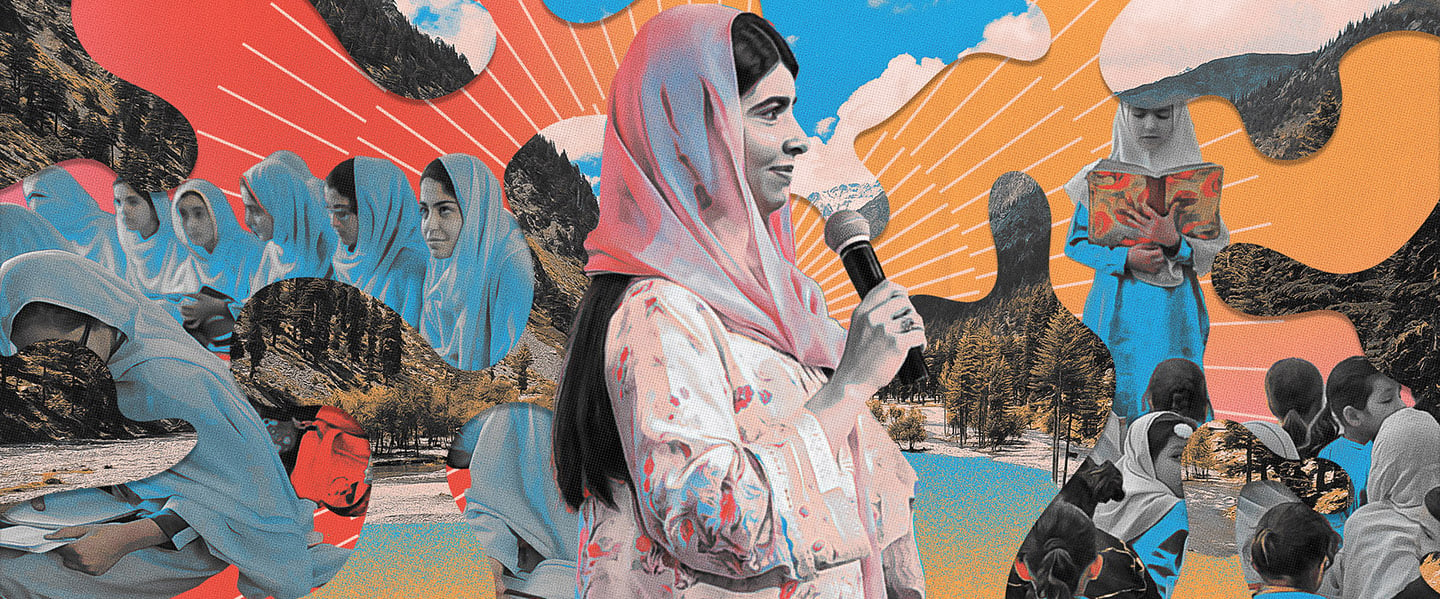
The bravery of Malala Yousafzai
The Nobel laureate challenges Rotary members to make their own daring leaps
10 Sept 2026
In the fall of 2017, during her first weeks as a student at Oxford University, Malala Yousafzai snuck out of her dormitory in the middle of the night and climbed to the top of a campus bell tower, a feat that required eluding detection, teetering on rooftops and window ledges, and making death-defying leaps.
“People had been watching me my entire life, making sure I followed the rules, obeyed orders, stuck to the script,” Yousafzai explains in her latest memoir, Finding My Way. “Since arriving at college, I felt high on independence. Every choice, even the bad ones, belonged to me.”
Yousafzai’s daring leap in the dark epitomized everything that this Nobel Peace Prize laureate — the youngest ever — and courageous advocate for girls’ education has represented since she survived the Taliban assassination attempt that nearly took her life in Pakistan in October 2012. In June, she spoke at the Rotary International Convention in Taipei. Afterward, for an episode of the Rotary Voices podcast, she sat down with Yin Khvat, the senior producer and host of the weekly current affairs program Taiwan Talks. Among other things, they talked about Yousafzai’s experience at Oxford, her mother’s dreams, and her school for girls. Fittingly, their conversation began with a consideration of Yousafzai’s bravery and concluded with her imploring Rotary members to make their own leap and, like her, to be bold.
What makes you so brave?
I could not see a future for myself without an education. Girls are determined to keep learning despite the hardships they face. I feel very lucky now that I’ve completed my education and graduated college. But when I think about the 11-year-old girl I was, I could not believe in that moment this would ever come true. So, I had to fight for it.
I feel like the best way to fight against extremists is to keep empowering women. I thought: They don’t want to see an educated girl, so I will become that. They don’t want to see an empowered woman, and I will become that. They wanted to silence one girl for daring to be in school. Today, I want to help millions of girls be in school.
Your father named you “Malala” after a female hero and warrior. What do you make of his choice three decades later?
My father is very passionate about supporting women and girls. He was a teacher, an activist, and I looked up to him. There were many other girls in my community who wanted to be in front of a camera, participate in the activism, but their fathers or brothers stopped them.
One time my cousin was complaining to my dad, saying, “Malala is in the public eye now, she should cover her face, she should not be participating in these public events.” My father told him to mind his own business and not interfere in my life. I’m grateful that he stood up for me. It makes a huge difference when you have the support of your male family members — when they become your allies.
My father’s five sisters did not go to school. For him, it was two distinct realities of what life is like when you are born a girl or a boy. That’s when he made a commitment to educating his daughter. He named me “Malala” after Malalai of Maiwand, the Afghan heroine, because he wanted me to have my own identity.
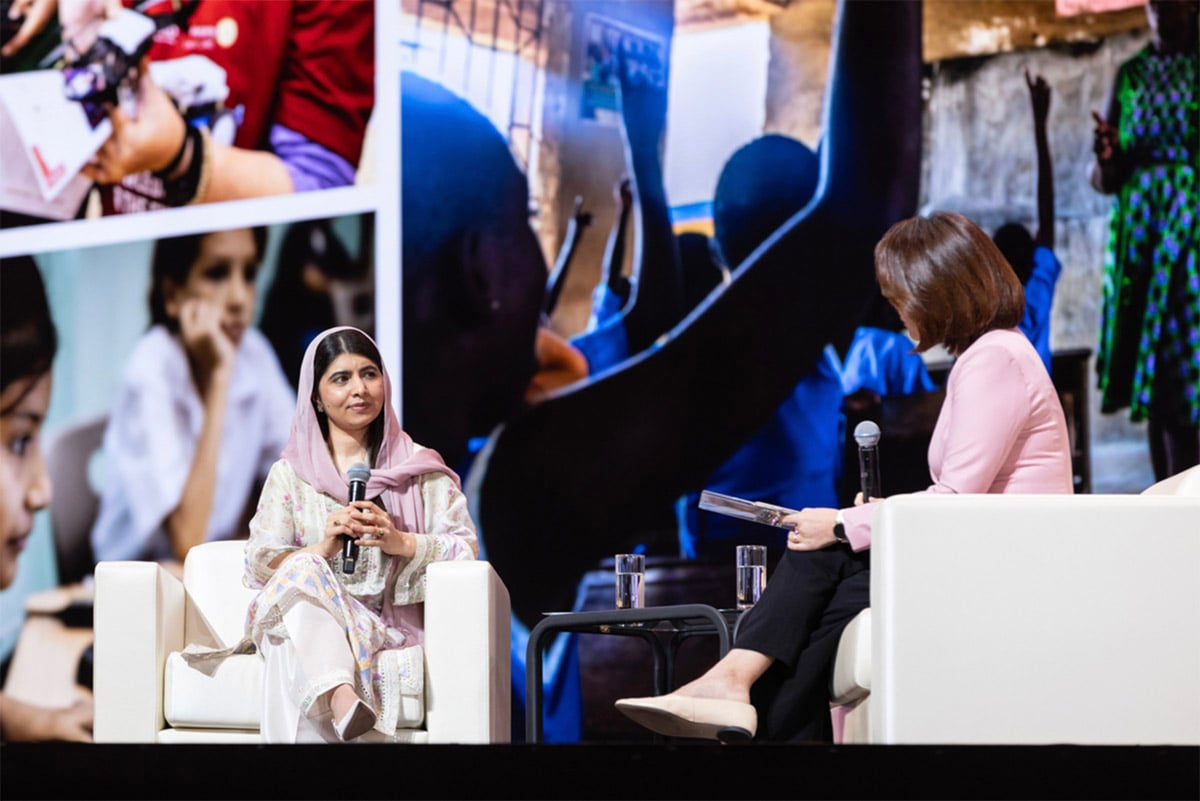
Malala Yousafzai and Yin Khvat speak about education and peace during general session 2 at the Rotary International Convention in Taipei.
Image credit: Monika Lozinska
There was a heartbreaking moment in Finding My Way when you asked your mom what her dreams were. Can you tell me about that?
In that moment, I was deciding whether to get married and was wondering what life was like for my mom as a girl. Did she have a dream? My mom’s answer was, “Oh, I just wanted to marry a man who could take me to the city, and we’d enjoy the rain and eat some kebab.” I said, “Mom, that’s different. What was your dream for yourself?” She had no answer.
That’s when I realized there’s a whole generation of women who have never imagined that they could have dreams for themselves. I felt very lucky that life was different for me, and it was because of their sacrifices that I was in a better position. There was no secondary school for girls in their time. My mom joined a local primary school but realized she was the only girl in that classroom. She sold her books and never went to school again. I hope that we make it easier for the next generation of girls.
My mom is strong, resilient, and brave. She has helped so many girls in our community get into school and protected them from forced marriages. Now she’s in her 50s, going to an adult learning center.
Let’s talk about your Oxford years. You talked about this freedom you had, but at the same time, there were tremendous pressures. How did they evolve over that time?
At the high school where I studied in the UK, I struggled to make friends because I was new to the country and culture. At college, I just wished I could be a normal student, have lots of friends, and have moments of joy.
In my activism, people would ask me all of these big questions about how to change the world, what we can do for girls, what prime ministers and presidents should do. I felt that I was supposed to have an answer for every question. For a period of time, I actually thought I couldn’t have friends, I couldn’t find love, and I was only supposed to be this serious person.
My friends gave me comfort where, in their company, I didn’t feel like I was making a political statement or something. We were just chatting about boys, gossiping, talking about star signs, and I could finally just relax.
As I grew and met more people, made friends, and found love in life, I realized that the real beauty of humanity is that when we come together, we’re able to figure out solutions to all of these problems. This idea that one person has it all in their head is false. It’s a delusion. Learning is not limited to books. You learn a lot from the people around you.
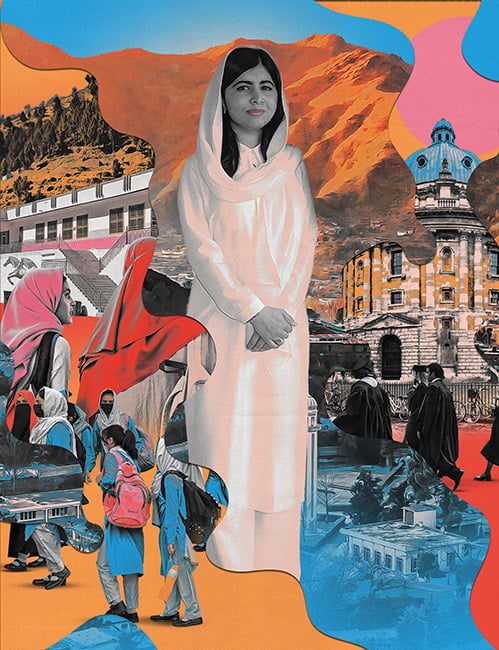
Illustration credit: Máximo Tuja
At Oxford, there was one point where you were failing a bit in your studies, and yet you were this champion for girls’ education. Can you take me through that?
College was an interesting dynamic because you have to study, socialize, and get some sleep as well. And then for me there were a few other layers like advocacy work, earning for my family, and so many other things to manage. I remember in one week I was in three different countries. My teachers got really concerned because I was behind in my essays, was not performing well, and nearly failed my first-year exams. I said, “OK, I need to figure out a way to balance this.”
There was an academic support office, and I’ve noticed that oftentimes in colleges the support system is there. I think it’s important for universities to ensure that students actually know about it. It helped me a lot with my studies, so in the end I figured it out. I know a lot of students go through that struggle. I want to tell them that they’re not alone. We all go through it.
Do your imperfections and humanness make you a better role model for girls and women?
It’s important that we speak the truth. I don’t want to tell young people that when someone is called a role model, they have it figured out. When I get to meet young kids who are reading my story, I want them to know that I have been in the same place as them. When you are young, you are curious about the world and want to solve its problems. There are setbacks and you learn that the problems can be a lot more complex.
Your physical and mental health matter too. With every passing day, I felt that I was failing because 120 million girls can’t go to school. There’s a ban on girls’ education in Afghanistan, and there are so many challenges. I felt like, “Why can’t we fix it in a day? Why can’t this change sooner?” I was not looking after myself.
In college, I started getting panic attacks and flashbacks of the Taliban attack. My mental health was in a very difficult state. That’s when I started getting therapy. I’m so glad I did because it changed everything for me.
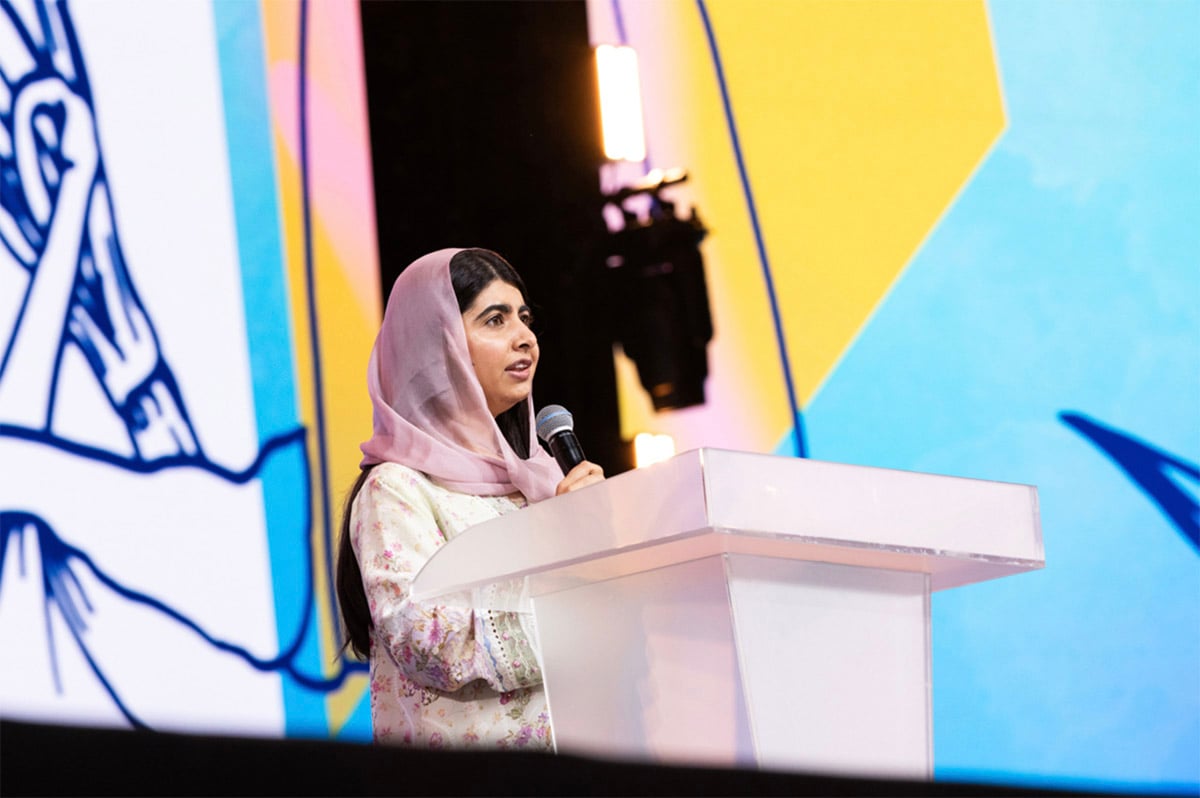
Image credit: Monika Lozinska
It’s hard for us to ask for help sometimes, isn’t it? Is that one of the important lessons you want to get across?
I was so hesitant to ask for help and felt that nobody could understand what I was going through. We all feel like our situation is unique. My therapist said, “You’re not the only student who is facing all these challenges. The reasons can be different, but there are a lot of similarities as well.” That gave me a little comfort.
In my case, I never received therapy after the Taliban attack. After seven years, when I started getting these flashbacks, I realized I should have received help for this many years ago. I was lucky that I got the support and the therapist diagnosed me with PTSD and anxiety. Those sessions have been so helpful for me, and I continue to get therapy.
It’s not like it’s all become easy. I’ve had many panic attacks after that as well. What I have learned from this is that it’s going to be OK. I’m going to make it. I just hope that a lot of young people get this message that you are going to be OK, and you should ask for help when you feel like you need it.
You have supported schools in Pakistan and Lebanon with your Nobel Peace Prize money, right?
We actually bought a piece of land in my parents’ village, Shangla, in the north of Pakistan. I had this dream. I said, “This is the place where my mother could not complete her education. This is a place where we still do not have a high school for girls.” And everybody said, “It’s up in the mountains and it’s hard to construct a school there.” I thought, if we can make it happen there, we have no excuse not to do it anywhere else in the country.
We made this amazing state-of-the-art school and started enrolling girls. Last year, I got an opportunity to visit and meet the first graduating class. These girls were incredible. They are so ambitious and bold. They were telling me about their dreams, that they want to be teachers, engineers, and doctors. They want to serve their community.
They were painting and playing chess and sports like cricket. They also had a mental health office. Like other students, these girls are under a lot of pressure, and they also have real challenges at home, from safety and security to forced marriages. Just recently, a 14-year-old girl was forced into a marriage. The school administration and local police saved that girl. She remains in school. We’ve saved the lives of so many girls and are helping them continue their education. They are role models to that community and have changed the future for women and girls there.
What kind of tips can you offer Rotary members if they want to take practical steps to help women’s equity?
First, I want to tell Rotarians that it’s not the first time I’m hearing about them. In Swat Valley where I grew up, my father was a Rotary member. He was doing a lot of community work, helping clean the river, doing cultural events, and helping kids get into school. So for me, this is full circle. All your Rotary work reaches so many different parts of the world that you can’t even imagine. I want people to understand the power that it has. Each individual act matters. Never feel alone when you are getting started.
Second, it’s so important for us to join hands because then we are stronger than ever. We can make our vision into a reality. I want to thank everybody for their service, and I want to push you all to do more, to be more ambitious, and to be bold in the work that you do.
This story originally appeared in the September 2026 issue of Rotary magazine.