

When lifequakes jolt your world
If you’re seeking solid ground, one bit of advice rises above others: Don’t go through it alone
by Kate Silver | Photography by Juan Diego Reyes
10 Sept 2026When Tia Coppus’ husband, Ethan, died of cancer, a fog came over her. At just 38 years old, she felt as though she’d lost half of herself. Then came the silence.
This was October 2021, and for 19 months, it had just been her and Ethan locked away from the world to keep COVID out. During that time, she’d forgotten how to be alone. And she’d forgotten how to be around other people. When a friend invited her to a Rotary dinner meeting soon after the funeral, she wasn’t sure she was capable. “I’m thinking, I don’t even know what to do,” Coppus recalls. “I haven’t been out since March of 2020. What if I’m not OK?”
Rotary had been an important part of Coppus’ life since 2014. In fact, she attended her first meeting just a few months after Ethan’s diagnosis, and the Rotary Club of Cary-Kildaire in North Carolina quickly became an outlet just for her. Every Thursday night, she could meet with friends and laugh. As her husband endured the side effects of chemotherapy and clinical trials, Rotarians were there for her. They raised money to send the couple on a bucket-list trip to Colorado; they dropped off meals and checked in; they even sang Christmas carols in the driveway during the pandemic.
So she decided to go to dinner.
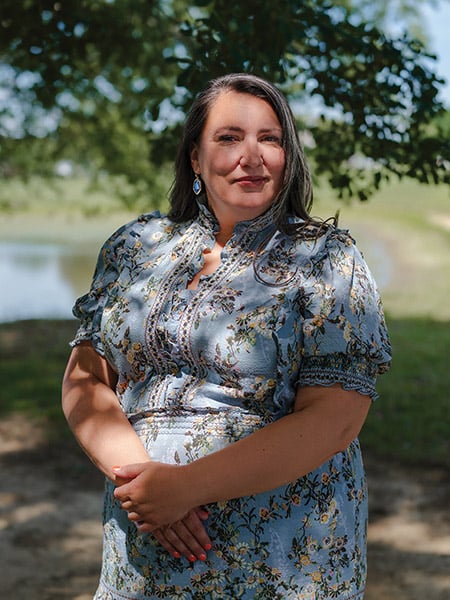
Following the death of her husband, Tia Coppus found the support she needed with her Rotary club.
From the moment she arrived, she found herself hugging new members and old friends. She laughed at people’s stories. She made eye contact with a recent widower. And she realized she wasn’t alone. “Grief is like a complete destruction of your life and your normalcy. You just don’t know where to go, where to start,” she says. “Rotary put a path in front of me that I could take.”
There’s a name for the type of crisis that Coppus was living through. Author Bruce Feiler calls these disruptions “lifequakes” because they can shake a person to the very core. “The damage they cause can be devastating, they’re higher on the Richter scale of consequence, and their aftershocks can last for years,” Feiler writes in his 2020 book, Life Is in the Transitions.
Feiler, who was once a Rotary scholarship recipient, became interested in the subject after going through a series of lifequakes himself; they involved his own cancer diagnosis, financial troubles, and a sick and suicidal father. He traveled across the United States collecting stories from people in all 50 states and then mined those stories for patterns. He calculated that an individual could expect some kind of disruption, big or small, about every 12 to 18 months. “That’s more often than many people see a dentist,” he says.
He attributes that frequency to the fact that our lives are no longer linear. In the past, many of us had expectations that seemed straightforward: one job, one partner, one political belief system, one identity. Yet modern life is filled with curves, and it’s often defined by multiple jobs, multiple partners, evolving political belief systems, fluid identities.
Most of the changes we get through OK, but a few of them reach lifequake status. On average, Feiler calculates that adults tend to experience three to five of these more consequential lifequakes, which last about five years each. “We think the stable periods are normal,” says Feiler, “but in fact, the transition is equally normal.”
Learning to navigate these changes is a must. When a lifequake happens, the first and most important step, says Feiler, is deciding you want to go through the transition. Then, the support of a community can be instrumental. “Don’t go through it alone,” says Feiler.
“We think the stable periods are normal, but in fact, the transition is equally normal.”
In an active group, whether it’s a church, a support group, or a service organization, people can tell their stories, they can meet others who have been through similar transitions, and they can be a part of something that’s bigger than themselves.
By Feiler’s count, half of the adults around us are going through a transition at any given time — and the rest aren’t far behind. With that in mind, we reached out to Rotary members about events that caused fundamental shifts in their lives. Each story we heard started out with a plot twist: death, divorce, retirement, struggles with identity. As they wrote their next chapter, the individuals found community, purpose, hope, identity, and resolve, all with the support of their clubs.
Montana is famous for its majestic, rugged beauty. That’s what drew Leigh Larson and her husband to Great Falls in 2022. But when their marriage crumbled soon after the move, Larson found herself profoundly alone. Quickly, she learned that the seclusion and isolation that make those wild landscapes possible can break a person. “There were whole weeks where I wouldn’t leave the house,” says Larson. “I didn’t see anybody.
Images courtesy of Rotary members
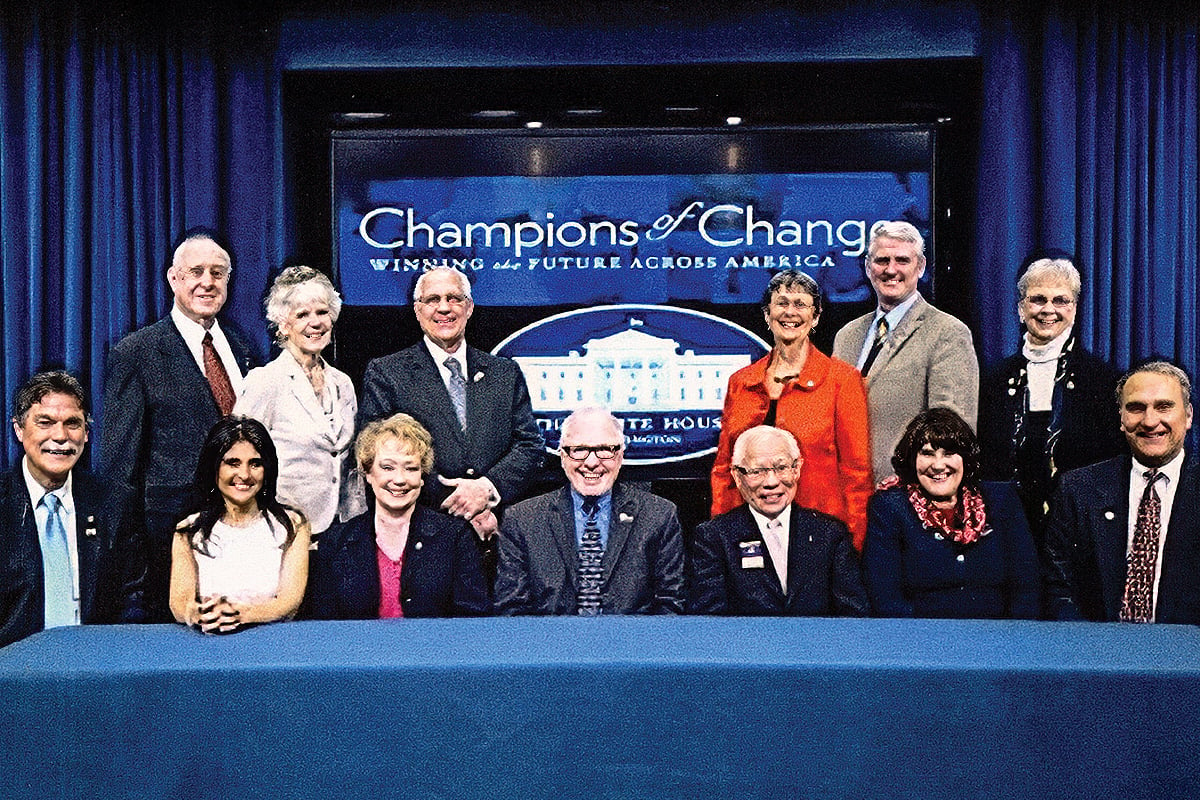
Peggy Halderman (bottom row, third from left) at the White House Champions of Change ceremony.
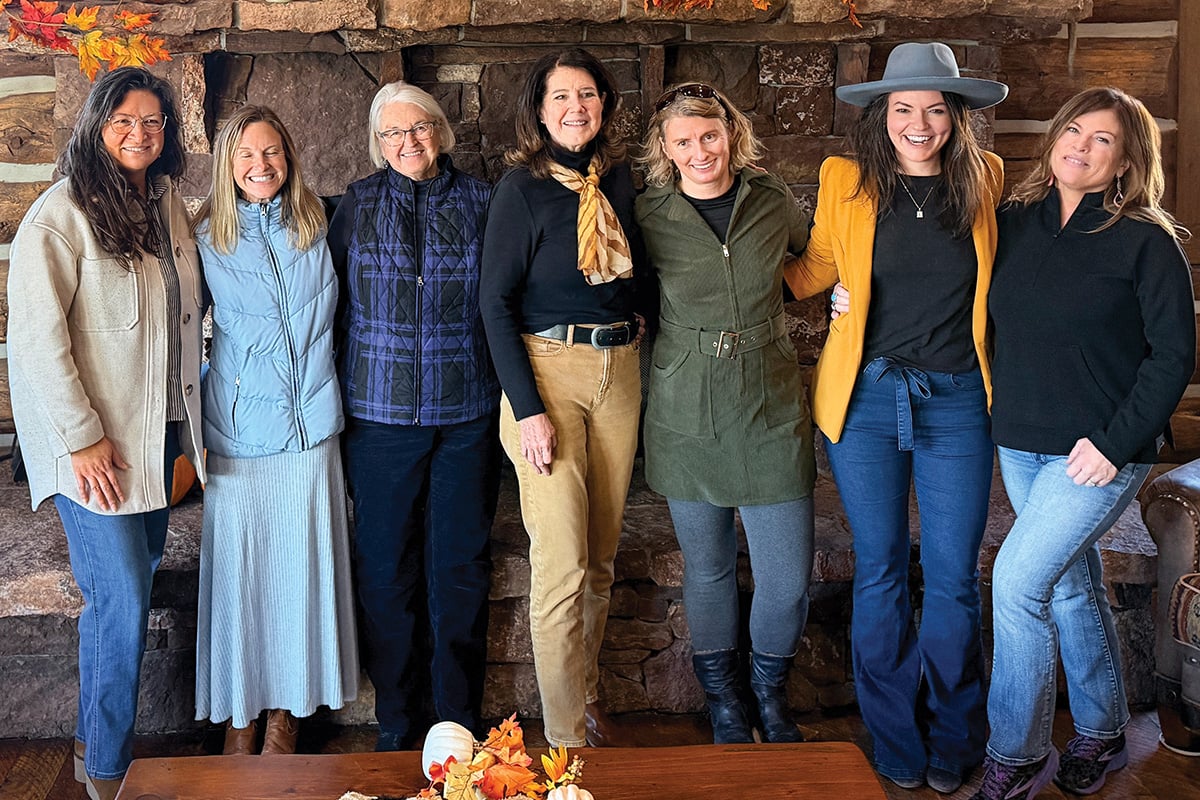
Leigh Larson (second from right) joins other Rotary women at a brunch.
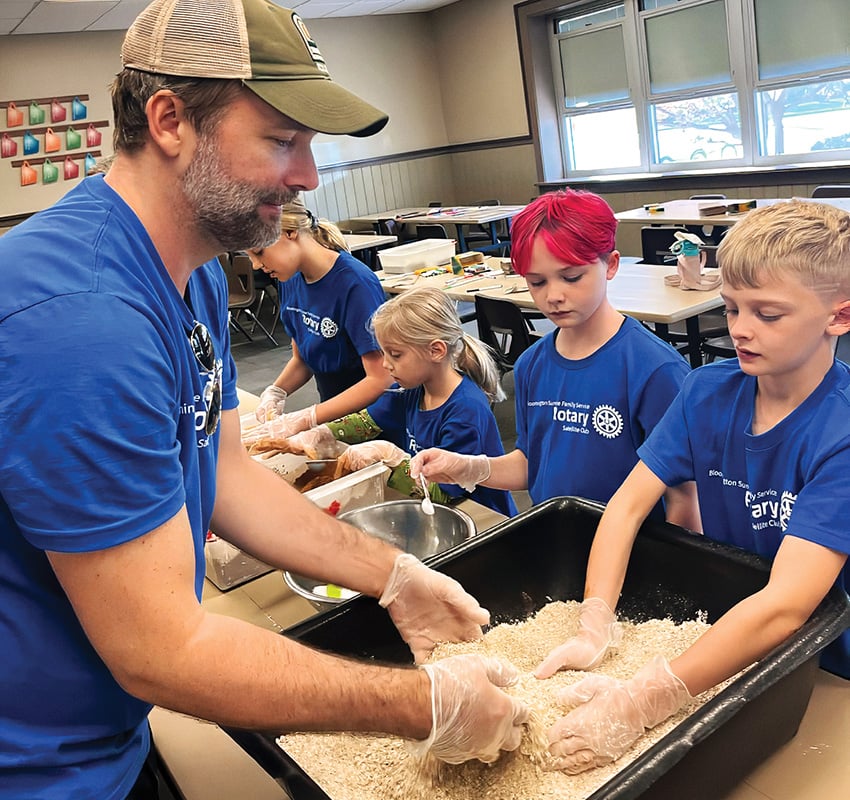
Gabe Gloden takes part in a service project alongside his children.
As a self-employed web and graphic designer, she knew she needed to build her professional network, even as she was enduring a personal crisis. So she reached out to the local chamber of commerce. “If you want to be with the movers and shakers,” they told her, “you should check out the Great Falls Rotary club.”
At her first meeting, Larson noticed the club’s social media and photography needed updating, so she volunteered to help. Before long, she was asked to assist with social event planning, which immersed her in the local scene as she toured organic farms and museums and checked out different restaurants. The Rotarians she met were eager to help her get settled, whether that meant introducing her to others in the area or teaching her the ways of Montana. “A few of them offered to help me with either firearm or bow-and-arrow safety,” she says. She took them up on it.
Settling into her new rural life, Larson started learning the ropes. When her car broke down on the side of the highway in an area with no cell service, she was reminded that, yes, she needed to be tough; and also that survival out there depended on people helping other people.
For that, Rotary has been a hub. It’s fostered professional connections and close friendships, along with a deeper understanding of who her neighbors are and what they need. In those early days, Larson was looking to network. What she found was a community that, today, feels like home. “I look after them,” she says, “and they look after me.”
For many years, community service had been a part of Gabe Gloden’s life. He’d been an AmeriCorps member, and he even got his master’s degree in nonprofit management. But when he married and had kids, his priorities shifted. He didn’t feel like he had extra time to give. Parenthood, after all, can feel like its own lifequake.
Then, he went through a divorce. As he and his two young children rebuilt their lives together, Gloden was feeling unmoored, disconnected from the community around him. In therapy, he began to understand that he had an opportunity to shift his focus to activities that were important to him.
Around that same time, a colleague asked if he’d be interested in joining a nontraditional Rotary club she was starting for families. The Family Service satellite club of the Rotary Club of Bloomington Sunrise, in Indiana, would meet monthly for service projects that kids and parents participate in together.
Gloden was energized by the idea. “I could engage my children around the value of service,” he says, “and I also saw this as an opportunity for us to have a social experience outside of the house.”

Since 2024, Rock, who is 10, and Beatrice, 11, have helped fill book bags with food for kids, sorted items at food pantries, weeded gardens, and served as extras in a movie made by an arts organization. They’ve also gotten to know the other like-minded families in the club, who are committed to making Bloomington a better place. Gloden says that by participating regularly in something that’s bigger than themselves, all three have grown. “Service is not just about the action and the outcome you expect to have with the organization you’re volunteering for,” he says. “It’s also about the change that takes place in the volunteer.”
Glenys Robertson came to a similar realization: that in moments of upheaval, helping others can be steadying. Like Gloden, she went to her first Rotary meeting at a time when she felt broken. She’d endured a traumatic divorce while living in Spain and then moved back to her native Britain to pick up the pieces. A friend invited her to a meeting at the Rotary Club of Grantham, where she was touched by the warm welcome.
At the time, she was partially retired and had time to fill in her schedule. When club members asked her to help run the district’s Disability Games, she eagerly agreed. The day of the event, she ran herself into the ground, making sure everything went smoothly. At the end of it all, a young athlete embraced her. “She said, ‘This is the best day I’ve ever had,’” Robertson recalls. “And I cried, because I was just so tired, but so elated, because I thought this is what Rotary is. Rotary gives you joy because you are doing and giving.”
Robertson threw herself into more service projects and, as time passed, took on leadership roles with the club. She saw that the more she gave, the more she healed. Today, at age 75, she’s an assistant governor of District 1070. Although she’s retired, she says she’s busier than ever. And she wouldn’t have it any other way. “If we are altruistic, we get so much more out of life,” she says. “I got my mojo back.”
In 2025, John Weiss completed his second term as president of the Rotary Club of Morro Bay, California, and his daughter, Jessica Bailey Weiss, started her first. The passing of the baton would turn out to be more significant than either of them knew.
John had been a dedicated Rotary member since Jessica was a teenager. In 2011, he helped charter the Rotary Club of Morro Bay Eco to draw in younger, more environmentally conscious members, and he let Jessica know that she’d be helping. “He asked me if I wanted to be treasurer or secretary,” she says with a laugh. “That was the choice. He didn’t ask me, do you want to join?”
At club meetings, Jessica saw her dad from a new perspective. Although he’d been something of a workaholic while she was growing up, in Rotary, he was a playful, funny guy whom everyone liked. He seemed to especially enjoy recruiting new Rotarians and mentoring members.
In 2017, John was preparing to serve as governor of District 5240 when he learned he had a rare form of cancer. One day, he was gearing up to visit the district’s 73 Rotary clubs, and the next, doctors were saying he might not survive five years. It was the ultimate lifequake, but he wasn’t budging from his plan. “He didn’t want to step down,” says Jessica. “He didn’t want to quit.”
Through various treatments and nine surgeries, John carried out his Rotary duties in the years that followed, often attending virtual meetings from his hospital bed. As he defied his doctor’s expectations, living past six years, then seven, Rotary gave him hope and purpose. In the eighth year, he trained his daughter to be president. And when he died on 4 September 2025 at age 66, he did so knowing the club was in good hands.
Jessica is grateful that her term as president followed her father’s because it meant they got to spend so much time together preparing for the handoff. Now, she’s comforted by the outpouring of support from Rotarians who loved her father deeply. “It feels like his legacy is living on,” she says. True to that legacy, after her father died, Jessica didn’t miss a meeting.
Gregor Baum thought he was living the dream. In 2021, he moved from his native Germany to Rocky Mount, North Carolina, to attend North Carolina Wesleyan University on a tennis scholarship with the aim of going pro. Then, at the first practice of the year, an intense pain wracked his back. A doctor told him that because of the injury, he might not be able to safely play tennis again.

Without tennis, Baum wasn’t sure who he was and fell into a deep depression. When a counselor encouraged him to explore new interests, he thought back to a Rotary Youth Exchange trip when he was 17. He had traveled to La Paz, Mexico, and learned to communicate with his host family even though they didn’t speak the same language. “It taught me the immense value of venturing outside of my comfort zone — where true growth and transformation happen,” he says.
Now, outside of his comfort zone once again, he started a Rotaract club on campus where students could talk about challenges and setbacks of their own and find a way forward. Along the way, he developed a journal for students called The Inner Journey Journal, filled with questions that encouraged users to reflect on their experiences and grow from them.
Today, resilience is Baum’s identity. After graduating, he became a life coach and speaker, and he continued developing journals, including one designed for Rotary members called The Rotary Mindset. He’s now pursuing his master’s degree in organizational leadership at Jacksonville University in Florida, where he’s the president of another Rotaract club that he helped charter. Baum encourages people to move beyond their comfort zone and transform their pain into purpose. And he still credits Rotary with pushing him to do more. “Rotary has not only changed my life but also provides me with the chance to uplift others,” he says.
For Peggy Halderman, the pivot came much later in life. After retiring from what she calls “the best job on the planet” — three decades of working for the National Park Service — she saw a blank canvas in front of her. She enrolled in culinary school, thinking she’d like to launch a personal chef business; she joined the Rotary Club of Golden, Colorado, where her husband was a longtime member; and she started volunteering. While helping at a local nonprofit, a chef told her about an issue that stopped her in her tracks: hidden child hunger. The hundreds of kids in Golden who receive federal assistance for their meals at school often don’t have reliable access to food on weekends and school breaks. “A fury broke out in me,” says Halderman. “And I said, Not in my backyard.”
She took the issue to her Rotary club’s board, and they told her to fix it — they’d pay. She set up meetings with city officials, nonprofit leaders, and school administrators, and in 2008, the Golden Backpack Program was born, with a mission to provide healthy meals to students and their families. “All I had to do was share the news and the community sprang into action,” she says. “Doors started opening.”
“It taught me the value of venturing outside of my comfort zone — where true growth and transformation happen.”
Word about the program spread well beyond Colorado. In 2013, Halderman was recognized as one of the Champions of Change by the White House, and, later, Rotary highlighted her work in its People of Action campaign. By the time Halderman stepped away from the nonprofit organization, which is now called BGOLDN and serves people of all ages, it had delivered 500,000 meals to area kids in about 10 years.
Now, as she approaches her 78th birthday, Halderman has moved on to her next chapter: She’s taken on a mentoring role and loves introducing others to Rotary so they can pursue their passions and achieve their own dreams. “I love bringing people in,” she says, “And I love helping people get to ‘yes.’”
When Tia Coppus attended that first Rotary dinner after Ethan died, she took the most important step that a person can take following a lifequake: She decided she wanted to go through the transition.
That evening, Coppus knew that if she were able to make it through a meal and perhaps even find a way to enjoy herself, she could then do other things as well. She felt more confident about having conversations with other people, and she could learn how to buy groceries for only one person. In time, she could even use the word “widow.” “It really was a lot more than just eating dinner and socializing,” she recalls. “It was helping me reenter the world.”
In those early days of grief, there were times when she didn’t want to get out of bed. But she started to put things on the calendar — coffee with a Rotary member here, a service project there. Before long, her schedule filled with activities that brought meaning, connection, and even joy. During her darkest times, she had a source of positivity. And when she was ready, she started to give back to the organization.
Today, almost five years since that meeting, Coppus is an assistant governor of District 7710. “We will never move on, but we have to move forward, like the sun rises tomorrow,” she says. “Rotary gives you so many steps forward. It reminds you that even when you’re the one who’s used to giving, it’s OK to receive.”
This story originally appeared in the August 2026 issue of Rotary magazine.