Ohio club serves up pancakes with potential
The Rotary Club of Logan, Ohio, uses funds from its annual pancake breakfast to support youth in their community
by Rose Shilling
31 Jul 2026An elementary school-aged girl hops out of her family car outside a county fairgrounds building in this Appalachian foothills town to find out the cost to eat at the pancake breakfast inside. $8.
She asks the people out front if the fundraiser accepts cards. Without hesitation, Rotarian Sherry Kilbarger says she has extra tickets to give away and invites the girl and her family inside for the all-you-can-eat pancakes. Plus sausage links and OJ. A woman walking out of the building into the spring sunshine overhears the exchange and hands Kilbarger two more tickets to share.
Looking out for the kids in this small town is a top motivation for members of the Rotary Club of Logan, Ohio. Nestled among rolling hills, the area is popular with visitors for its miles of hiking trails that wind through gorges with waterfalls, awe-inspiring rock formations like a natural bridge of stone, and dazzling fall leaves. The club provides bikes to local kids at Christmas and holds a popular fishing day each spring when the state’s nature officials stock Rose Lake with trout. “Because we are a small club, the things that we do are community-minded,” Kilbarger says. “We want our youth to have opportunities.”
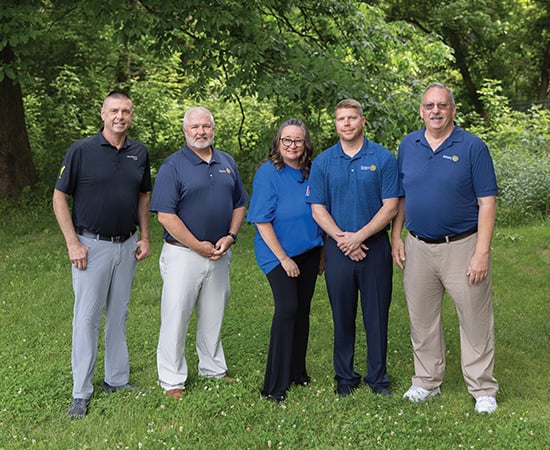
Looking out for local kids is a motivator for the Rotary Club of Logan, including (from left) Damon Kuhn, Chad Grow, Sherry Kilbarger, Andrew McGhee, and Jim Robinson.
Image credit: Maddie McGarvey
The Logan club expects to earn about $3,000 from the pancake breakfast, its largest fundraiser, which has been gathering neighbors over syrup drizzles for more than 50 years. Club members make the most of every dollar, accomplishing as much as they can for the community, where the percentage of people living in poverty is well over twice the national rate.
One club project provides duffle bags filled with a blanket, toiletries, socks, and underwear for children going into foster care or young people staying in group homes. The club also awards stipends to young people who are joining the workforce, learning a trade, or starting a two-year educational program. Those funds for work clothes, tools, personal protective equipment, or other basics are in addition to college scholarships the club distributes. And for the town’s high school, the club contributed $20,000 toward an indoor sports facility, digging into its reserves from decades past when the pancake breakfast and an arts fair brought in more money.
Given how well they organize their projects, it’s apparent that these Rotarians are dynamos at working with local leaders and drumming up sponsors and donations to stretch the good that $3,000 in flapjack profits can do. Jim Robinson, a City Council member who has organized the pancake breakfast for a decade, has hawking tickets to the people who can afford them down to a science. He encourages those who have a conflict with the date (or who want to avoid the carbs) to give the tickets away — or he jokes that they can eat the paper tickets themselves, as long as they donate $16, the price for two. Many people round up and hand over a twenty.
These Rotarians also work their connections to recruit sponsorships for the annual fishing day, Get Hooked on Rotary; those sponsors include Walmart, a canoe livery, and a local boot manufacturer. The sponsors’ support supplements the club’s $500 contribution, which is matched by $500 from Rotary District 6690, allowing the group to give away T-shirts, more than 100 fishing poles, four bicycles, canoe trips, and toys.
Early on, when members learned that many of the kids, about 150 this year, were arriving at the lake without breakfast, they started serving grilled hot dogs and chips, says member Damon Kuhn. He came up with the idea for the event, now in its 18th year, when he joined Rotary and wanted to do something for the town’s children. One time, when a girl caught a 7-pound bass, he got it mounted for her.
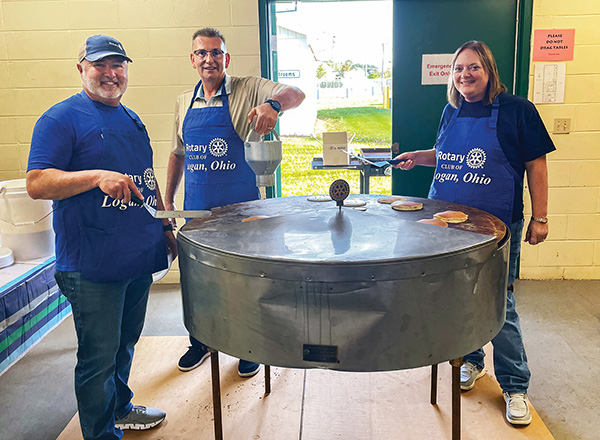
The special griddles the club uses were crafted in 1988 by late Rotarian Ed Runge, an engineer and machinist. Rotarians still use the two drum-shaped cookers Runge designed, each with a revolving griddle disk. Three or four Rotarians stand at a cooker; one uses a big metal batter dropper to plop circles on the rotating griddle while the others flip, until, after two rotations, the cakes are cooked to a golden brown. “The pancake goes around, gets flipped, goes around, and they tend to come out really well,” Robinson says. “We’ve got it timed up pretty good.”
Kuhn is president of Valor Retreat, a recreational site under development near Logan that will take advantage of the tranquil Hocking Hills to provide a free retreat for military veterans who are recovering from their service or have post-traumatic stress disorder. The Logan club has partnered on fundraisers with the retreat as it builds accessible cabins and pursues plans to bring in horses for equine therapy.
Robinson says that the club is also working with the chamber of commerce to try to promote Rotary membership to young business owners. He talks with people who are curious about Rotary and some of its areas of focus — from providing clean water to supporting education — as well as Rotary’s role in the push to end polio. And Kilbarger adds that the group is discussing whether to start a satellite club or a group that would emphasize social gatherings more than traditional weekly meetings over lunch.
Brendan Johnson, a member in his 20s, says that he’s ready to try to recruit more members, and he is also considering restarting river and highway cleanups the group used to organize. But he, too, is in the club “especially to help the kids — get them Christmas gifts with our bike drive,” he says. Currently a sausage links server, Johnson also expects to someday take over planning the breakfast.
Because raising funds isn’t the breakfast’s only purpose, Robinson says that the club is intent on keeping the meal affordable. He enjoys seeing so many residents sharing a meal face-to-face, chatting, and catching up with the neighbors they bump into. “Society is becoming less and less interactive,” he says. “People don’t even go out to eat anymore.”
But here, as tables fill and the pancake makers work more quickly, Kuhn, who for years has mixed buckets of batter, shares his secret for tasty cakes — adding vanilla. It works: People line up to grab a second stack of the pancakes with the potential to provide children in Logan a little help or simply some happy memories.
This story originally appeared in the August 2026 issue of Rotary magazine.