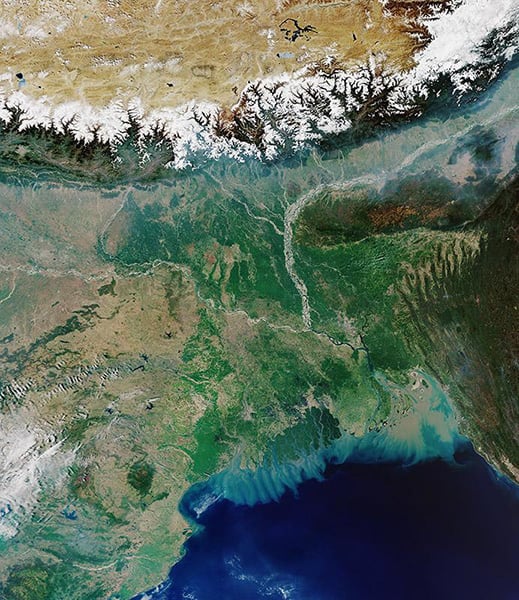
Like many parts of the world, the region has surface water that is often contaminated by runoff, industrial pollution, and poor sanitation — a problem amplified by recurring floods. As a result, West Bengal has India’s highest share of waterborne diseases, particularly acute diarrheal diseases. Starting in the 1970s, officials encouraged people to drill what are known as tube wells into groundwater aquifers. But in a painful irony, that water too was contaminated with a deadly poison: arsenic.
The highly toxic element leaching into water is a widespread global issue, putting as many as 230 million people at risk, with most contamination arising from arsenic that is naturally found in rock and soil. It’s a particular problem in northeast India and Bangladesh, where experts once called the situation the largest mass poisoning in history. Long-term exposure causes a host of illnesses from skin lesions to cancer.
On the Indian subcontinent, rivers carry weathered rock from the Himalayas and deposit it as arsenic-rich sediment in the vast alluvial plains that stretch like a ribbon across northern India and Bangladesh. With no smell or taste, arsenic is undetectable in groundwater except through regular testing.
Several years ago, Arindam Roychowdhury, owner of a health care company in Kolkata, traveled to the remote subdistrict of Kakdwip, among the interwoven tidal channels and islands along the Bay of Bengal. He was dismayed by what he saw. “People had tied a rudimentary cloth filter over tube wells to keep the insects out of the water,” he says. “Villagers were consuming water from highly polluted ponds and using the same source of drinking water for washing clothes and utensils, as well as bathing. Some of these ponds were green, ridden with moss. The stomachs of the children I met were swollen like a bowl, and it was clear that there was immense suffering from waterborne illnesses.”
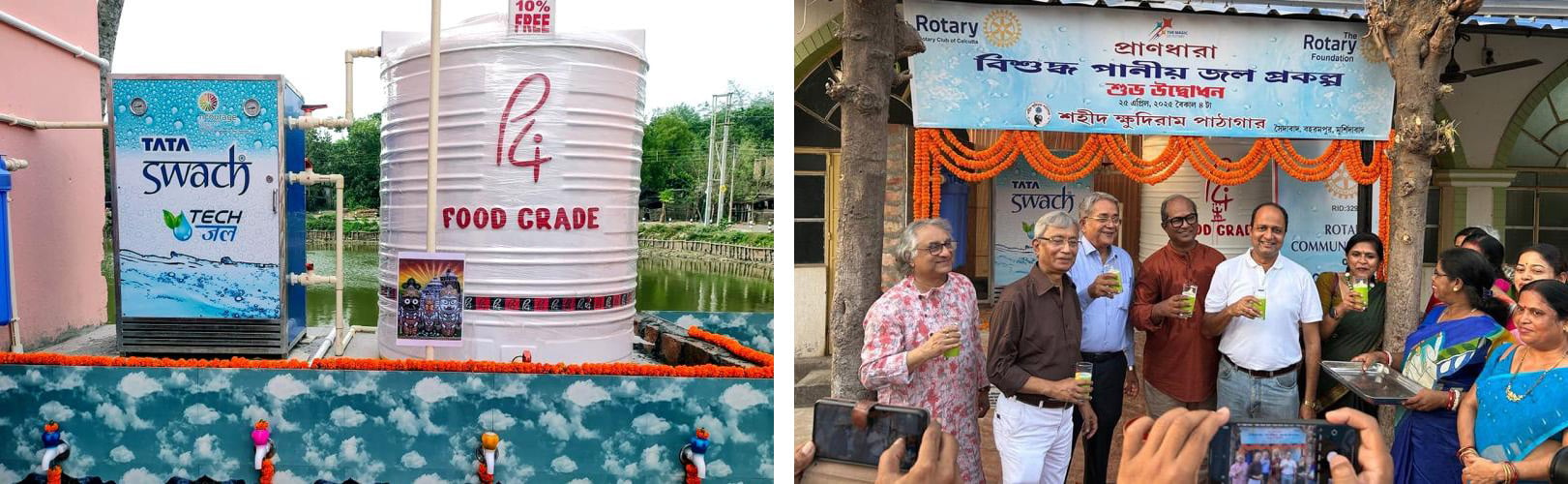
Roychowdhury, a member of the Rotary Club of Calcutta, wanted to help and knew his club, which focuses on service projects in health care, water and sanitation, and basic education and literacy, would be ready to join him.
An acquaintance at Tata Chemicals, a company specializing in the manufacture of chemical products for the pharmaceutical and other industries, told him about a filtration machine that employs a form of nanotechnology that is effective at destroying contaminants in water.