Submerged ships transform into artificial reefs in Mexico
Submerged ships in Mexico become artificial reefs, restoring marine habitat and supporting conservation, tourism, and local livelihoods with Rotary’s help
by Clara Germani
1 Aug 2024Marine biologist Carlos Sánchez has spent much of his 40-year career plying the placid blues of the Sea of Cortez on census expeditions, counting the rich biodiversity that has lured explorers from the Spanish conquistadors to oceanographer Jacques Cousteau.
Beneath this 750-mile-long inlet of the Pacific Ocean along Mexico swarms an array of life that Cousteau is said to have called “the world’s aquarium.” Rocky and coral reefs sustain a food chain starting with microscopic phytoplankton and topping out with the largest mammal on Earth, the blue whale.
However, scientists like Sánchez and the people who depend on the region for their livelihood know that the sea isn’t all it once was.
The loss of reefs is a source of eco-anxiety globally — from subsistence fishers with empty nets to people far from shorelines touched by heartbreaking documentaries about the death of brilliant reef life. But the problem, in turn, does inspire hopeful environmental and economic innovation.
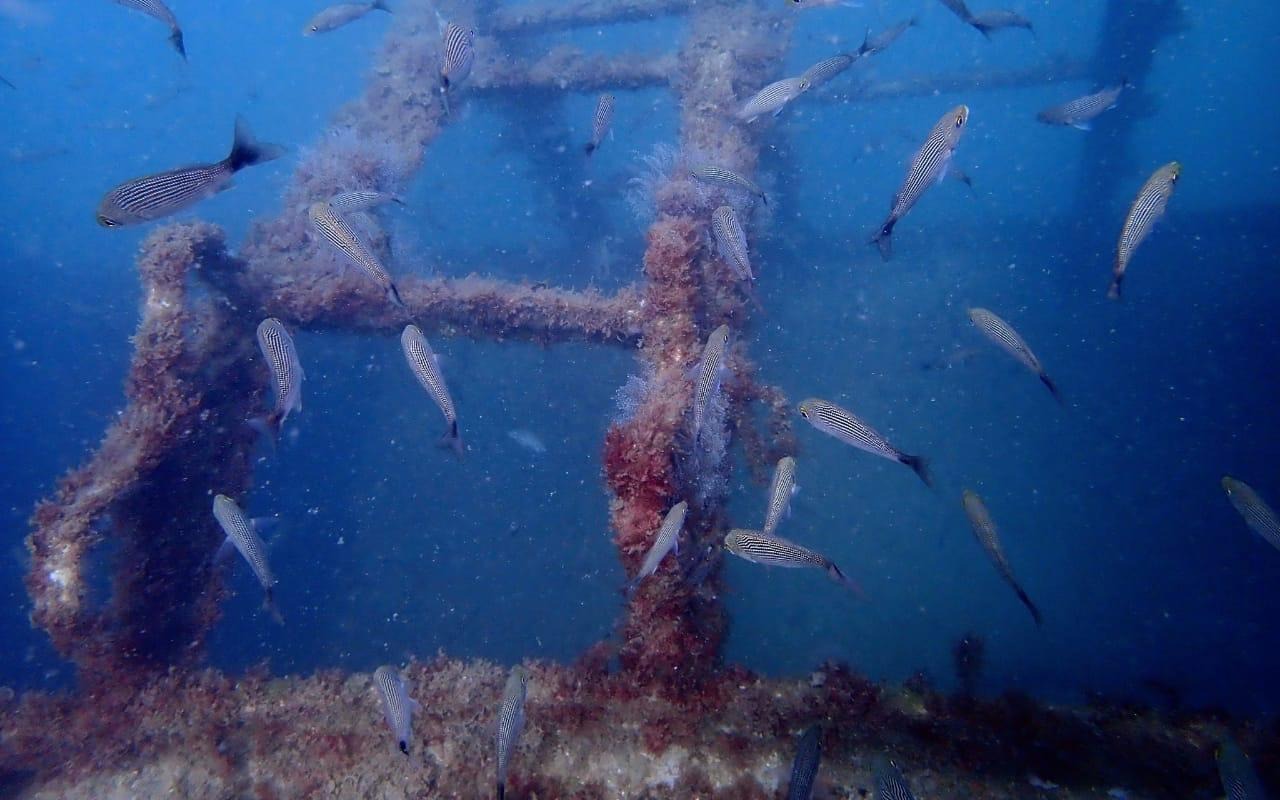
Marine life is drawn to the submerged skeleton of the first of two ships sunk in a planned chain of artificial reefs at Guaymas.
Courtesy of Juan Dworak
The contagiousness of that innovative impulse has taken shape in an ambitious artificial reef project in the port city of Guaymas in northwest Mexico.
A coalition of city, state, and Mexican navy officials — supported by far-flung Rotary clubs and a Rotary Foundation global grant — are sinking an armada of decommissioned Mexican military ships, helicopters, an airplane, an amphibious vehicle, and artillery to form reefs.
Intentionally submerging vessels and other structures, including bridges and lighthouses, has been used around the world to form reef-like habitats for corals, fish, and other marine life. Behind the Guaymas project’s sink-it-and-they-will-come approach is the hope that the hard surfaces of these structures will quickly draw flora and fauna, and in turn tourists, local subsistence fishers, and conservation education and research opportunities. The idea is not to replace but to supplement and take pressure off natural reefs, and to capture carbon that contributes to global warming.
To illustrate how dire habitat loss has become, Sánchez offers a bit of nostalgic show-and-tell: a 1982 episode of the TV show Wild Kingdom featuring scientists as they free dive in a roiling school of dozens of hammerhead sharks at an underwater ridge off Espíritu Santo Island. Today, he says, divers at that spot near the entrance to the Sea of Cortez are wowed if they encounter a single hammerhead.
The health of a reef, he says, can be measured by how many sharks and other top predators, like big grouper and snapper, it hosts: “Around Espíritu Santo you see small fish [today] but no big predators.” Their absence, explains Sánchez, a professor at the Autonomous University of Baja California Sur in La Paz, is evidence of the collapse of links in the food chain.
A census that Sánchez helped conduct last fall in partnership with the Scripps Institution of Oceanography at the University of California San Diego examined about 100 reefs throughout the sea. Ninety percent were found to be suffering significant degradation. One obvious cause is the industrial fishing trawlers that haul away vast amounts of sardines, groupers, and shrimp. Less understood, but well-documented, are the warmer water temperatures caused by climate change.
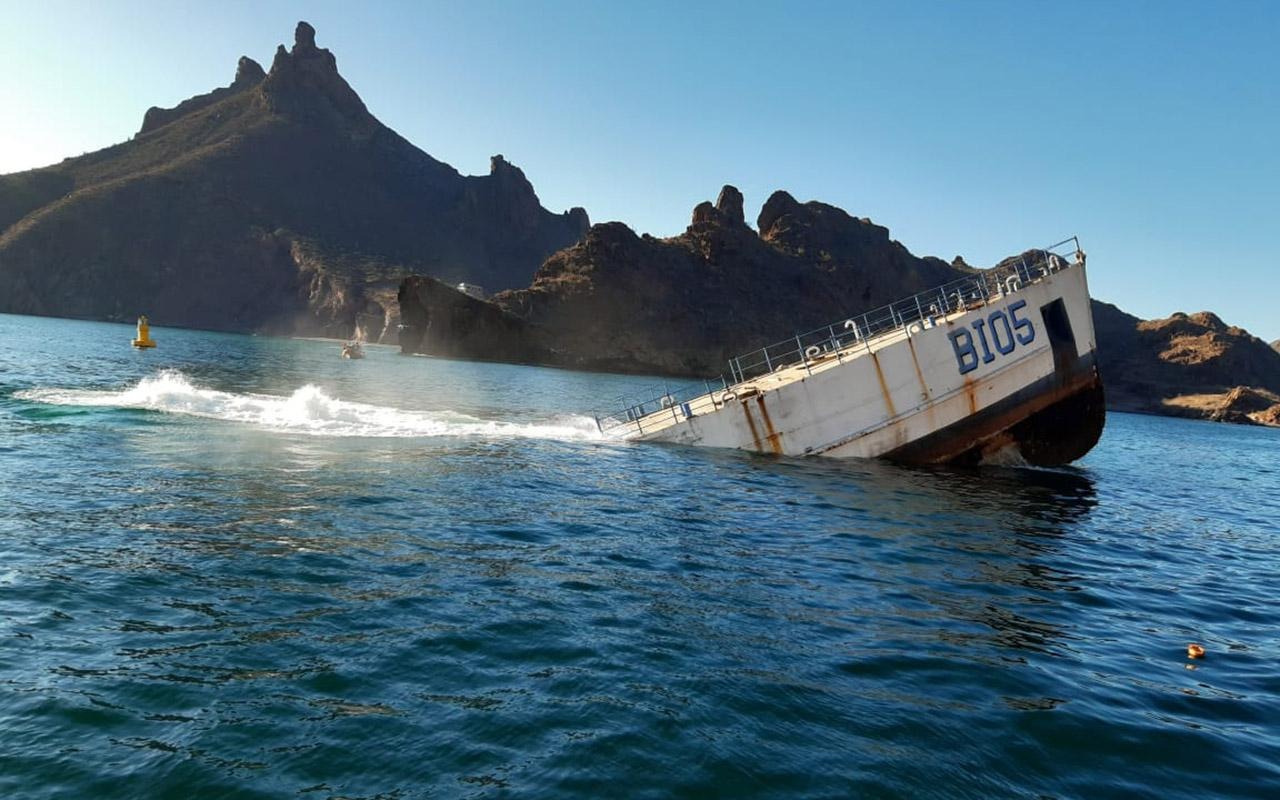
To sink the 190-foot Suchiate, a decommissioned Mexican navy research vessel, small explosives were detonated in the hull.
Courtesy of Kikis López de Arbesú
In the attempt to reverse the declines, the first ship was sunk to the sandy bottom, 100 feet deep, less than a mile off the rocky shore in 2022 and has grown a thriving reef system. But “nobody knew how to do the next step,” says Juan Dworak, the Guaymas marine consultant who conducted the environmental impact study for the project.
Then, he says, The Rotary Foundation’s $176,000 global grant provided a “miracle” boost and became “a crucial factor for a cascade of events that are happening now.” It paid for the cleanup and sinking of a second decommissioned ship, the 190-foot Suchiate, a 1940s-era U.S. Navy water barge inherited by the Mexican navy as a research vessel. But possibly more crucial, the grant funded the environmental impact study, which was written to cover all future sinkings in the project.
“There was the first sinking without Rotary. But there wouldn’t be a second vessel sunk without Rotary, and there wouldn’t be an environmental impact assessment already approved for the other artifacts to be sunk,” explains Dworak.
Avery Paxton, a research marine biologist with the U.S. National Oceanic and Atmospheric Administration, says there was a 2,000 percent increase in the seafloor “footprint” of artificial reefs in the past 50 years in the United States. But growth has slowed significantly due to costs, challenging logistics, and a lack of materials permitted for use in artificial reefs. Paxton’s studies suggest artificial reefs are “hot spots” for large predatory fish, likely because they create such tall underwater habitats.
Some illegal dumping to create habitat, however, has also caused environmental problems in sensitive ecosystems.
Sánchez, the marine census taker, says that the natural reef nearest Guaymas he has visited is so degraded that he deems the prospect of artificial reefs nearby a good idea for drawing fishing pressure away if done well.
Standing in the warm gulf breeze aboard a Mexican navy frigate last March was Kikis López de Arbesú, a member of the Rotary Club of Puebla Gente de Acción, 1,000 miles to the south. López, a driving force behind the global grant, recalls shivering with goose bumps as she watched the Suchiate barge descend gently — her dream of making a difference as a Rotary district governor reaching its climax. (The sinking was gentle because only small explosives could be detonated in the hull to prevent damage to the reef forming on the first ship nearby.)
This all started in 2020, she says, when she saw a documentary about the loss of coral. A year later, as she was trying to decide on a project for her 2022-23 year as governor of District 4185, she focused on the idea of protecting reef ecosystems. A conversation with her brother, a Mexican navy officer, led to a plan to sink a ship for an artificial reef in Veracruz, on the Gulf of Mexico. But that project was scuttled when local officials who had supported it were voted out of office.
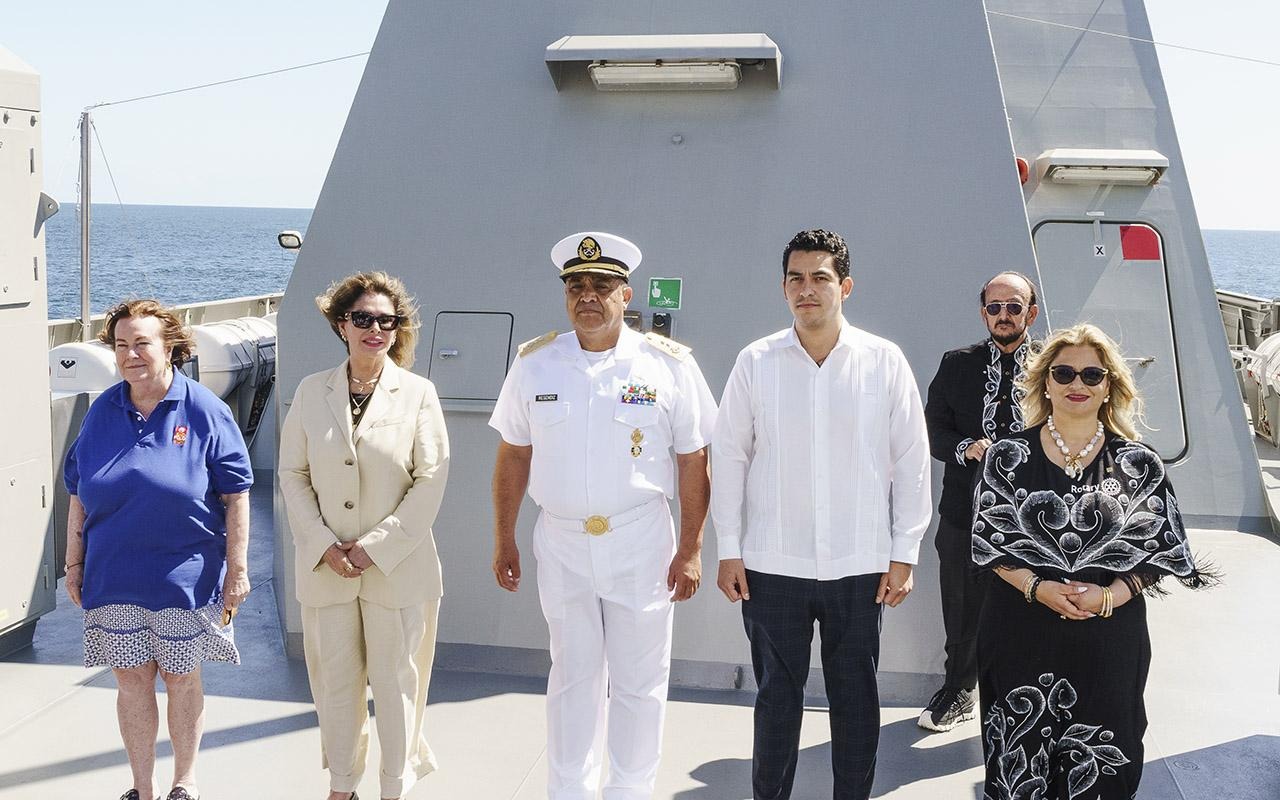
Rotary members joined government and navy officials to watch the sinking of the Suchiate from a frigate last March.
Courtesy of Kikis López de Arbesú
López’s project partner Kevin Pitts, an Arizona Rotarian who served as 2023-24 governor of District 5495, admits the loss of Veracruz felt like the end. But he and Salvador Rico, a member of the Rotary Club of South Ukiah, California, who is a member of The Rotary Foundation Cadre of Technical Advisers, both point to López’s description of herself as a “restless spirit” who won’t take no for an answer. Soon, through her brother, she found the Guaymas project.
Rico considers the Guaymas project one of the most complex he’s ever seen, with difficult layers of state, local, and environmental requirements to meet and a significant fundraising burden. But keys to successful Rotary grants, says Rico, are walking the talk and channeling volunteer passion impactfully. And López was serious about those points as she stepped in to help the Guaymas project, which was already showing signs of its sustainability with a nascent reef and tourists eager to visit.
Within months — record time, says Dworak — the project was approved, all parties were cooperating, and the barge was ready to sink.
López, who plans to dive on the reef this month, still chokes up when she repeats a line from her speech at the sinking as a way to encourage club members to fulfill their service to help the world: “If we can dream it, we can live it.”
This story originally appeared in the August 2024 issue of Rotary magazine.