Rotary members provide modular housing to Ukraine
Rotary members provide modular housing in Ukraine, offering affordable, fast‑to‑install homes that bring shelter, stability, and hope to families
by Etelka Lehoczky
31 Aug 2023Natalia Perehrestenko’s life changed forever on 16 March 2022. That’s when her home in the Ukrainian village of Moshchun was demolished by a Russian attack.
“The house was destroyed as a result of a projectile hitting the room where my daughter lived with her child,” she says. “Thank God, by the time the house caught fire, we had already been evacuated.”
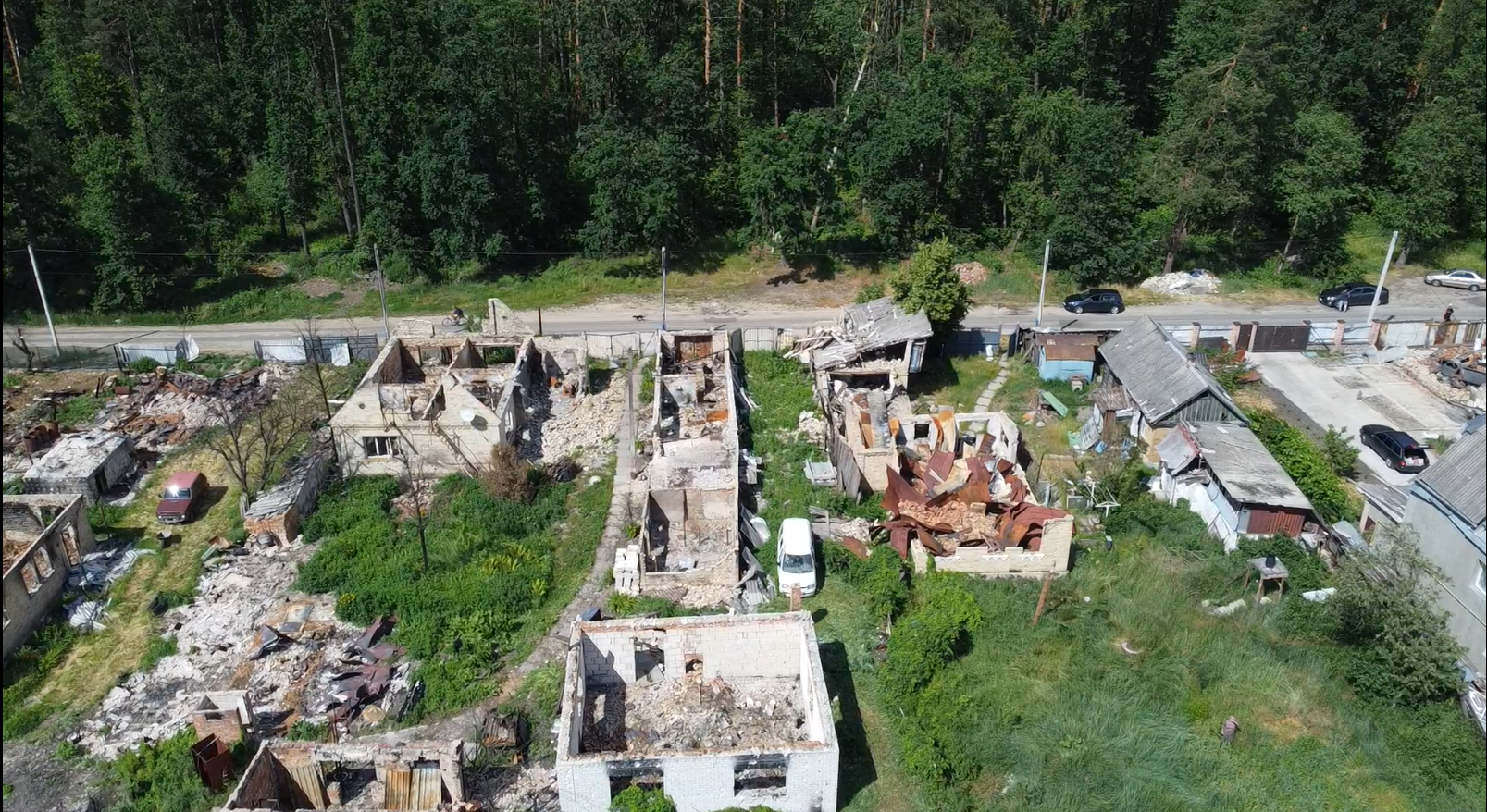
Devastation in Moshchun
Credit: Sergii Zavadskyi
Today, Perehrestenko and her family are back in Moshchun. They’re even living on their own land, in a modular house donated by Rotary members.
Rotary districts around the world have used disaster response grants totaling nearly US$1 million to donate 76 of the small structures, mostly for use in Moshchun. The effort supports jobs in Ukraine and is sustainable because the structures can be repurposed. But most important, the modular homes have made a swift and significant impact on people’s lives – and are creating a sense of hope.
It wasn’t an arbitrary choice to focus on Moshchun, which before the war had a population of about 1,500 people. Located about 30 kilometers (20 miles) north of Kyiv, Moshchun suffered catastrophic damage during the early months of the war. Nearly 85% of its buildings were destroyed, and many people were killed.
When members of the Rotary Club of Kyiv-City began asking Rotary districts around the world to help the country rebuild, they knew they needed to concentrate their efforts if they were going to make a measurable difference right away.
Donate to the Rotary Foundation Ukraine Disaster Response Fund.
“We decided to focus on the village in order to be visible and to make an impact,” says Sergii Zavadskyi, the executive secretary/director of the Rotary Club of Kyiv-City, Ukraine, and the coordinator of the project. “Otherwise, it would be difficult to do the project logistically: to deliver to different locations and have a real impact in multiple places.”
Other Rotary members around the world realized that the village could serve as an example for similar efforts elsewhere in Ukraine. That’s what prompted members of District 7910 (Massachusetts, USA) to donate two modular homes.
“Moshchun is a template,” says Roy Balfour, a member of the Rotary Club of Shrewsbury, Massachusetts, and District 7910’s Rotary Foundation chair. “In effect, the issue isn’t just how to rebuild Moshchun. The issue is, how do you rebuild the country of Ukraine?”
One way is with modular homes. The prefabricated units are an important part of the rebuilding effort for several reasons. Most cost just US12,500 each, and include the basics for a family of four: a living area, a kitchen, a bathroom with a toilet and a shower, and bunk beds for two adults and two children.
Modular homes have many advantages over new construction. Small and lightweight, they’re assembled in factories before being shipped to the locations where they’ll be used. Once there, they can easily be lifted into place by crane. Because they don’t require skilled workers to assemble onsite, they’re ideal for places where a great deal of rebuilding needs to be done at one time.
“These people needed homes, and they needed them quickly,” says Howard Caskie, a member of the Rotary Club of Limavady, Northern Ireland, and the Rotary Foundation chair for District 1160. “If they built traditionally, there was no way to build homes in the time frame we were talking about. We were talking about four weeks to go from nothing to people living in really nice homes.”
Caskie’s district donated two homes for families in the Kyiv area. One went to a family of four and a larger module went to a family of ten.
“It was a fantastic home, I mean really great,” Caskie says. “I couldn’t believe that it was produced and assembled so quickly.”
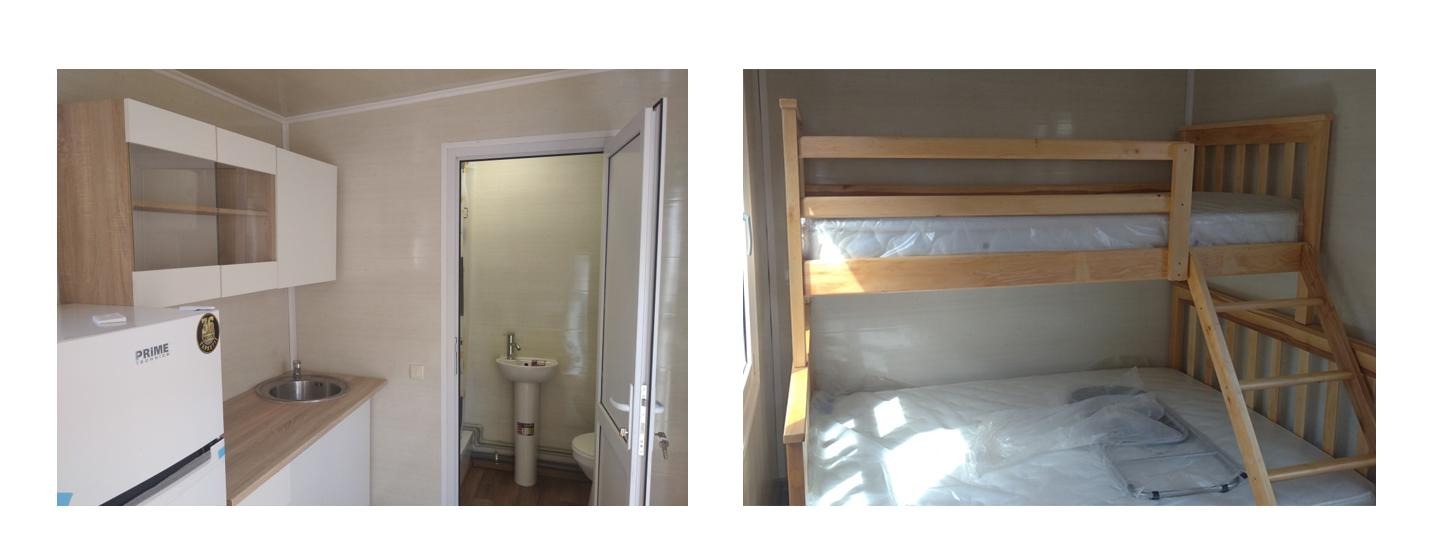
The interior of a modular home
Credit: Sergii Zavadskyi
Besides being customizable, the little houses are versatile. Each house is loaned to a family, rather than given outright. Then, once the family’s permanent home is rebuilt, the modular one can be repurposed.
“The modular house goes to the next family, or maybe gets converted into a medical station or a classroom,” Balfour says.
Modular housing also serves as an alternative to refugee camps for displaced people, Zavadskyi says. Since the modules can be placed almost anywhere – even atop existing basements and crawl spaces – they allow residents to stay on or near their own land.
“Previously, the major approach used in towns and cities for people who lost their housing was to create camps,” Zavadskyi says. “But we thought that for Moshchun it wasn’t a good solution, because every citizen of the village would like to stay somewhere close to their land plot. In addition, if you create a camp, you need to organize a special electricity supply for 100 houses or more, and a water supply. It’s a really big project.”
Most of the recipients get water from their own wells, but electricity is more of a problem. The houses are heated by ceramic electrical panels, but since the power often fails, the residents needed backup generators. Zavadskyi quickly put out an international call for donations.
“We had really big problems with blackouts, especially in the rural areas,” he says. “That’s why we organized additional projects to supply generators to each family that has a module. Now most of these families have generators, so they’re independent. If there is no electricity supply, the generator can – in a very cold situation – provide the electricity for heating.”
Balfour notes one more benefit to the modular homes: They don’t just help their recipients. Because they’re built in Ukraine, they provide jobs as well as shelter.
“The word ‘sustainable’ comes up in Rotary a lot, and this is what I call sustainable,” Balfour says. “It is a sustainable system by which the Ukrainians can help rebuild – and not only a village, but also the rest of the country. They can use the same system to rebuild other villages – and some of the same houses, maybe.”
Perehrestenko and her family received their modular home in September 2022. She says she wept for joy when she returned to her land and found the little house in place.
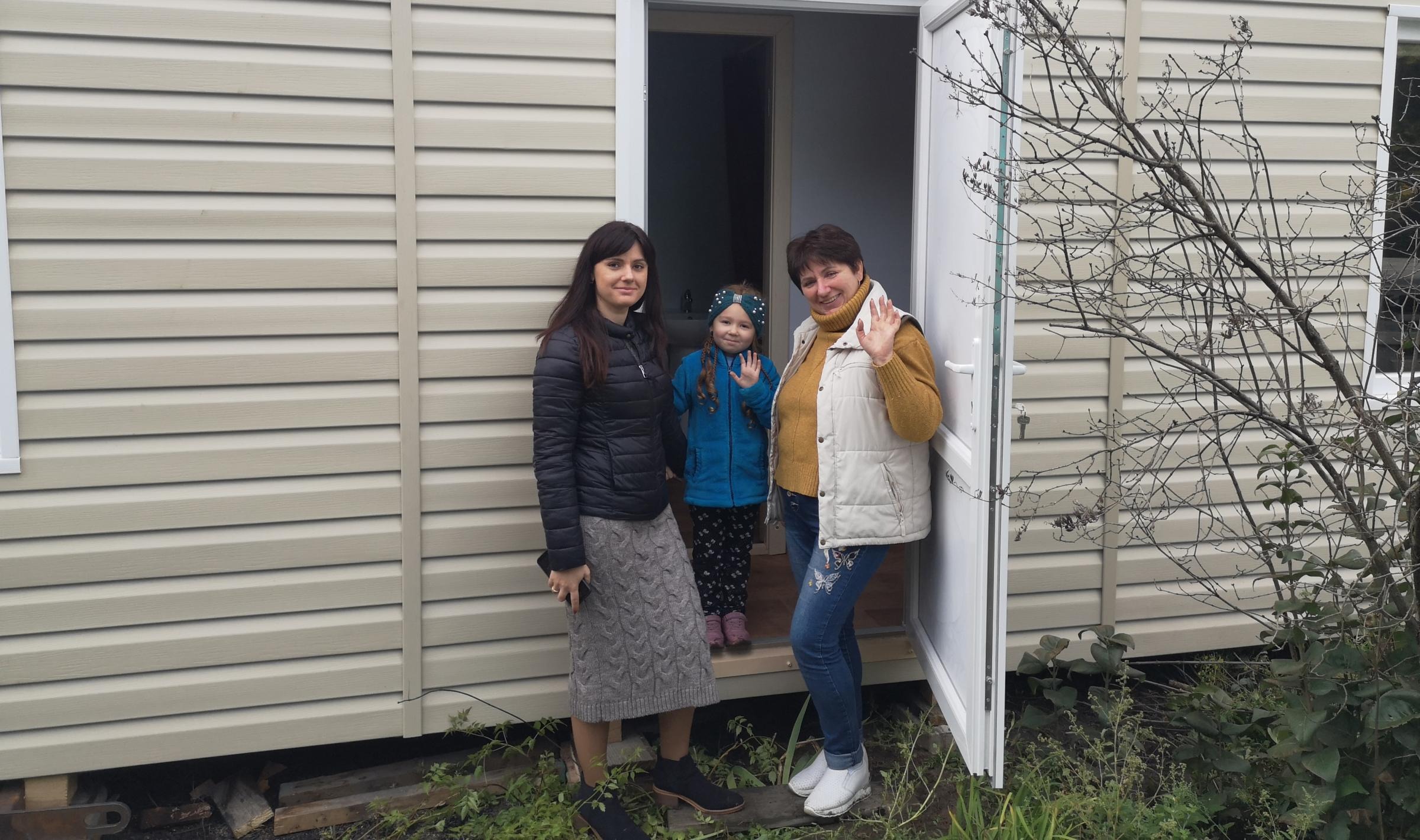
Natalia Perehrestenko, her daughter, and her granddaughter with their modular home
Credit: Sergii Zavadskyi
“When we saw in the yard, where there was nothing, that a house was built for us and we were able to move home, to our own yard – [what] incredible feelings!” she says. “It’s happiness, it’s tears of joy. It certainly gave us strength.”
With that newfound optimism, she’s now making plans to rebuild.
“There was no longer that feeling of despair and not knowing what to do next,” she says. “When we got the house, it was as if the strength appeared to start working in the yard, cleaning up debris. Thoughts about restoring [our original house] began to appear. Before that, we simply gave up and did not want to do anything. But we felt ‘at home’ energy [in] our native place. [It’s now] a place of strength.”
Rotary clubs’ modular home donations were funded by disaster response grants.